
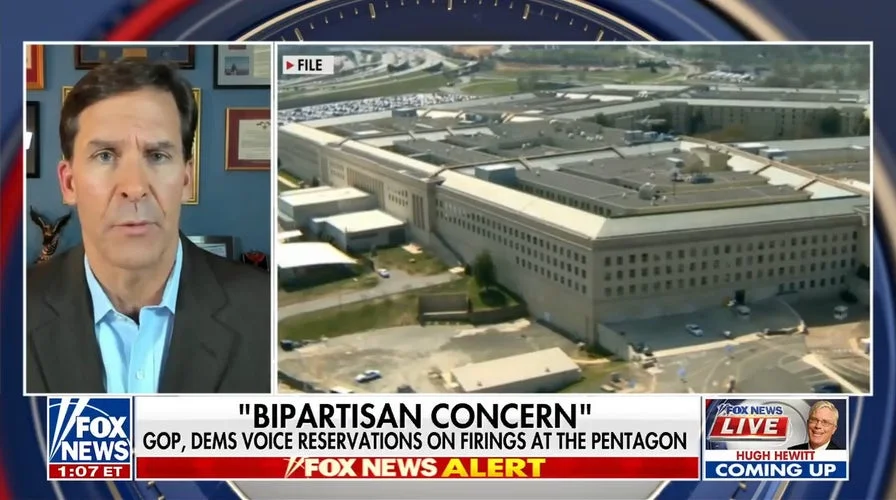
Trump and Hegseth's $1.5 Trillion Defense Budget Plan Hits GOP Gridlock
President Donald Trump’s ambitious plan to push the Pentagon budget past $1.5 trillion is facing unexpected resistance from within his own party, as Defense Secretary Pete Hegseth scrambles to hold together a fragile Republican coalition on Capitol Hill. Despite closed-door meetings with senior House Republicans this week, the administration’s bid to secure an additional $350 billion in mandatory defense spending via the budget reconciliation process is running into serious procedural and political headwinds.
On June 14, 2026, new reporting from POLITICO and Bloomberg Government reveals that while House Republican leaders are open to exploring a third reconciliation package—dubbed “Reconciliation 3.0”—Senate Republicans are far more skeptical. The Senate Armed Services Committee voted 18-9 on Thursday to advance the National Defense Authorization Act (NDAA) for fiscal year 2027, but only after setting a discretionary spending cap of $1.15 trillion, far below Trump’s desired $1.5 trillion total. The remaining $350 billion, which includes funding for munitions production, shipbuilding, missile defense, drones, and artificial intelligence, would require a separate party-line reconciliation bill to bypass a Senate filibuster—a move many Republican senators view as politically risky.
“I don’t agree with them,” Rep. Mike Rogers (R-Ala.), chair of the House Armed Services Committee, said this week when asked about Senate GOP reluctance. “It’s possible that circumstances may alter those points of view,” Sen. Roger Wicker (R-Miss.) added cautiously, reflecting the growing divide between the two chambers.
The Hegseth Huddle: A Closed-Door Push for Reconciliation 3.0
Defense Secretary Meets House Republican Leaders
Secretary of Defense Pete Hegseth held a private meeting with key House Republicans on June 12, including House Budget Committee Chairman Jodey Arrington and Republican Study Committee Chairman August Pfluger. The meeting, first reported by CrispNG, was designed to build momentum for a third budget reconciliation package that would deliver the administration’s $350 billion in supplemental defense funding while also advancing the SAVE America Act, a sweeping election reform proposal.
Arrington described the proposal as both a response to ongoing military operations and a long-term investment in future readiness. Lawmakers discussed replenishing resources used in current conflicts while modernizing military capabilities for future threats. The meeting also explored how spending reductions tied to anti-fraud initiatives could offset portions of the proposed defense investment, reducing the impact on federal deficits.
Senate Republicans Push Back
However, Senate Republicans are raising alarms about both the political and procedural viability of a third reconciliation package. With the 2026 midterm elections approaching, many senators are wary of using a partisan tool to pass massive defense spending at a time when the administration is also cutting food aid and healthcare programs. Just this week, Republicans used reconciliation to pass $70 billion in new funding for U.S. Immigration and Customs Enforcement and Customs and Border Protection—a move that already stretched party unity.
Sen. Susan Collins (R-Maine), chair of the Senate Appropriations panel, told reporters Wednesday that Democrats are blocking a regular budget process, which complicates the path for any bipartisan compromise. “It’s evident that Democrats don’t want to have a regular budget process this year,” Collins said. Without Democratic support, Republicans would need to rely entirely on their own caucus to pass the NDAA and any supplemental funding bill—a near-impossible task given the party’s slim majorities in both chambers.
The Price Tag: $1.07 Trillion vs. $1.5 Trillion
House vs. Senate Discretionary Caps
The House Appropriations Defense Subcommittee advanced its Fiscal Year 2027 Defense Appropriations Bill this week during a closed-door markup, providing $1.072 trillion for the Pentagon and other military-related activities. That represents a $234 billion increase from the current year’s enacted level, but it still falls $350 billion short of Trump’s broader national security proposal.
Meanwhile, the Senate Armed Services Committee is working on its own version of the NDAA, with hopes of finishing by mid-June. The Senate version caps discretionary defense spending at $1.15 trillion, mirroring the House bill’s structure. The remaining $350 billion in mandatory spending—earmarked for munitions, drones, satellites, and other long-term programs—cannot be authorized through the regular NDAA process. It can only be done through reconciliation, which requires a simple majority in the Senate but unity within the GOP conference.
The Disconnect Between Discretionary and Mandatory Spending
GOP appropriators are raising the alarm that they don’t see a third party-line budget package happening this summer, to the dismay of the House and Senate Armed Services chairs. Without the additional defense dollars, Congress and the Pentagon will run into accounting issues on key programs because the administration crammed some top priorities into the mandatory, partisan-process request. “The majority has written a Defense Appropriations Act that provides the department with over a trillion dollars—an unprecedented sum,” said Rep. Betty McCollum (D-Minn.), ranking member of the Defense Appropriations Subcommittee. “But this level of defense spending comes at the cost of cuts to domestic investments like education and workforce training, as well as international diplomacy.”
Growing Bipartisan Opposition to Trump’s Pentagon Budget
Democrats and Some Republicans Join Forces
Opposition to the Trump administration’s defense spending plans is not limited to the Senate. In the House Armed Services Committee, an amendment to cut Trump’s Pentagon budget by $150 billion received 25 votes, and 12 members ultimately voted against the entire $1.15 trillion bill. According to Public Citizen, a consumer advocacy group, a bipartisan majority of the House has voted in support of a War Powers resolution directing Trump to end his war on Iran, signaling that Congress is pushing back against both the cost and the conduct of the administration’s foreign policy.
The Senate Armed Services Committee vote of 18-9 to advance the NDAA demonstrated significant opposition, with Sen. Mark Kelly (D-Ariz.) proposing a $150 billion cut to Trump’s Pentagon budget through an amendment during the closed-door committee hearing. “There is a rising tide of Democratic and Republican opposition to Trump’s illegal Iran war and massive proposed increases to the Pentagon budget,” said Robert Weissman, co-president of Public Citizen. “The money that Trump wants to burn on war should instead be spent on the needs of the American people, including restoring funding for health care, food, housing, and climate action.”
Cuts to Social Safety Nets
The push for a record defense budget comes as the Trump administration and congressional Republicans are simultaneously slashing food aid and healthcare programs. Common Dreams reports that the GOP has voted to take food aid from millions of women and children, with over 700,000 poor children across 12 states already losing food aid under the Trump-GOP budget law. This juxtaposition—trillion-dollar defense spending alongside cuts to domestic social programs—has become a central argument for Democrats and some Republicans who oppose the Pentagon budget increase.
In related news, the No Kings Movement Shifts to Concert as Trump Turns 80 on June 14 shows how public protests against the administration’s policies continue to evolve.
What’s at Stake: The Future of Defense Spending and GOP Unity
Reconciliation as a Double-Edged Sword
The budget reconciliation process has become a double-edged sword for Republicans. It allows them to pass legislation with a simple majority in the Senate, bypassing the filibuster, but it requires near-unanimity within the party. With the House GOP’s razor-thin majority—and the Senate’s equally narrow margin—any defection could derail the entire package. The White House is pushing for a third reconciliation bill this summer, but many Republicans are wary of using the process again so close to the midterms, fearing that voters will punish them for prioritizing defense over domestic needs.
The 2026 Midterm Elections Loom Large
The 2026 midterm elections are casting a long shadow over the debate. Republicans are already facing tough races in swing districts and states, and the administration’s decision to cut food aid while expanding the Pentagon budget is a vulnerable point. California's slow vote count fuels Trump fraud claims as Supreme Court ruling looms adds another layer of complexity, as election security and voting rights become intertwined with the defense debate.
Implications for U.S. Global Standing
If the Trump administration cannot secure the full $1.5 trillion in defense funding, it could signal to U.S. adversaries that the American political system is gridlocked on national security. On the other hand, pushing through a massive defense budget at the expense of social programs could fuel domestic unrest and further polarize the electorate. As one senior Republican aide put it: “We’re in a bind. Do we want to be the party of strong national defense, or the party that takes food from poor kids? Right now, we’re trying to be both, and it’s not working.”
Conclusion: A Summer of Discontent for the Pentagon
President Trump’s $1.5 trillion Pentagon request is on the verge of unraveling in Congress. With the House advancing a $1.072 trillion defense bill and the Senate capping discretionary spending at $1.15 trillion, the remaining $350 billion in mandatory funding is stuck in reconciliation limbo. Defense Secretary Pete Hegseth’s closed-door meetings with House Republicans have failed to win over skeptical Senate Republicans, and bipartisan opposition to the budget continues to grow.
The stakes could not be higher: the NDAA must be passed by September 30 to avoid a government shutdown, and the Pentagon needs clarity on long-term funding for munitions, drones, and satellite programs. As the summer progresses, all eyes will be on whether Trump and Hegseth can salvage their record-breaking defense plan—or whether it will become yet another casualty of partisan gridlock.
Comments