
California's Slow Vote Count Under Fire as Supreme Court Decision Looms
A week after California’s June 2 primary, millions of ballots remain uncounted, and the slow pace has reignited baseless fraud claims from President Donald Trump and his allies—just as a Supreme Court ruling threatens to upend the state’s voting rules before November’s midterms.
As of June 9, an estimated 3 million ballots were still being processed across the state, according to the California Secretary of State’s office. In the governor’s race, Health and Human Services Secretary Xavier Becerra has secured the first runoff spot with 27% of the vote, but Republican Steve Hilton and Democrat Tom Steyer remain locked in a tight battle for second place, separated by roughly 320,000 votes. In Los Angeles, City Councilmember Nithya Raman (D) overtook Republican reality TV star Spencer Pratt for second place in the mayoral jungle primary, advancing to face incumbent Mayor Karen Bass (D) in November.
President Trump, who has long attacked mail-in voting, seized on the shifting totals. “Not possible for Spencer Pratt to have lost the L.A. runoffs after the big lead he had,” he wrote on Truth Social. “3rd World Nation. Rigged Elections!” He also claimed Democrats were “trying to STEAL THE GOVERNOR OF CALIFORNIA PRIMARY.” Election officials and experts—including California Secretary of State Shirley Weber—say the delays are the predictable result of the state’s pro-voter policies, not fraud.
Why California Takes So Long to Count
California’s slow vote count is rooted in a mix of logistics, state law, and political choices, none of which indicate wrongdoing, according to election experts quoted in multiple reports.
Heavy reliance on mail-in ballots: California is one of the most mail-heavy states in the nation. Nearly all registered voters receive a ballot automatically, and a large share—especially Democrats—choose to vote by mail. These ballots take time to process because they must be removed from envelopes, signature-verified, and checked for other errors. “Californians rely unusually heavily on vote by mail,” said Donna Crane, a political science professor at San Jose State University. “So we just get a greater proportion of our votes coming in by mail than in person than other states do. So it's not really fair to compare us to other states in that respect.”
Signature verification and curing: State law requires elections officials to verify the signature on each mail ballot against the voter’s registration record. If a signature does not match or is missing, voters have up to eight days after the election to “cure” the problem by providing a valid signature. This process, while time-consuming, is designed to prevent fraud and ensure eligible votes are counted.
Late strategic voting: Many Democrats hold their ballots until election day, sometimes after assessing which candidates are leading, in a tactic known as “strategic voting” to avoid a two-Republican runoff. These late-arriving ballots are often among the last to be processed. “There are still a lot of ballots left to count and a number of them are coming from urban areas which tend to skew Democratic,” Professor Crane said.
County-level disparities: California’s 58 counties each run their own elections, using different equipment and levels of investment. Some counties have state-of-the-art high-speed scanners; others rely on older machines or manual counting. Crane noted that “some counties might just not buy the machines that they need because they decide not to invest that taxpayer money, but it means the count takes longer.”
Legal deadlines: California law allows counties up to 30 days after election day to complete the canvass—the formal process of verifying ballots, auditing results, and certifying the final count. The state also allows ballots to be counted as long as they are postmarked by election day, even if they arrive up to seven days later. This “grace period” for late-arriving ballots adds another layer of delay.
“California’s county elections officials are hard at work counting the millions of ballots cast by California voters for the June 2 Primary Election, ensuring accuracy and preserving the integrity of every vote,” Secretary Weber said after the primary.
The Stakes: Trump’s Fraud Claims and the Supreme Court
The slow count has provided fuel for a familiar pattern: President Trump and his allies alleging without evidence that Democrats are manipulating the results. Trump has a long history of attacking mail-in voting, which he claims—without proof—is prone to fraud. His claims this month have been amplified by Spencer Pratt and other Republicans.
But the underlying reality is that California’s system, while slow, is designed to catch illegitimate ballots. “Ironically, they also help catch any illegitimate ballots that shouldn’t be counted—exactly what Trump and his allies attack the state for not doing enough on,” noted a Democracy Docket analysis.
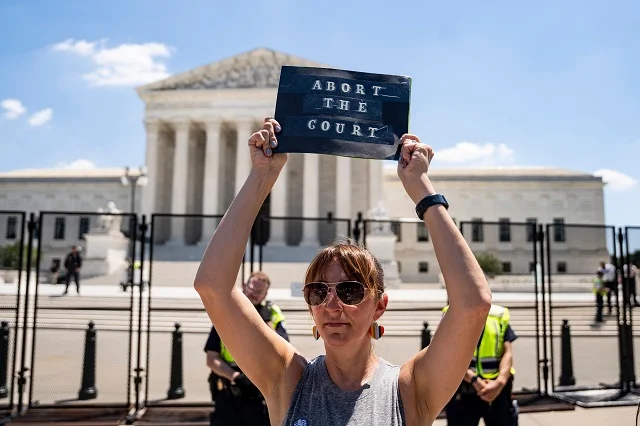
The looming Supreme Court ruling: The slow count may be forced to change sooner than expected. The U.S. Supreme Court is preparing to rule on a case that could decide whether mail ballots must be received by election day in order to be counted. If the Court strikes down California’s postmark grace period (which allows ballots to arrive up to seven days after the election), the state would have to process and count all ballots more quickly.
Election experts, however, say ending the grace period would do little to speed up results, because the biggest bottlenecks come from ballots cast on or before election day—not those that arrive late. “We’re all on the edge of our seats, waiting to see what the Supreme Court does,” said Kim Alexander, president of the California Voter Foundation. “We’re certainly planning for a bad Supreme Court decision in this case, but we don’t really know all of our options for how to respond until we see the court’s decision.”
In response to the uncertainty, Assemblymember Gail Pellerin (D-Santa Cruz), chair of the Assembly Elections Committee, has requested $35 million in state funds to educate voters on any new deadlines and to upgrade mail ballot processing equipment. She has been coordinating with the offices of Governor Gavin Newsom, Secretary Weber, and Attorney General Rob Bonta on contingency plans.
What This Changes: A Test for American Democracy
The California primary is the latest flashpoint in a long-running debate about election integrity, voting access, and the speed of results. The state’s slow count is not new—it has drawn criticism for years—but the combination of a high-profile primary, Trump’s continued attacks on mail voting, and a potential Supreme Court ruling makes this moment particularly consequential.
For California: If the Supreme Court ends the postmark grace period, the state will need to invest in faster counting infrastructure and voter education to avoid disenfranchising voters who rely on mail ballots. Assemblymember Pellerin said she has requested $35 million for these purposes, though the funds have not yet been approved. Counties may also need to purchase new equipment and expand same-day or “hybrid” in-person voting options.
For the national debate: The slow count has been weaponized by Trump and other election deniers. But experts say the real story is that California’s system works as intended: it prioritizes accuracy over speed. “In California, every ballot is counted properly and every ballot is accounted for,” Secretary Weber said.
For voters: The primary has also highlighted the importance of voter education. Many voters do not know that ballots can take weeks to count, or that results on election night are almost always incomplete. As the Supreme Court ruling approaches, state and county officials are urging voters to stay informed and to return their ballots early to help speed the process.
In a broader sense, the California primary shows that the tension between voting convenience and rapid results is unlikely to be resolved soon. As one expert put it: “We want the Goldilocks version—fast results, maximum access, and no fraud. But you can’t have all three at once in a system as large and diverse as California’s.”
More than 3 million ballots remain uncounted. The world will be watching to see how the count—and the political fallout—unfolds.
By the numbers:
- 3 million ballots still uncounted statewide as of June 9
- 30 days: California’s legal deadline for final certification
- $35 million: State funds requested for voter education and equipment upgrades
- 58 counties each running their own counting operations
Related reads:
- For more on election integrity and legal battles, see our coverage of the Judge Denies Bid to Block $1.8B Anti-Weaponization Fund, Warns DOJ Not to ‘Play Possum’.
- For a look at how international diplomacy handles controversy, read about Zelensky Balances Drone Warfare Honor, Poland Diplomatic Row and Royal Diplomacy.
Comments