
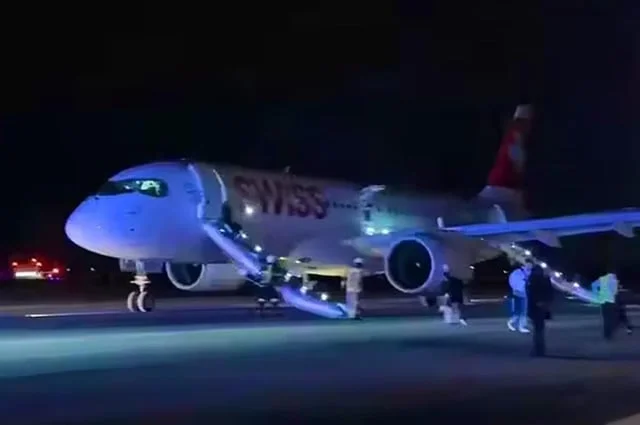
Co-Pilot's Medical Emergency Forces Swiss Flight to Divert to Almaty
A Swiss International Air Lines flight from Seoul to Zurich made an unscheduled emergency landing in Almaty, Kazakhstan, on Wednesday, May 6, 2026, after the co-pilot suffered a sudden medical emergency mid-flight. The incident, which occurred about six hours into the journey, prompted the crew to activate the emergency transponder code 7700 and divert the Airbus A350 to Almaty International Airport, where the co-pilot was immediately hospitalized.
According to Swiss officials, the flight — LX123 operating an Airbus A350-941 (registration HB-IFB) — was carrying 227 passengers and 14 crew members when the emergency unfolded. The aircraft had departed from Seoul's Incheon International Airport just before 10 a.m. local time and was scheduled to land in Zurich approximately 13 hours later. Instead, the plane made a sharp turn south over the Karaganda region of Kazakhstan and landed in Almaty shortly after 9:47 a.m. Swiss time (around 12:45 p.m. local time).
Swiss confirmed in a statement to blue News that the landing was due to "a medical emergency of the co-pilot." The airline added that "three doctors on board provided immediate assistance." Based on the doctors' recommendation, the crew decided to divert to Almaty to ensure rapid hospital treatment for the distressed pilot. Upon landing, the co-pilot was taken to a local hospital accompanied by another crew member.
Passenger Impact and Onward Travel
Passengers and crew were accommodated in hotels in Almaty while Swiss arranged for an additional pilot to fly to the city to complete the journey to Zurich. The airline explained that despite having two other pilots among the crew, strict regulatory and safety requirements prevented the flight from continuing immediately. Both remaining pilots were captains, and regulations mandate that the co-pilot seat must be operated by a pilot specifically qualified for that role. Furthermore, continuing the journey would have exceeded legally prescribed maximum duty times for the flight crew.
"We fully understand that the unscheduled landing in Almaty and the necessary stay there are causing inconvenience to our guests and affecting their travel plans," Swiss said in a statement. "We sincerely regret this. At the same time, we kindly ask for understanding that the health and well-being of our colleague are the top priority in this situation."
After securing the required replacement pilot and allowing the original crew to rest, the airline scheduled departure from Almaty at 1:45 a.m. local time on Thursday, with arrival in Zurich expected on the morning of Friday, May 8. The aircraft itself remained in Almaty during the ordeal.
Why This Incident Matters: Aviation Safety and Medical Emergencies at 35,000 Feet
The Swiss Airlines emergency underscores the critical role that in-flight medical assistance and rapid decision-making play in modern aviation. Medical emergencies are among the most common causes of unscheduled diversions, and the presence of trained medical professionals on board can be decisive in determining whether a flight must divert or can continue to its destination.
According to aviation data, medical events occur on roughly one in every 600 flights globally, with the most serious cases — such as cardiac issues, strokes, or severe allergic reactions — often requiring immediate hospital care. In this case, the swift intervention of three physicians who happened to be passengers likely prevented a more severe outcome and provided the medical rationale for the diversion.
The activation of transponder code 7700 — the universal signal for a general emergency — indicated the severity of the situation and alerted air traffic control across the region to give the aircraft priority handling. The A350-900 then executed a controlled descent and landing at Almaty, a well-equipped international airport with medical facilities capable of receiving the stricken pilot.
The Stakes for Airlines and Passengers
For Swiss and its parent company Lufthansa Group, the incident highlights the operational complexities of managing a dual-pilot cockpit when one pilot becomes incapacitated. With the co-pilot hospitalized, the airline had to navigate labyrinthine regulations that govern cockpit composition. "The two other pilots are captains and strict regulations mean that the flight requires a pilot specifically qualified to operate from the co-pilot’s right-hand seat," Swiss explained. This regulatory detail, often unfamiliar to passengers, can cause significant delays even when multiple qualified pilots are present.
The diversion also stranded 227 passengers in Kazakhstan for nearly 48 hours, forcing Swiss to arrange hotel accommodations, meals, and rebooking logistics. For a carrier that prides itself on premium service, the reputational risk is considerable. However, the airline's transparent communication and focus on the co-pilot's health have generally been viewed positively by aviation experts.
This is not the first time Swiss has dealt with a medical emergency involving a crew member. In 2024, a Swiss flight from Zurich to Miami turned back after a flight attendant suffered a medical issue. But a pilot emergency — particularly one requiring hospitalization — is far rarer and more disruptive because of the specialized qualifications required to replace a cockpit crew member.
The incident also comes amid a broader context of aviation industry challenges. Just last month, a jet fuel crisis grounded Spirit Airlines, threatening summer travel chaos across the United States. While the Swiss situation is unrelated to fuel or infrastructure, it serves as a reminder that unexpected medical events remain one of the most unpredictable variables for airlines.
Broader Implications: What This Changes for Air Travel and Crew Health
The Swiss Airlines co-pilot emergency raises important questions about pilot health monitoring, crew resource management, and the robustness of contingency plans for in-flight medical crises. While mandatory medical examinations for pilots are rigorous — typically every six to 12 months depending on age — acute medical events can occur without warning, even in individuals who pass routine checks.
Pilot Health and Fitness for Duty
The aviation industry has long grappled with the balance between strict medical standards and the reality that pilots, like all humans, can experience sudden health crises. In recent years, several high-profile incidents have drawn attention to the issue. In 2022, a United Airlines pilot was subdued by passengers and off-duty pilots after suffering a mental health episode mid-flight. In 2023, a Delta Air Lines pilot collapsed and died while taxiing at the gate. These cases have prompted calls for enhanced mental and physical health screening, as well as better in-cockpit medical equipment.
Swiss did not disclose the nature of the co-pilot's medical emergency, citing privacy concerns. However, the fact that three doctors on board recommended an immediate diversion suggests the condition was serious and potentially time-sensitive. The airline's quick decision to land at Almaty — rather than continuing to a hub with more medical resources — reflects a growing trend among carriers to prioritize rapid medical access over schedule convenience.
Regulatory and Operational Challenges
The incident also shines a light on the complex regulatory framework that governs cockpit composition. Under European Aviation Safety Agency (EASA) rules, the co-pilot seat must be occupied by a pilot with specific type rating and licencing qualifications. A captain cannot simply sit in the right-hand seat and act as first officer. This regulation, designed to ensure both pilots are fully qualified for their respective roles, can create significant logistical hurdles when a co-pilot becomes incapacitated.
Swiss faced exactly this scenario: it had two additional captains on board, neither of whom was qualified to operate from the co-pilot's seat on the A350. The airline was forced to fly a replacement pilot to Almaty — a delay that added nearly two days to passengers' journeys. For an industry already struggling with pilot shortages and operational disruptions, such scenarios underscore the need for more flexible regulatory frameworks, or at least better contingency planning.
Passenger Rights and Compensation
Passengers on diverted flights are entitled to certain protections under international law. Under the Montreal Convention, airlines are liable for costs incurred by passengers due to delayed or diverted flights, including accommodation, meals, and alternative transportation. Swiss has indicated it will cover all hotel costs and is working to rebook affected passengers. However, compensation for inconvenience is not typically required for diversions caused by medical emergencies, which are considered force majeure.
Still, the experience can be deeply frustrating for travelers, many of whom had connecting flights or important commitments in Zurich. One passenger told local media that "the airline kept us informed, but it was still a nightmare trying to rearrange our plans." Swiss has promised to proactively contact all affected passengers and offer assistance.
A Growing Trend: In-Flight Medical Emergencies on the Rise
Medical emergencies aboard commercial aircraft have increased in recent years, driven partly by an aging passenger demographic and longer flight durations. The A350-900 is capable of nonstop flights of up to 15 hours, and ultra-long-haul routes are becoming more common. With longer time aloft comes a higher probability of medical incidents.
Airlines have responded by equipping aircraft with increasingly sophisticated medical kits, including defibrillators, advanced first aid supplies, and telemedicine capabilities. Many carriers now maintain direct radio links with ground-based medical professionals who can advise the cockpit on whether a diversion is necessary. In the Swiss case, the presence of three doctors provided an immediate on-site assessment, which accelerated the decision-making process.
The incident also highlights the importance of passengers with medical training. Airlines often ask for medical volunteers during emergencies, and many frequent travelers — particularly from the medical profession — carry credentials that allow them to assist. The three doctors on board Flight LX123 exemplify how passenger expertise can directly influence the outcome of an in-flight crisis.
What Happens Next for the Co-Pilot and Passengers
As of May 8, 2026, the co-pilot remains hospitalized in Almaty. Swiss has not issued a public update on his condition, but the airline stated that he is receiving "the best possible medical care" and that a crew member is staying with him. The airline's priority, according to its statement, is "the health and well-being of our colleague."
For the passengers, the ordeal is expected to end when the replacement aircraft departs Almaty in the early hours of Friday morning. Swiss has arranged for a fresh crew to operate the final leg to Zurich, and the airline has apologized for the inconvenience. The flight is projected to arrive at Zurich Airport around 6:30 a.m. on May 8 — nearly 48 hours later than originally scheduled.
The incident serves as a stark reminder that air travel, despite its remarkable safety record, remains subject to the unpredictability of human health. For Swiss, the successful handling of the emergency — from the doctors' swift intervention to the crew's professional execution of the diversion — reflects the robustness of modern aviation safety protocols. But it also underscores the need for continued vigilance, better regulatory flexibility, and greater investment in crew health monitoring.
In a year already marked by extreme weather events and infrastructure disruptions, the Swiss Airlines pilot emergency is a sobering reminder that sometimes the most disruptive events in travel are human ones.
Comments