
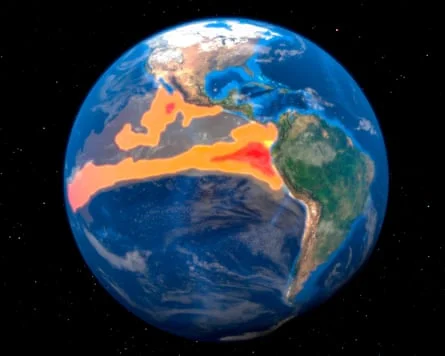
El Niño Forms in Pacific, Poised to Be Strongest of Century, NOAA Warns
Meteorologists have officially confirmed the arrival of El Niño in the tropical Pacific Ocean, and the phenomenon is predicted to intensify into one of the most powerful events on record by late 2026. The National Oceanic and Atmospheric Administration (NOAA) issued an El Niño Advisory on Thursday, warning that sea surface temperatures in the equatorial Pacific have risen at least 0.5°C above average for several consecutive months. Forecasters now estimate a 63% chance that this El Niño will rank among the strongest events observed since 1950, with sea surface temperatures potentially exceeding 2.0°C above average in the Niño-monitored region — a threshold NOAA classifies as a “very strong” El Niño.
A Historic Event in the Making
“This could be the strongest of the century,” said Ken Graham, director of NOAA’s National Weather Service, in a statement accompanying the advisory. The development comes after months of careful monitoring through the Northern Hemisphere spring, a period typically marked by lower forecast accuracy due to transitional sea surface patterns. With spring now past, confidence in a strong to very strong event has increased markedly. The World Meteorological Organization (WMO) has also weighed in, with Secretary-General Celeste Saulo urging global preparedness for what she described as an event that will “exacerbate drought and heavy rainfall and increase the risk of heatwaves both on land and in the ocean.”
United Nations Secretary-General António Guterres went further, calling the unfolding El Niño an “urgent climate warning.”
Why This Matters: Global and Regional Stakes
El Niño is the warm phase of the El Niño–Southern Oscillation (ENSO), a natural climate cycle that shifts sea surface temperatures and atmospheric pressure across the Pacific Ocean. While its counterpart La Niña brings cooler waters, El Niño releases vast amounts of heat into the atmosphere, altering jet streams and rainfall patterns worldwide. The result is often a cascade of extreme weather events, from severe storms and flooding to prolonged droughts and heatwaves.
Impacts Across the United States
For the U.S., El Niño typically brings stormier weather to the southern states, increased risk of high tide flooding along the coasts, and algal blooms on the West Coast. California, which has endured several volatile wildfire seasons — including the devastating Hughes fire in January 2025 — is expected to see a wetter winter. While this could alleviate some drought conditions, it also raises the risk of flash floods and mudslides in areas scarred by burns. Hawaii and other Pacific islands face heightened danger from increased tropical cyclone activity in the eastern Pacific, even as the Atlantic hurricane season may see a temporary reprieve.
A Mixed Picture for Hurricanes
Colorado State University (CSU) has already reduced its 2026 Atlantic hurricane season forecast, citing increased confidence that a strong El Niño will suppress storm development. The revised forecast now predicts 11 named storms, 5 hurricanes, and 2 major hurricanes (Category 3 or higher), down from April’s estimate of 13 named storms. El Niño’s strengthening of winds high in the atmosphere — known as wind shear — can rip apart the towering thunderstorms that form hurricanes, effectively capping the season’s intensity. However, the eastern Pacific basin is expected to see an opposite effect, with enhanced hurricane activity threatening Mexico, Hawaii, and other Pacific territories.
Global Ripple Effects
Outside the U.S., the stakes are high. Parts of western South America — where the first El Niños were observed decades ago — often face torrential rain and catastrophic flooding. The drought-stricken Middle East could see some relief, though scientists caution that benefits will be uneven. In Southeast Asia and Australia, El Niño typically brings drier conditions and a heightened risk of bushfires. The WMO has stressed that stronger El Niño events do not guarantee strong impacts everywhere, but they raise the probability of dangerous weather extremes in vulnerable regions.
Broader Implications: El Niño in a Warming World
The arrival of this potent El Niño comes against a backdrop of rising global temperatures. According to NOAA and the WMO, 2025 was Earth’s third-warmest year on record, and the added heat from El Niño could push global temperatures to new highs. Scientists warn that identifying and measuring ENSO events is becoming more challenging as the climate warms, because the baseline against which “normal” conditions are measured is shifting.
Not a “Super” Event — Yet
Despite popular use of terms like “super” and “extreme” on social media, both NOAA and the WMO emphasize that their operational classifications are limited to weak, moderate, strong, and very strong. The label “super El Niño” is not part of official forecasting language. However, if sea surface temperatures in the Niño 3.4 region exceed 2.0°C — a threshold currently considered probable — the event will officially become one of the strongest in the historical record.
What Comes Next
NOAA continues to monitor the Pacific closely, with monthly ENSO discussions and frequent data updates. The agency’s Coral Reef Watch satellite imagery already shows striking warmth across the equatorial Pacific, a clear signal that the event is accelerating. For communities in typical El Niño zones, the message from meteorologists is clear: prepare for extremes. “Every El Niño is not the same; each one is unique with its own imprint on our weather,” Graham noted, adding that improved monitoring enables better forecasting.
As the world watches this climate engine rev up, the intersection of a historically strong El Niño with an already warming planet may produce conditions unlike any seen before. The coming months will test global preparedness for weather volatility, from floods in South America to droughts in Australia — and the ripple effects will be felt everywhere.
King Charles Praises Grimsby’s Revival Efforts During Rain-Swept Visit Rocket Lab Stock Surges 265% in Year as $2 Billion Backlog Fuels Space Race Bet
Comments