
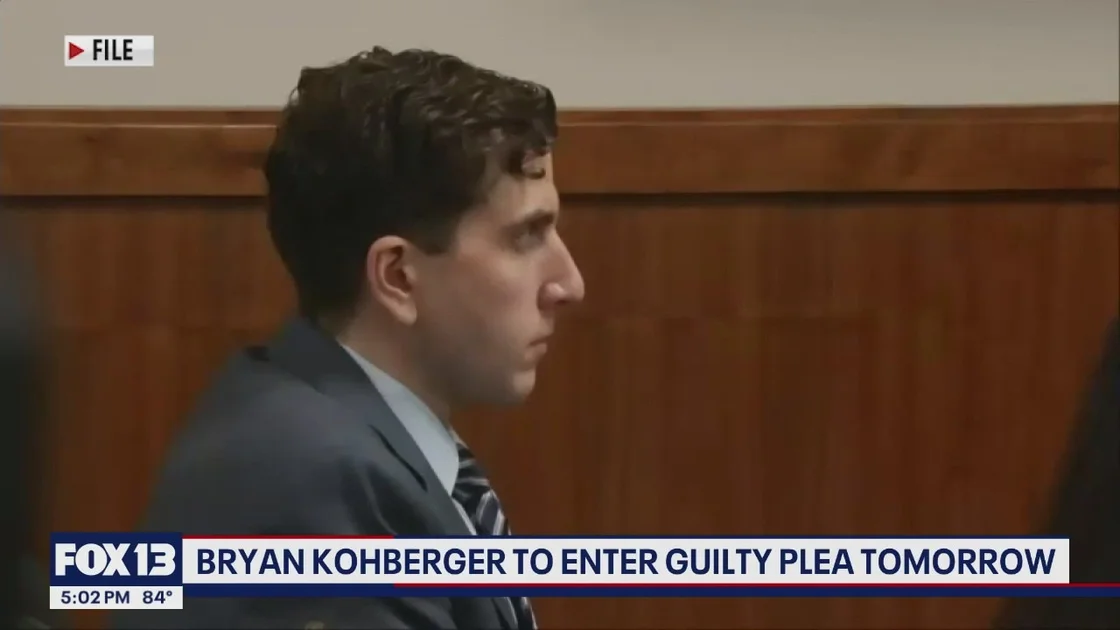
Kohberger Withdraws Guilty Plea, Vows to Fight Death Penalty
In a stunning reversal that has rocked the legal world, Bryan Kohberger—the man convicted in the 2022 murders of four University of Idaho students—announced late Sunday that he is abandoning his guilty plea and will re-enter a plea of not guilty. The statement, released through his legal team at 9:23 PM on July 26, 2026, explicitly calls for the state to reinstate the death penalty and declares his “actual innocence.”
“Over a year later, it is self-evident that, in State v. Kohberger, justice was not served,” Kohberger wrote. “Unanswered questions seem to multiply with each piece of discovery unsealed, and the public demands the truth.” He characterized his original plea as “broken” and “hinged on by false promises and blatant disinformation,” arguing that the trial never provided the public with the clarity needed for closure.
The move effectively nullifies the conviction that was entered after Kohberger abruptly pleaded guilty in early 2025, surprising many who had anticipated a lengthy trial. Now, nearly four years after the grisly November 2022 stabbings of Kaylee Goncalves, Madison Mogen, Xana Kernodle, and Ethan Chapin, the case is set to return to square one—with the possibility of a full trial and a renewed push for capital punishment.
The announcement immediately sent shockwaves through the families of the victims, legal analysts, and the broader public, who had largely considered the case closed. The Latah County Prosecutor’s Office has not yet issued a formal response, but sources close to the investigation indicate that the state is prepared to refile for the death penalty, as Kohberger himself invited in his statement: “I welcome the State the opportunity to prove their case at trial, as well as to, again, file for the death penalty.”
The Original Plea: A Year of Uncertainty
Kohberger’s original guilty plea in April 2025 came after months of pretrial motions and legal wrangling. At the time, legal experts speculated that the former criminology Ph.D. student might have been seeking to avoid a potential death sentence—Idaho is one of the few states that still actively executes inmates—or to gain some measure of control over the narrative. The plea was entered without a formal agreement on sentencing, leaving the judge to determine whether Kohberger would face life in prison or death.
But the plea never sat well with Kohberger’s supporters, who had maintained his innocence since his arrest at his parents’ home in Pennsylvania in December 2022. The discovery process, which dragged on for months after the plea, reportedly unearthed inconsistencies in the state’s case—including challenges to the DNA evidence linking Kohberger to a knife sheath found at the crime scene, and questions about the reliability of cellphone tower data used to place him near the King Road house.
In his statement, Kohberger specifically referenced the “faulty premises” of the original probable cause affidavit (PCA), which was released nearly four years ago and which he said were “never challenged at trial.” He argued that the public has been denied “the truth” and that only a full trial can provide it. The statement reads, in part: “Circumnavigated by a broken plea, the trial never provided the public the clarity conducive to closure, and justice shall remain abjectly miscarried unless that plea is withdrawn.”
Evidence Under Scrutiny: What New Details Have Emerged?
Since Kohberger’s guilty plea, a series of unsealed court documents have raised eyebrows. Among the most significant developments is the revelation that the DNA sample from the knife sheath—a key piece of evidence—was a touch-DNA sample, meaning it could have been transferred indirectly. Additionally, the defense has pointed to the presence of an unknown male’s DNA at the scene that does not match Kohberger.
Cellphone data, once thought to place Kohberger near the crime scene multiple times before the murders, has also been challenged by defense experts who argue that the towers were overloaded on the night of the killings, leading to potential inaccuracies. The timeline of the 911 call—which was not made until nearly eight hours after the murders—has also been a point of contention, with Kohberger’s team suggesting that the crime scene was compromised before police arrived.
“The state’s narrative has not evolved since the PCA was released,” Kohberger wrote, criticizing prosecutors for clinging to a “work of fiction.” He insisted that the public deserves a trial where all evidence is aired, not a plea deal that silences unanswered questions.
The Victims’ Families: Grief Turned to Anguish
The news of Kohberger’s plea withdrawal has reopened wounds for the families of the four victims. Kaylee Goncalves’ father, Steve Goncalves, who has been a vocal advocate for transparency throughout the case, told reporters that the family is “devastated but not surprised.” He said, “We knew he was playing games. This was never about justice for him—it was about control.”
Madison Mogen’s family released a brief statement asking for privacy as they process the development. Xana Kernodle’s mother, Cara Kernodle, posted on social media: “I thought we could finally start to heal. Now we have to relive the horror all over again.” Ethan Chapin’s family did not comment, though a family friend indicated they are “exhausted and angry.”
The families had attended every hearing leading up to the original plea, often sitting in the front row, holding each other as the details of the attack were read aloud. The prospect of a new trial means they will likely have to endure the process once more—potentially including graphic testimony and evidence that has been sealed for years.
Legal Analysis: What Comes Next?
Legal experts are divided on Kohberger’s strategy. Some see it as a high-risk gamble: by withdrawing his plea, Kohberger exposes himself again to the death penalty, which he successfully avoided—at least temporarily—by pleading guilty. Others argue that the move is calculated, perhaps based on newly discovered evidence that could exonerate him or at least create reasonable doubt.
“This is an extraordinary step,” said former federal prosecutor Jennifer Coffindaffer, who has covered the case extensively. “Judges are not typically keen on allowing a defendant to withdraw a guilty plea after sentencing has been imposed. But in this case, the sentencing had not yet occurred, so the legal threshold is lower. Still, the court has to be convinced that there was a manifest injustice—that the plea was not knowing, intelligent, or voluntary. Kohberger is arguing that he was coerced by false promises or misinformation, which is a very serious accusation.”
The judge will likely schedule a hearing to determine whether Kohberger’s plea withdrawal is valid. The court may examine whether Kohberger was under duress or whether his original attorney provided ineffective counsel. If the withdrawal is approved, the case could proceed to trial as early as 2027—nearly five years after the murders.
Broader Implications: The Death Penalty Debate Intensifies
Kohberger’s case has become a flashpoint in the broader debate over capital punishment in the United States. Idaho is one of 27 states that still allow the death penalty, though executions are rare. In 2023, the state executed its first prisoner in over a decade, reviving controversy over the method and morality of state-sanctioned death.
By explicitly inviting the state to “again, file for the death penalty,” Kohberger has inserted himself into that debate. Some anti-death penalty advocates worry that a high-profile case like this could galvanize support for executions, especially given the brutality of the crimes. Others, including Kohberger’s own family, have maintained that he is innocent and that executing an innocent person would be the ultimate injustice.
“I send my love to my family, who have never wavered in their belief in who I am, their belief in my innocence,” Kohberger wrote in his statement, a rare personal touch in a document otherwise filled with legalistic language.
What This Changes: Public Trust in the Justice System
The sudden reversal is likely to erode public confidence in the handling of the case. Already, conspiracy theories and misinformation have swirled online—some claiming that Kohberger was a patsy, others that the real killer is still at large. The withdrawal of the guilty plea will only fuel those narratives.
For the media, the case is a reminder of the power of discovery and the fragility of plea deals. The Lampard Inquiry into Oxevision earlier this year showed how evidence that is initially accepted as credible can later be challenged, and this case may well follow a similar trajectory.
As the legal system braces for what could be a years-long battle, the victims’ families must once again prepare for a painful journey. The question remains: will a trial finally deliver the closure that has so far eluded everyone involved? Or will the case, as Kohberger claims, continue to multiply “unanswered questions” without resolution?
Conclusion
Bryan Kohberger’s decision to abandon his guilty plea has upended what many thought was a settled case. His statement—demanding a trial, calling out the state’s narrative, and asking for the death penalty—has set the stage for a legal battle that could last years. The families of the four murdered students are left to relive the nightmare, while the public is left to wonder whether true justice can ever be achieved in a case this complex.
One thing is certain: the story of the Idaho college murders is far from over.
Comments