
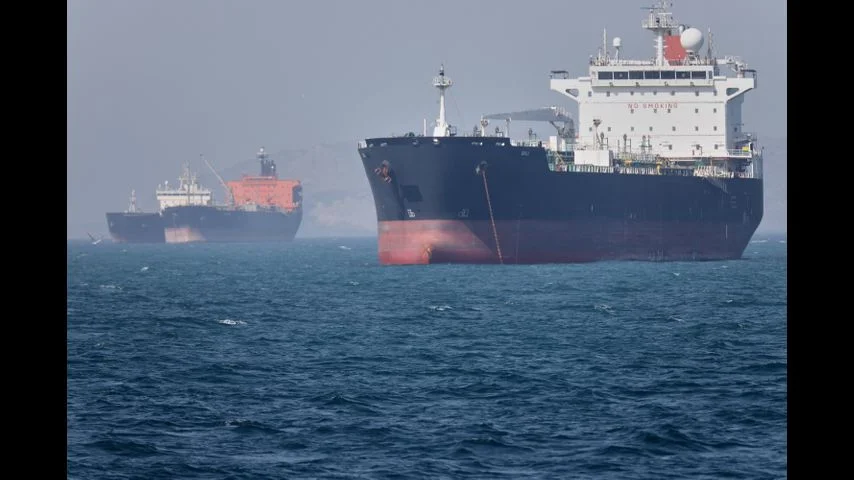
US Navy Disables Iranian Oil Tanker as Trump Issues Fresh Ultimatum
The United States military fired on an Iranian-flagged oil tanker on Wednesday, disabling its rudder as the vessel attempted to breach the US naval blockade of Iranian ports. The attack came just hours after President Donald Trump issued a stark ultimatum to Tehran, demanding Iran accept a deal to end the ongoing war or face a renewed wave of bombing at “a much higher level and intensity than it was before.”
According to US Central Command, a US fighter jet fired several rounds at the tanker, effectively rendering it inoperable. The incident occurred amid a high-stakes diplomatic push, with unconfirmed reports suggesting Washington and Tehran are close to agreeing on a one-page memorandum of understanding. Axios reported that the US expects Iran to respond to key points within the next 48 hours. However, Iran’s top negotiator, Mohammad Bagher Ghalibaf, remained defiant, accusing Washington of seeking Tehran’s “surrender through a naval blockade, economic pressure and media manipulation.”
The attack marks a significant escalation in the ongoing US-Israeli military operation against Iran, dubbed “Epic Fury,” which began in February. Trump’s social media post on Truth Social warned that if Iran does not agree to the deal, “the bombing starts, and it will be, sadly, at a much higher level and intensity than it was before.” Israeli Prime Minister Benjamin Netanyahu, who was scheduled to speak with Trump on Wednesday evening, said Israel was “prepared for all scenarios.”
The Last Tanker: California Braces for $6 Gas and Looming Supply Crunch
As the conflict rages in the Middle East, the real-world impact on American consumers is becoming unavoidable. The last oil tanker from the Middle East to reach the United States before the Strait of Hormuz was closed has arrived in California. The vessel, named New Corolla, delivered approximately 2 million barrels of crude oil from Iraq to Long Beach. It was the final planned shipment to pass through the strait before the war disrupted global oil routes.
California, which imports about one-third of its oil from the Gulf, is now facing a stark reality. The state already has the highest gas prices in the nation, with the average price hitting $6.16 per gallon on Tuesday, compared to a national average of $4.54 — the highest in nearly four years. The California Energy Commission vice-chair, Siva Gunda, told legislators that the state can meet fuel demand for only the next six weeks with its current supply.
“The war in Iran and the closing of the Strait of Hormuz has actually been buffered by the fact that all of these tankers were at sea when the strait closed,” said Michael Ross, a professor at UCLA. “This is the last shipment of that supply that was keeping prices relatively stable. So that should worry us.”
Political Fallout in the Golden State
The surging gas prices have become a flashpoint in California politics, particularly during Tuesday’s gubernatorial debate. Democratic candidates largely pinned the blame for the recent cost spike on Trump’s war in Iran, while Republican candidate Steve Hilton countered by pointing to California’s own stringent environmental regulations. The debate highlighted how the international crisis is reshaping local political dynamics. For more on the tight race, see our coverage of the California Governor Race Polls Show Tightening Field After Heated CNN Debate.
Colorado Train Crash Spills 6,000 Gallons of Oil
While the world’s attention is fixed on the Middle East, a separate incident on Wednesday brought the risks of oil transportation closer to home. A luxury passenger train slammed into an oil tanker truck near Rifle, Colorado, closing US Highway 6 and spilling approximately 6,000 gallons of oil.
The crash occurred at about 9:40 a.m. near Mile Pond Road. The truck driver sustained minor injuries and was taken to a hospital. The train, operated by the Canyon Spirit line — which runs from Salt Lake City to Denver with stops in Moab and Grand Junction — derailed six passenger cars and two engines. No injuries were reported among the train passengers, who were later transported by motor coach to Moab.
Photos from the Garfield County Sheriff’s Office showed a mangled tanker with oil spilling onto the highway asphalt. The Colorado Department of Transportation closed the road in both directions between Mile Pond Road and Peterson Lane. The cause of the collision is under investigation.
Environmental and Safety Concerns
The spill, while relatively small compared to major pipeline ruptures, underscores the dangers of oil transport by road and rail. Colorado has seen a rise in crude-by-rail shipments in recent years, and environmental groups have long warned of the risks associated with transporting volatile fossil fuels through populated areas and sensitive ecosystems. The incident near Rifle serves as a reminder that the oil supply chain remains vulnerable to accidents even as geopolitical tensions strain global markets.
Global Oil Market Under Siege
The simultaneous events — the US attack on an Iranian tanker, the closure of the Strait of Hormuz, and the arrival of the last pre-war oil shipment in California — paint a picture of a global oil market under unprecedented strain.
The Strait of Hormuz: A Chokepoint Closed
The Strait of Hormuz is a narrow waterway between the Persian Gulf and the Gulf of Oman, through which about 20% of the world’s oil passes. The US-Israeli war with Iran has effectively closed this chokepoint, halting the flow of oil from major producers like Saudi Arabia, Iraq, Kuwait, and the United Arab Emirates. While some oil that was already in transit when the war began has continued to reach consumers, that buffer is now gone.
The closure has driven up gas prices worldwide. In the US, the national average has risen by 52% since before the conflict began, according to recent data. The economic impact is being felt across industries, from transportation to agriculture, and is expected to contribute to broader inflationary pressures.
Negotiations on a Knife’s Edge
Despite the military escalation, diplomatic channels remain open. Reports from Pakistan and other intermediaries suggest that an initial framework for a ceasefire could be agreed upon within 48 hours. However, the situation remains highly volatile. Trump’s ultimatum, combined with the tanker attack, signals that the US is willing to increase military pressure to force a deal — or to punish Iran if negotiations fail.
Iranian officials have indicated that they will not capitulate to what they see as a campaign of “maximum pressure.” Ghalibaf’s defiant statement suggests that Tehran is prepared to endure further hardship rather than accept terms it views as a surrender.
Broader Implications: What This Changes
The convergence of these events is reshaping the global energy landscape and domestic American politics in ways that will persist long after the current crisis resolves.
Shift in Energy Supply Chains
The closure of the Strait of Hormuz is forcing countries like the United States, which had become increasingly reliant on Middle Eastern oil, to seek alternative sources. California, in particular, will need to pivot to suppliers in the Americas, including Canada, Mexico, and possibly Venezuela. This could accelerate investments in domestic production and renewable energy, but in the short term, it means higher costs and potential shortages.
Domestic Political Consequences
The war and its economic fallout are becoming central issues in the 2026 midterm elections. The California gubernatorial race is just one example of how local politicians are being forced to take positions on foreign policy. Incumbents across party lines will be held accountable for rising prices at the pump. The Trump administration’s handling of the war could be a defining factor in November.
The Human and Environmental Toll
Beyond economics, the war is exacting a human cost. The bombing campaign in Iran has caused casualties and displacement, though exact figures are hard to verify. The missile attack on the tanker and the Colorado train crash are reminders that the risks of conflict and industrial accidents are not abstract — they affect real people, communities, and ecosystems.
At the same time, the world is watching to see if diplomacy can prevail. The next 48 hours could determine whether the war escalates further or whether a fragile peace takes hold. For now, Americans are left to navigate higher gas prices, uncertain supply chains, and the unsettling knowledge that the last tanker has arrived — and no one knows when the next one will come.
For more on other pressing stories, read about the Mississippi Tornado Emergency: Violent Twisters Leave Destruction, Residents Trapped or check out Mother's Day 2026: Last-Minute Deals, Gift Ideas and What to Know Before Sunday.
Comments