
US and Iran Trade New Strikes as Trump Declares Ceasefire ‘Over’
The fragile ceasefire between the United States and Iran collapsed into open conflict Thursday as both nations launched a second wave of military strikes, with President Donald Trump declaring the truce “over” during a NATO summit. The escalation marks a dramatic turning point in a crisis that has already shaken global energy markets and drawn in multiple Gulf Arab states.
Second Night of US Strikes Targets 90 Iranian Sites
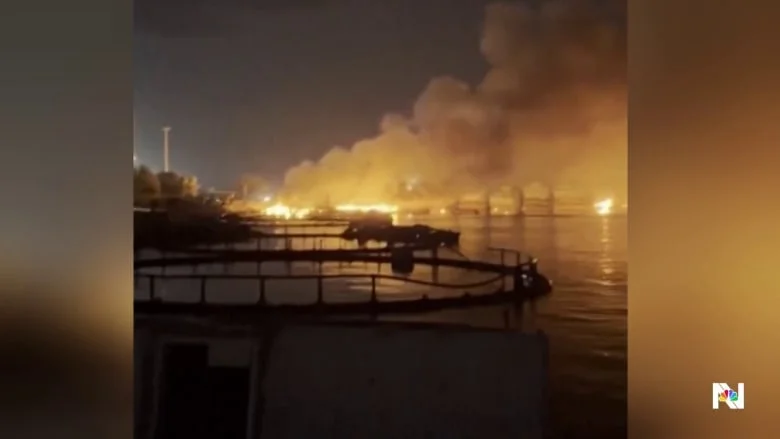
The United States military carried out its second consecutive night of strikes against Iranian targets late Wednesday, hitting approximately 90 locations across Iran, according to U.S. Central Command. The targets included missile and drone storage facilities, air defense systems, naval infrastructure, and logistics hubs.
“The goal was to further degrade Iran’s ability to attack commercial shipping and innocent civilian mariners in the Strait of Hormuz,” Central Command said in a statement on X, accompanied by video footage of the airstrikes.
Iran’s official IRNA news agency, citing local officials, reported that the strikes killed three people and wounded several others on the outskirts of Ahvaz in southwestern Iran. The reported death toll remains relatively low compared to the scale of the bombardment, suggesting that U.S. forces may have targeted primarily military infrastructure rather than population centers.
Iran Retaliates Against Gulf Arab Allies
Tehran responded swiftly, launching missile and drone attacks against U.S. bases and allied positions in Bahrain, Kuwait, and Qatar. Iran’s Revolutionary Guard claimed responsibility for the attacks, which appeared to be larger in scale than the previous day’s exchanges.
Air raid sirens sounded at least twice in Bahrain, which hosts the U.S. Navy’s 5th Fleet headquarters. Kuwait’s military confirmed it was actively intercepting incoming drones and missiles, while Qatar also reported missile alerts. There were no immediate reports of casualties or significant damage in the three countries, but the attacks underscored the widening geographic scope of the conflict.
The tit-for-tat cycle began after Iran struck commercial shipping vessels in the Strait of Hormuz earlier this week, prompting the initial U.S. retaliatory strikes. The strait, a chokepoint for about one-fifth of the world’s oil supply, has become the central flashpoint in the confrontation.
Why the Collapse of the Ceasefire Matters
Trump’s NATO Summit Remarks Seal the Deal
President Trump’s comments at a NATO summit in The Hague effectively ended any remaining hope for a diplomatic resolution. When asked about the ceasefire with Iran, Trump responded bluntly: “As far as I’m concerned, it’s over.” He added that he was not sure he wanted to make a deal with Iranian leaders, whom he called “sick,” and declared it “a waste of time dealing with them.”
The remarks came as a surprise to some NATO allies, who had been urged to support the interim deal brokered in recent weeks. Trump’s dismissal of further negotiations signals a clear shift toward a military-first approach, with the president framing the new strikes as “retribution” for Iranian attacks on shipping.
Global Markets React as Oil Prices Surge
The renewed hostilities have sent shockwaves through global energy markets. Oil prices spiked sharply on Thursday, with Brent crude rising above $95 per barrel before settling partially. Stock markets in Asia and Europe declined as investors priced in the risk of prolonged conflict in a key energy-producing region.
Economists warn that if the Strait of Hormuz remains contested, oil supplies could be disrupted for weeks or months, potentially triggering a global recession. “This is not just a regional conflict anymore,” said Dr. Elena Marchetti, a geopolitical risk analyst at the London School of Economics. “Every country that relies on Middle Eastern oil is watching this closely. The stakes are enormous.”
Iran Threatens ‘Massive’ Retaliation
Iranian state media, citing military sources, reported that Tehran is preparing a “massive” retaliation against U.S. bases in the region if attacks continue. Iran’s top negotiator also stated that the Strait of Hormuz would only reopen under “Iranian arrangements,” effectively threatening to blockade one of the world’s most critical maritime routes.
Iran’s leadership is under intense domestic pressure following the death of Supreme Leader Ali Khamenei, whose funeral was held this week. The convergence of a leadership transition and external military confrontation creates a volatile mix that could push Tehran toward even more aggressive actions.
Broader Implications and What Comes Next
A Regional War Takes Shape
The conflict is no longer a bilateral U.S.-Iran affair. The involvement of Bahrain, Kuwait, and Qatar — all key U.S. allies with significant American military presence — has transformed the crisis into a broader regional war. These Gulf states, while militarily capable, are vulnerable to Iranian missile and drone attacks. Their air defense systems have been tested repeatedly in recent days.
Bahrain’s interior ministry activated air raid sirens and urged civilians to take shelter, while Kuwait’s military reported intercepting multiple projectiles. The attacks risk drawing these countries deeper into the conflict, potentially forcing them to choose between direct retaliation and restraint.
Diplomatic Prospects Dim
With Trump’s declaration that negotiations are a “waste of time,” diplomatic off-ramps have narrowed considerably. The interim deal, which had been supported by several European and Arab nations, is now effectively dead. Mediators from Oman and Qatar — who had previously helped arrange prisoner swaps and limited ceasefires — have been sidelined.
Senator Bernie Sanders condemned the latest U.S. strikes, warning that “endless war in the Middle East is not the answer.” But such voices are increasingly isolated as the administration pursues a military strategy.
Impact on NATO and Global Alliances
Trump’s remarks at the NATO summit also highlighted tensions within the alliance. Some European leaders expressed concern that the U.S. was acting unilaterally without consulting allies. The U.S. decision to revoke oil sale waivers — which had previously allowed some countries to purchase Iranian crude — has further strained relations.
“The revocation of waivers is a significant economic weapon, but it also pressures countries like India and China, who depend on Iranian oil,” said Marchetti. “We could see fractures in global trade alliances if this continues.”
Military Escalation Could Spiral
The pace of escalation shows no signs of slowing. While U.S. officials insist the strikes are calibrated to degrade Iranian military capabilities without triggering a full-scale war, each round of attacks invites retaliation. Iran’s missile and drone arsenal, while not comparable to U.S. firepower, is large enough to overwhelm defenses in small Gulf states.
“Iran’s strategy is asymmetric,” explained retired U.S. Navy Captain Daniel R. Henson. “They know they can’t match us in conventional combat, so they’ll target our allies and our economic vulnerabilities — shipping, oil infrastructure, bases. The question is whether both sides have off-ramps or are just accelerating toward something worse.”
Civilian Toll and Humanitarian Concerns
While the reported death toll remains low — three in Ahvaz, with no confirmed fatalities in Gulf states — the human cost could rise quickly if strikes become less discriminate. Human rights organizations have called for restraint, warning that civilians are already bearing the burden of disrupted shipping and economic instability.
“Every missile fired and every drone launched ratchets up the risk of catastrophic error,” said Dr. Leila Hosseini, a researcher at the Middle East Institute. “A single miscalculation could lead to hundreds of civilian deaths. The region is on edge.”
Conclusion
The collapse of the U.S.-Iran ceasefire marks a dangerous new chapter in Middle Eastern geopolitics. With Trump rejecting diplomacy, Tehran retaliating against Gulf allies, and global markets in turmoil, the path forward looks increasingly uncertain. Both nations appear dug in, and the conflict is already spilling beyond their borders. Whether this escalation remains contained or spirals into a broader war will depend on decisions made in the coming days and weeks.
Comments