
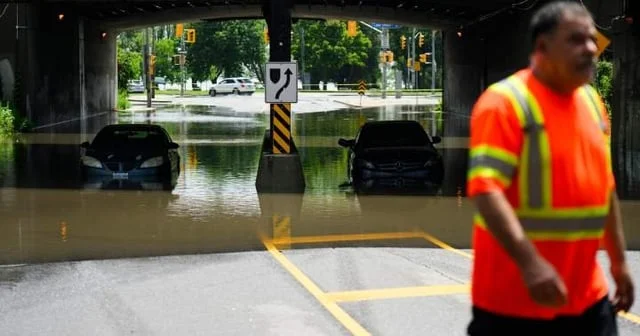
Toronto Begins Massive Cleanup After '100-Year Storm' Leaves Flooding, Damage
Toronto is entering the second day of recovery after a violent thunderstorm system swept through the Greater Toronto Area on September 2, 2026, dumping over 100 millimetres of rain in some areas and triggering widespread flooding, power outages, and structural damage. The storm, which the Toronto and Region Conservation Authority (TRCA) has classified as a '100-year storm' in localized areas, brought traffic to a standstill, flooded transit vehicles, and led to nearly 1,500 calls for service to Toronto Fire.
Crews are now working around the clock to clear debris, restore electricity, and assess the damage to both public and private property. Toronto Hydro reported that 'major repairs' are still needed throughout the city, with thousands of residents remaining without power as of Thursday morning. As of the latest update, the DVP and the Gardiner Expressway have been partially closed in certain sections to allow for cleanup and assessment after the deluge.
A City Under Water
Video shared on social media on Wednesday showed water pouring through the doors of city buses and cars attempting to navigate flooded underpasses. Several drivers had to be rescued by police after becoming stranded in submerged vehicles. Toronto Fire Chief confirmed that the department received 'just shy of 1,500 calls' related to the storm, including water rescues and reports of collapsed scaffolding.
One of the most dramatic incidents occurred at Rogers Stadium at Downsview Park, where significant infrastructure damage was reported due to strong winds. A representative from Live Nation Canada confirmed that the venue sustained 'significant damage,' although no employees or contractors were injured. The extent of the damage is still being assessed, and future events at the venue could be affected.
Infrastructure Strains Under Severe Weather
The storm has reignited long-standing conversations about Toronto's preparedness for extreme weather events, which are becoming more frequent due to climate change. The city's aging infrastructure, including its stormwater management systems and road networks, was visibly overwhelmed by the sheer volume and intensity of the rainfall.
According to TRCA rain gauges, Morningside Works Yard in Scarborough received 112.6 millimetres of rain, while the Vaughan gauge recorded 107.6 millimetres and Albion Hills in Caledon received 100.1 millimetres. The TRCA defined these levels as a '100-year storm,' meaning a rainfall event with a one percent chance of occurring in any given year at any given location. However, experts caution that this does not mean such a storm will only happen once every century.
Critical Facilities Affected
The storm also disrupted essential services. Michael Garron Hospital reported flooding in its Stavro Emergency Department, but said the facility remains operational. Hospital officials, however, are asking the public to seek alternative care options for non-life-threatening conditions to ease pressure on the department.
Meanwhile, the Toronto Wildlife Centre sustained widespread damage, including destroyed outdoor aviaries, shattered windows, and flooding across the facility. The organisation confirmed that five recovering pigeons escaped and remain unaccounted for, but no people were injured. They are now appealing for public donations to help cover the costs of repairs.
Human Cost and Community Response
Despite the severity of the storm, there have been no reported fatalities. Many residents have expressed relief that the death toll is zero, but also frustration over the recurring nature of such flooding events. The storm has prompted discussions about building codes, flood plain management, and the need for investment in resilient infrastructure.
Mayor Olivia Chow said in a statement that the city is conducting a full review of its emergency response and infrastructure resilience. She acknowledged that city crews are facing a 'long haul' and urged residents to avoid non-essential travel in affected areas.
Driving Through the Storm: A Personal Account
Michael Thompson, a resident of Scarborough, was driving on the DVP when the storm hit. He described the experience as 'terrifying,' with visibility dropping to zero within minutes. 'I had to pull over under an overpass and wait for it to pass. The water was rising quickly, and I saw several cars abandon their vehicles and wade to higher ground,' he told Global News.
Thompson's account reflects the often sudden and dangerous nature of such weather events. He stressed that while he believes in infrastructure upgrades, 'the raw power of Mother Nature is something we can't fully control.' He said he's hoping the city will look at ways to better manage stormwater, but also acknowledged the challenge of doing so in a city that's heavily built up.
Why This Storm Is Different
The classification of this storm as a '100-year event' has drawn attention to the fact that such storms are occurring more frequently than the name implies. In fact, Toronto has experienced two '100-year storms' within the last 15 years, with a major flood event in July 2013 that caused over $1 billion in insured damages.
Climate scientists point to a warming atmosphere as the primary driver behind the increased intensity of rainfall events. A warmer atmosphere holds more moisture, which leads to heavier downpours. According to a 2023 report by the Insurance Bureau of Canada, the frequency of severe weather events has been trending upward, and municipalities need to adapt their infrastructure accordingly.
The storm also exposed weaknesses in Toronto's power grid. Thousands of residents were left without electricity, and the city's hydro utility has warned that some neighbourhoods could be without power for days. Outages have also affected traffic signals, leading to hazardous road conditions and a need for additional police presence at major intersections.
Looking Ahead: The Future of Toronto's Flood Defenses
As the city dries out, experts are calling for a fundamental shift in how Toronto approaches stormwater management. Traditional grey infrastructure—such as sewers and storm drains—is designed for a certain capacity, but changing rainfall patterns are overwhelming these systems. The solution, they say, involves a combination of green infrastructure, updated building codes, and more aggressive climate adaptation planning.
'We need to move from simply reacting to these events to anticipating them,' says Dr. Darla Green, an urban hydrologist at Ryerson University. 'That means investing in permeable surfaces, creating more green spaces that can absorb rainwater, and ensuring that new buildings are built with their potential flood exposure in mind.'
Councillor Andrew Chernevsky, who represents a ward along the Don River, echoed these sentiments in a webinar on Thursday. 'We can't keep building in flood plains and expect not to get wet. The cost of inaction is only going to grow.' He cited examples from other cities, like Copenhagen, which has implemented cloudburst management plans that integrate flood protection with recreational spaces.
The issue is not unique to Toronto. Across Canada, municipalities are grappling with the financial challenge of upgrading infrastructure. The Federation of Canadian Municipalities estimates that a significant portion of the country's infrastructure is in fair to poor condition, and the gap between what needs to be spent and what is currently budgeted continues to widen.
The Bottom Line: Recovery on a New Thermometer
The immediate priority for Toronto is recovery. That includes restoring power, reopening roads, and ensuring that residents have access to essential services. But the larger takeaway from this storm—one that is being echoed by climate scientists, urban planners, and residents alike—is that the city must adapt to a new normal.
The '100-year storm' moniker is no longer a measure of rarity, but a benchmark for emerging expectations. Toronto's experience suggests that what used to be considered a once-in-a-lifetime event is now becoming a 'new normal' every 15 to 20 years, as one commenter on Global News wryly noted. The challenge is to build a city that can withstand the next one with more grace and less destruction.
As the cleanup continues, residents are left with a basic but profound question: is the city doing enough to prevent the next disaster? For now, the answer remains uncertain, but the conversation has certainly been reignited—one that will carry into the next municipal election cycle and beyond.
Comments