
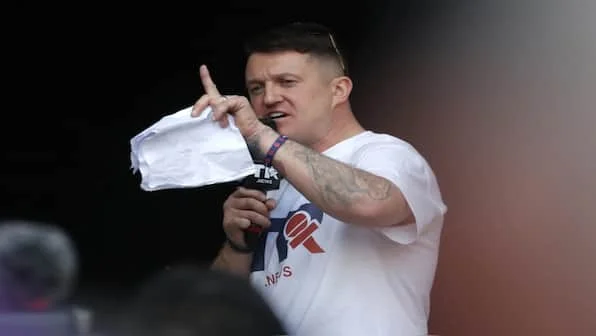
Musk Foundation Took Tommy Robinson to Russia, Father Confirms
The far-right activist Tommy Robinson—whose real name is Stephen Yaxley-Lennon—traveled to Moscow last month with expenses covered by the Musk Foundation, the charitable organization founded by Elon Musk and his brother Kimbal. The revelation came from Errol Musk, Elon Musk’s father, who told the Guardian that he personally brought Robinson to Russia and that both men held meetings with Russian business figures.
Robinson appeared in Moscow in June, issuing calls for supporters to take to British streets after a knife attack in Belfast. He shared video footage of himself in a luxury Moscow hotel alongside Errol Musk, whose son has been a vocal supporter of Robinson. British police stopped Robinson upon his return and seized his phones.
Ed Davey Calls Robinson a ‘Useful Idiot’
Liberal Democrat leader Ed Davey condemned the trip, calling Robinson “a useful idiot for a hostile state.” In a statement, Davey asked: “What kind of so-called British patriot jets to Moscow to rub shoulders with Putin’s cronies, bankrolled by a US trillionaire?” He urged stronger action to protect UK democracy from “far-right thugs, shady tech bros and foreign interference.”
Errol Musk, who has previously met Vladimir Putin, described the 43-year-old activist as “a fine young man” who is “very hotheaded, but at the same time, he’s learning.” Musk senior, a self-described Russophile who believes Russia holds a “genetic advantage” over the West, attended a Kremlin-backed economic forum in St Petersburg during the same trip.
Robinson’s Broader Far-Right Network
The Moscow visit coincided with Russia hosting Andrew Tate and his brother, the self-styled misogynistic influencers who posted footage of themselves firing weapons and riding a tank with apparent Russian military personnel. Robinson has previously visited Russia, but this trip marked an escalation in his explicit praise for the country. He shared footage of Russian ultra-nationalists rallying in memory of murdered British teenager Henry Nowak.
Broader Context: Hanson, Musk, and the Far-Right Media Ecosystem
Robinson’s Kremlin-backed trip is part of a wider pattern of far-right figures building global platforms through international travel and high-profile media appearances. The activist is scheduled to appear on a long-form podcast with Australian One Nation leader Pauline Hanson, who is currently visiting the UK on what she calls a “fact-finding mission.” Hanson’s meet-and-greets have included Holly Valance, Reform UK officials, and Robinson himself.
The Stefanovic Fallout and Platforming Debate
Robinson—whose real name is Stephen Yaxley-Lennon—first gained notoriety in Australia after appearing on Karl Stefanovic’s podcast in June, a move that led Channel Nine to sever ties with their former golden boy. That incident highlighted how far-right activists are leveraging mainstream and alternative media platforms to amplify their reach. Robinson’s invitation to Australia via the Stefanovic podcast and his subsequent global engagements demonstrate a coordinated strategy to expand influence across borders.
Criminal Record and Public Safety Concerns
Robinson’s criminal record includes a five-year stalking protection order and two contempt of court convictions. In 2024, he was jailed for repeating false claims about a 15-year-old Syrian refugee in defiance of a court injunction. Despite this, he continues to be platformed by prominent figures and political organizations, drawing criticism from politicians and far-right experts who warn that such attention normalizes extremist views and helps build a dangerous global brand.
Broader Implications: Democracy, Foreign Interference, and the Global Far-Right
The Musk Foundation’s direct funding of Robinson’s Moscow trip raises urgent questions about the role of private wealth—particularly from tech billionaires—in enabling foreign influence operations. Errol Musk told the Guardian that foundation money covered the trip, including meetings where topics ranged from Russia’s birth rate decline to business opportunities. The involvement of the Musk family, whose members have deeply intertwined business interests with global tech platforms such as X (formerly Twitter), adds a layer of complexity to concerns about disinformation and radicalization online.
What This Changes
The incident marks a potential turning point in how the UK government and intelligence agencies approach the intersection of transnational far-right activism, oligarch funding, and digital megaphones. Ed Davey’s call to defend UK democracy signals that mainstream political parties are increasingly viewing this as a national security issue, rather than a fringe concern.
Comparisons to other recent events are unavoidable: just as authorities are grappling with a cyclospora outbreak that has sickened thousands, and while dust advisories blanket parts of Florida and Arizona, the Robinson-Musk connection represents a different kind of hazard—one that spreads not through contaminated food or air, but through algorithms and influence networks.
As Robinson continues to build ties with both Russian oligarchs and Australian populists, the line between domestic protest and foreign-engineered disruption grows increasingly blurred. The challenge for democracies will be to respond without feeding the very attention economy these figures depend on.
Comments