
Spain Threatens Retaliation as EU Row Over Ceuta Migration Deepens
Spain has issued a stark ultimatum to Italy, demanding the immediate reversal of border controls introduced in response to the mass migrant crossings into the Spanish exclave of Ceuta, or face unspecified countermeasures. The demand, made public on Friday, marks a significant escalation in a diplomatic dispute that threatens to fracture European unity on migration policy.
The Spanish government labelled Italy's partial suspension of the Schengen agreement as "unjustified" and "discriminatory against the Spanish population," setting a Sunday, 9 August deadline for its reversal. Madrid warned it would implement "proportionate measures to protect the interests and dignity of its citizens" should Rome fail to comply, without specifying what those reprisals might entail. Italy, which does not share a land border with Spain, responded sharply, refusing to accept "ultimatums or impositions" and indicating its intention to maintain the enhanced checks until at least 15 August, citing expectations of a potential second wave of migration that Madrid has not confirmed.
What Sparked the Confrontation?
The current crisis erupted late last month when border controls between Morocco and Ceuta, a small Spanish territory on Africa's northern coast, appeared to collapse. According to Spain's Interior Minister Fernando Grande-Marlaska, approximately 72,000 migrants crossed into Ceuta between 30 and 31 July. The vast majority, an estimated 70,000, have since been returned to Morocco, but the event has left a deep political imprint. At least 75 people died on the Spanish side of the border, with an additional 11 deaths reported in Morocco, making it one of the deadliest migration incidents in recent European history.
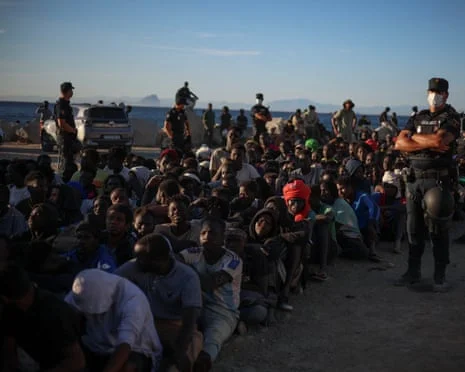
The sheer scale of the influx – equivalent to more than two-thirds of Ceuta's ordinary population – triggered a humanitarian emergency and sent shockwaves through the European Union. Images of hundreds of migrants lined up on a beach in Ceuta awaiting aid quickly circulated globally, drawing reactions from across the political spectrum. Italy's right-wing Prime Minister Giorgia Meloni described the scenes as "shocking" and framed the influx as a security threat, suspending the Schengen agreement with Spain, a move that effectively applies to air travel since the two nations do not share a border.
Finland and Denmark have voiced support for Italy's position, while the Czech Prime Minister Andrej Babiš has called for a temporary suspension of Spain's Schengen membership. This coalition of critics has amplified the pressure on Madrid, setting the stage for an acrimonious emergency meeting of EU interior ministers held earlier this week.
EU's Mixed Signals: Commendation and Critique
The emergency meeting, chaired by Irish Justice Minister Jim O'Callaghan, was intended to project unity. O'Callaghan emphasised that the EU stood in solidarity with Spain and that migration required a coordinated European response. Following the meeting, the European Union officially praised Spain's "swift response" to the crisis, with Grande-Marlaska describing the discussions as constructive and noting that member states had recognised Madrid's "immediate and efficient" handling of the situation.
However, the veneer of unity was quickly punctured. Magnus Brunner, the European Commissioner for Migration, issued a rare and pointed rebuke of Spain's broader migration policy. While acknowledging that the EU could not currently establish a direct link between the Ceuta events and Madrid's plan to regularise undocumented migrants, Brunner stated that the policy was "definitely not a good signal for the rest of Europe." This critique comes in the context of Spain's ambitious scheme to regularise approximately 500,000 undocumented migrants and asylum seekers, a policy that has drawn nearly 1.2 million applications. A letter organised by Italy and Denmark and signed by 22 member states has implicitly criticised the plan, labelling it a "pull factor" for "illegal migration."
The contradiction between the EU's public commendation of Spain's crisis management and the Commission's criticism of its policy on regularisation underscores the deep ideological divisions that remain unresolved. It suggests that while the immediate emergency may be under control, the political fallout is only beginning.
The Stakes for Schengen and European Unity
The escalating dispute between Spain and Italy transcends a bilateral disagreement; it strikes at the heart of the Schengen area, one of the EU's most cherished achievements. The Schengen agreement, which allows for passport-free movement across 29 countries and more than 450 million people, is predicated on mutual trust and shared responsibility. Italy's decision to reimpose border checks, even symbolically, signals a willingness to prioritise national security over collective integration.
This is not the first time Schengen has come under strain, but the speed and political nature of Italy's move have alarmed observers. The controls, which involve additional checks for passengers on flights between the two countries, are unlikely to physically deter migration. Their real impact is political, serving as a pointed criticism of Spain's policies and a signal to domestic audiences in Italy that the government is taking a hard line on immigration. Spain's retaliatory threat raises the prospect of a tit-for-tat escalation that could further erode the functioning of Europe's border-free zone.
For Spain, the dispute is deeply personal. Ceuta and its sister exclave Melilla constitute the EU's only land borders with Africa. They have long been symbols of Europe's attempts to manage migration from the world's poorest and most conflict-ridden regions. The Spanish government views its handling of the crisis as a success in protecting both its territorial integrity and the external border of the EU. Any move by Italy to impose checks on Spanish citizens is therefore seen not just as a policy disagreement but as an affront to national dignity.
The Ceuta Flashpoint: A Familiar Crisis, A New Scale
Ceuta has a long and tragic history as a migration flashpoint. Located on the Strait of Gibraltar, it is a destination for migrants from Morocco and sub-Saharan Africa who seek better economic opportunities or an escape from violence. The Spanish enclave, in Spanish possession since 1580, is heavily fortified to deter border crossings, but the terrain offers multiple points of entry. Migrants often swim from the nearby Moroccan town of Fnideq, covering a distance of roughly 5 kilometres, or attempt to climb the border fence or circumvent the breakwater separating the city from Moroccan territory.
Recent years have seen deadly tragedies in the area. In 2022, at least 23 people were killed during an attempt by around 2,000 people to cross into Melilla. In 2014, at least 14 people died off Ceuta under similar circumstances. The events of late July, however, were unprecedented in scale. Unlike previous incidents involving hundreds of migrants, this mass crossing involved tens of thousands. The Moroccan government's failure to halt the movement, which Madrid may perceive as a deliberate act of political pressure, transformed a manageable border issue into a humanitarian crisis overnight.
The majority of those who crossed were quickly returned, facilitated by an apparent cooperation between Spanish and Moroccan authorities. However, the speed with which the border controls broke down and the sheer number of people involved has raised serious questions about the resilience of Europe's external frontier. The event has also highlighted a worrying trend: the use of migration as a tool of diplomatic leverage. Whether Morocco actively encouraged the crossings to punish Spain for a diplomatic slight or simply failed to enforce its border, the result has been a stark demonstration of Europe's dependence on the goodwill of its neighbours.
A Test of European Resilience and a Shift in Perception
The Ceuta crisis and its aftermath represent more than just an administrative challenge for the EU; they are a litmus test of its stated values and strategic autonomy. As Commissioner Brunner noted, the past weeks have been "a test of our resilience" and the integrity of the EU's external border. The situation is currently under control, with no indication that migrants have moved to mainland Spain or that the broader Schengen zone has been affected. Yet, the political damage runs deep.
The crisis has exposed a fundamental fracture in how EU member states view migration. The coalition of 22 countries led by Italy and Denmark that criticised Spain's regularisation plans represents a powerful bloc advocating for a more restrictive approach. Their argument is that policies like Spain's create a magnet for irregular migration, undermining the collective security of the bloc. On the other side, Spain and its allies argue for a more expansive, humanitarian approach that recognises the demographic and economic needs of the bloc. The Murkowski Opposes Blanche, Leaving AG Nomination on Brink of Defeat highlights how political divisions can coalesce around significant issues, and this dispute shows a similar dynamic on the European stage.
Brunner's public criticism of Spain's regularisation scheme, despite acknowledging the EU's competence in this area, signals that the debate has shifted. Even as the EU official position praises Spain's crisis response, the Commission's rhetoric leans toward the sceptics. This suggests that any future proposal for a common EU migration policy will be judged against the backdrop of Ceuta and the perceived failures of current approaches. The immediate, simmering dispute between Spain and Italy is a microcosm of this larger debate. Spain's threat of retaliation may yet be walked back, but the precedent has been set: internal border controls are now a viable political tool for any member state feeling aggrieved by another's migration policy.
Looking Ahead: A New Reality for Europe
As the standoff between Madrid and Rome continues, the immediate question is whether Italy will yield to Spain's deadline. Given the intransigent tone from both capitals, a swift and amicable resolution appears unlikely. The risk is not of a physical closure of borders but of a continued erosion of political trust. Each new measure, each sharp statement, reinforces a zero-sum mentality where one country's security is seen as another's irresponsibility.
The long-term implications for Europe are profound. The consensus that built the Schengen area is predicated on a shared commitment to a common set of rules. The current crisis suggests that this consensus is fragmenting. If EU members can unilaterally impose barriers against each other in response to migration crises, the very concept of a borderless Europe is weakened. Furthermore, the crisis has again highlighted the inadequacy of Europe's response to global migration pressures. The causes of migration – conflict, climate change, economic disparity – show no signs of abating. Europe's policy instruments remain fragmented, reactive, and deeply contested. The scenes from the beach in Ceuta will not be the last, and unless the EU can forge a truly common and effective approach, future crises will likely become even more politically corrosive, testing the foundational principles of the union itself.
Comments