
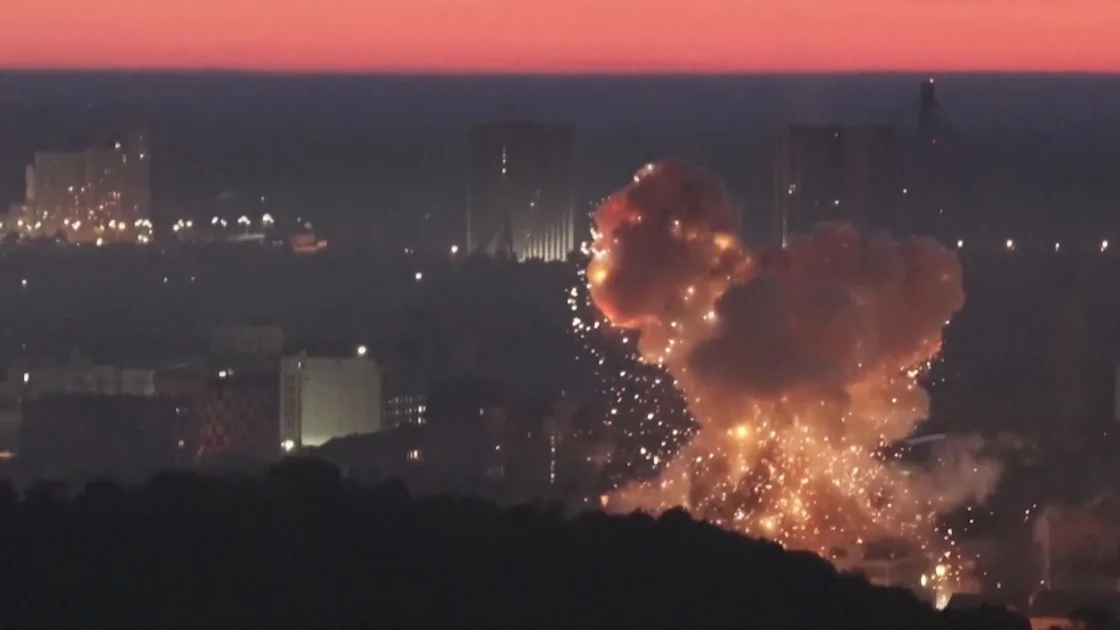
Russia pummels Kyiv with hypersonic missile in major escalation
Russia unleashed one of its heaviest bombardments on the Ukrainian capital since the war began, firing an Oreshnik hypersonic ballistic missile and hundreds of drones at Kyiv and surrounding areas early Sunday. The attack killed at least four people and wounded nearly 100, Ukrainian officials said. President Volodymyr Zelenskyy described the assault as “genuinely deranged” and called for a decisive response from Ukraine’s allies.
The Oreshnik missile—an intermediate-range weapon capable of carrying nuclear or conventional warheads—was used for the third time in the conflict, Russia’s defense ministry confirmed. The barrage involved around 600 drones and 90 missiles, 36 of them ballistic, according to Zelenskyy. Vitali Klitschko, Kyiv’s mayor, said damage was recorded in every district of the capital, including a school, a business center, and a market. The attack also hit a water supply facility and residential buildings.
“It was a terrible night,” said Svitlana Onofryichuk, a Kyiv resident who had worked at the destroyed market for 22 years. “There has never been anything like this.” The U.S. embassy in Ukraine had warned of a “potentially significant air attack” within 24 hours, underscoring the scale of the threat.
Casualties and cultural destruction
Two people were killed in Kyiv and two more in the surrounding region, officials said. Nearly 100 people were injured across the country. The strikes damaged Kyiv’s national art museum and philharmonic hall, both in the historic city center, as well as a newly opened museum dedicated to the 1986 Chornobyl nuclear disaster. “This is a war against our culture, memory, and identity,” said Kyrylo Budanov, a top aide to Zelenskyy. “For centuries, Moscow has tried to destroy everything that makes us Ukrainian.”
Why the attack matters
The assault marks a sharp escalation in Russia’s campaign against Ukraine’s energy and cultural infrastructure, coming as the war enters its fourth year. The Oreshnik missile—dubbed a “hypersonic” weapon—poses a particular challenge to Ukraine’s air defenses, which struggled to intercept many of the ballistic missiles. Zelenskyy said the attack was “the primary target of this Russian attack” and emphasized that “not all of the ballistic missiles were intercepted.”
European leaders condemned the strike. Britain and Germany described the use of the Oreshnik as an “escalation,” while EU foreign policy chief Kaja Kallas accused Moscow of “political scare-tactic and reckless nuclear-brinkmanship.” The attack also inflicted minor damage on Ukraine’s cabinet and foreign ministry buildings, adding to the symbolism of the assault.
Personal toll: tennis star’s family caught in strike
Among those affected was Ukrainian tennis player Marta Kostyuk, who learned hours before her French Open match that a missile had struck just 100 meters from her parents’ home in Kyiv. Kostyuk, the No. 15 seed, cried after her first-round win and said it was “one of the most difficult matches of my career.” She showed reporters a photo of the destruction at her news conference. Her story highlights how the war continues to touch the lives of Ukrainians far from the front lines, even those competing on the global stage.
Perspective: what this means for the war and NATO
The attack underscores a shifting battlefield dynamic. Ukraine has demonstrated a growing ability to strike inside Russian territory, prompting Moscow to retaliate with heavier bombardments of civilian areas. Zelenskyy has urged the U.S. and Europe to provide more advanced air defense systems and to allow Ukraine to use Western-supplied weapons to hit military targets inside Russia. “This is a new kind of war,” said Lviv’s mayor, who recently argued that Ukraine’s battle-tested army is now the most capable in Europe and should be integrated into NATO.
Russia’s repeated use of the Oreshnik missile suggests it is willing to escalate further, raising fears of a broader confrontation. The missile’s nuclear capability serves as a reminder of the stakes involved. Meanwhile, Ukraine’s resilience—and its allies’ response—will shape the conflict’s trajectory. For now, Kyiv’s residents are left to sweep up glass and rubble, as the city’s cultural landmarks lie scarred and its people brace for what may come next.
Zelenskyy previously warned that Russia might launch such strikes, and the attack confirms those fears. The international community now faces a test of whether it will back Ukraine with the decisive action the president demands—or risk allowing Moscow to achieve its aims through terror.
Comments