
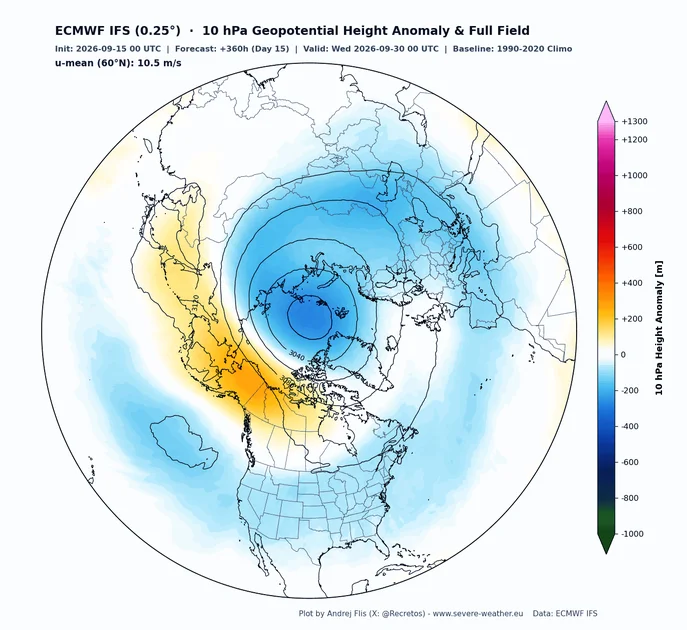
Polar Vortex Fears Grow as El Niño Threatens Early Winter Snow
Climate experts are warning that the polar vortex could unleash colder conditions and snowfall across the UK and parts of the US this winter, as the El Niño weather phenomenon continues to disrupt global weather systems. The warnings come as forecasters in the United States also track a powerful nor'easter set to batter the East Coast this weekend, underscoring the volatile weather patterns shaping the season ahead.
According to multiple UK news outlets, households are being urged to stock up on six essential food items—bread, milk, tinned goods such as soups and stews, snack foods, cereal and granola, and dried pasta with jars of sauce—in case of power cuts or difficulty reaching supermarkets during a cold snap. Experts also recommend an emergency kit including bottled water, battery or wind-up torches, a portable power bank, a battery or wind-up radio, spare batteries, a first aid kit, hand sanitiser and wet wipes, and baby supplies.
The warnings follow a summer of extreme heat in the UK, which experienced five record-breaking heatwaves. El Niño, characterized by the warming of ocean surface waters, has been a primary driver behind these unusually high temperatures and is now thought to be influencing the coming winter's outlook.
Nor'easter Adds to East Coast Weather Woes
Meanwhile, in the US, a powerful nor'easter is expected to impact parts of the East Coast this weekend, bringing wind gusts of 40 to 60 miles per hour along the Mid-Atlantic and Northeast coasts, according to AccuWeather meteorologist Chad Merrill. Some offshore buoys could record gusts up to 74 mph—equivalent to a Category 1 hurricane. Eastern Massachusetts could receive between four and eight inches of rain, with regional power outages expected on eastern Long Island and from Cape Cod to Boston.
Major coastal flooding is forecast from Atlantic City to Cape May in New Jersey, along the Delaware coast, from Virginia Beach to Nags Head in North Carolina, on eastern Long Island, and across the eastern Massachusetts coastline. Beach erosion and coastal damage are anticipated, with some replenishment projects—including those in Ocean City, NJ—potentially needing further restoration work.
The nor'easter, while separate from the polar vortex, illustrates the broader atmospheric instability affecting both sides of the Atlantic as El Niño interacts with jet stream patterns.
What Is the Polar Vortex and Why Does It Matter?
The polar vortex is a mass of cold air that ordinarily swirls above the North and South Poles. Its strength is susceptible to disruption from high-altitude jet streams, which can be impacted by El Niño. When the vortex is thrown off course, it can drive freezing air into the US and Europe, sparking cold snaps and snowfall.
Darryn Waugh, a professor in Earth and Planetary Sciences at Johns Hopkins University, explained to USA Today that "the polar vortex above the Arctic is linked to the jet stream. Both can be impacted by El Niño, and bring about changes in our weather patterns." Amy Butler, a physicist at NOAA's Chemical Sciences Laboratory, added that El Niño drives changes in high- and low-pressure patterns in the troposphere, the lowest layer of Earth's atmosphere where weather occurs.
The Met Office has noted that a hot summer does not guarantee a cold winter, calling any direct correlation a misconception. However, it acknowledged that "through the latter part of the winter, following a peak in El Niño, the stratospheric polar vortex (SPV) can become weaker, leading to an increased chance of Sudden Stratospheric Warming (SSW)," which can trigger severe cold spells.
Why This Winter Matters More Than Usual
The stakes are heightened by recent extreme weather and infrastructure strain. The UK's summer heatwaves have already tested water systems, with the Thames Water Crisis Deepens as Hosepipe Ban Persists and Nationalisation Demands Grow, highlighting how weather extremes can overwhelm essential services. A colder-than-usual winter could compound these pressures, straining energy supplies and increasing demand for heating.
In the energy sector, analysts are already noting that a polar vortex could add to risks of low renewable energy output during winter months, as calm, cold conditions often reduce wind generation. This could tighten electricity margins and raise prices for consumers already facing cost-of-living pressures.
For households, the advice to stock non-perishable food and emergency supplies reflects lessons from past cold snaps, when snow and ice disrupted transport and power. Direct Energy, which issued the guidance, emphasized the importance of preparation in case of power cuts or inability to reach shops.
A Pattern of Increasing Volatility
While the exact strength and path of any polar vortex disruption remain uncertain, the current forecasts fit a broader pattern of increasingly volatile weather driven by ocean-atmosphere interactions. El Niño's global reach means its effects are not confined to one region; it influences pressure patterns that can, in turn, affect the polar vortex and jet stream across the Northern Hemisphere.
Meteorologists caution that long-range winter forecasts carry significant uncertainty. The Met Office stresses that no single factor determines winter outcomes, and El Niño's influence on the polar vortex is an area of active research.
What to Watch in the Coming Weeks
Forecasters will be monitoring the stratospheric polar vortex closely through late autumn and early winter for signs of weakening or sudden warming events. In the US, the immediate focus remains on the weekend nor'easter and its coastal impacts, with further storm systems possible as autumn progresses.
For now, the advice is clear: prepare for the possibility of a colder, snowier winter than recent years, but treat long-range predictions with appropriate caution. As Waugh noted, the links between El Niño, the jet stream, and the polar vortex are real but complex—meaning the coming months could bring anything from mild conditions to a significant cold outbreak.
Comments