
Opening
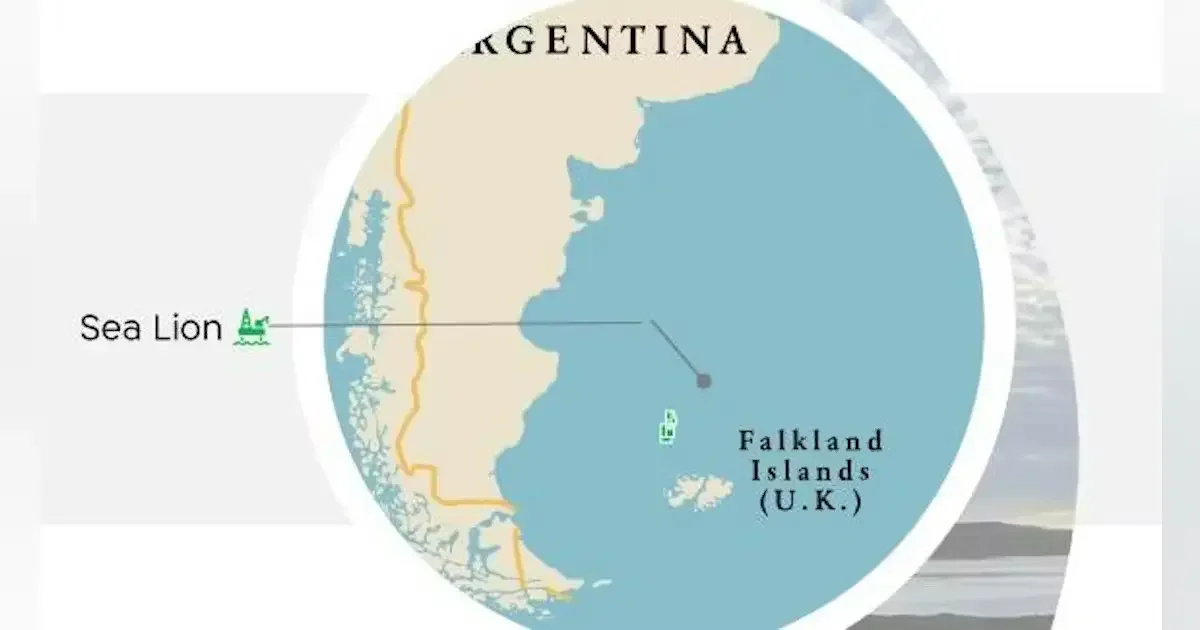
Argentina has directly threatened the chief executive of a British oil company with criminal prosecution and imprisonment as part of its escalating campaign to halt drilling at the Sea Lion oilfield north of the Falkland Islands, the Guardian has revealed. Sam Moody, CEO of Rockhopper Exploration, disclosed that Buenos Aires wrote to him and the company’s chief financial officer on 1 September 2026, warning of criminal prosecution, imprisonment and fines under Argentine domestic legislation.
The disclosure came in a witness statement submitted to the International Tribunal for the Law of the Sea (ITLOS) in Hamburg, which held two days of hearings this week on Argentina’s request for provisional measures to suspend drilling at the contested offshore project. Moody said he believed he was taking “some personal risk” by preparing the statement, given the repeated threats of prosecution and a custodial sentence in Argentina. The sealed document was made available after an application by the Guardian.
Tribunal Hears Final Arguments
The Hamburg hearings, which concluded on Wednesday, pitted Argentina’s claim that the project violates a 1976 UN resolution against Britain’s assertion that the tribunal has no jurisdiction over what is fundamentally a sovereignty dispute. ITLOS is expected to rule on provisional measures in the coming weeks, ahead of drilling due to begin in March 2027.
Opening
Argentina’s legal team, led by Marcelo Kohen, used the tribunal to mock Britain’s sovereignty claim, telling judges that the UK should not be permitted to act as a 17th-century colonial power treating the waters around the Falklands as a “Dominium maris Britannici.” Kohen argued that the dispute over the archipelago – known in Argentina as the Malvinas – did not turn the surrounding seas into a “legal black hole” where Britain could do as it wished.
“We are not in the 17th century,” Kohen told the panel. “We are in an era where we should put an end to the last vestiges of colonialism.” He accused the UK of ignoring the “elephant in the room” – the UN’s classification of the Falklands as a non-self-governing territory and its 1976 call for both sides to refrain from unilateral action.
UK Warns of Devastating Consequences
Ellie Reeves, the attorney general for England and Wales, countered that Argentina was surreptitiously pursuing its sovereignty ambitions through the tribunal and that suspending the project would kill Sea Lion outright. She warned of “disastrous consequences” for the Falkland Islanders, saying billions of pounds vital to the territory’s future would be lost. Reeves accused Argentina of seeking to “take control of those resources for itself” and noted that the islanders had a right to exploit their own natural resources.
The UK government has maintained that the hearing is not about sovereignty, with the prime minister’s official spokesman stating on Monday that the islands’ sovereignty is “not up for negotiation.”
Context
The Sea Lion project is a UK-Israeli venture to drill for oil in waters administered by the Falklands. Rockhopper Exploration, a British firm, and Israel’s Navitas Petroleum, the operator, expect to start the project in March 2027, with oil production beginning in 2028. According to Rockhopper, the field holds an estimated 1.7 billion barrels of oil in place, of which 500 million barrels are recoverable. The project is forecast to double the Falkland Islands’ GDP.
Argentina’s President Javier Milei announced measures to block the development in September, stating on X that he had instructed the foreign ministry and legal teams to initiate arbitration proceedings. “If in 2 weeks the United Kingdom does not halt the illegitimate exploitation, we will go to the International Tribunal for the Law of the Sea,” Milei wrote. “THE MALVINAS ARE ARGENTINA’s, and they are defended with facts, not words.”
Economic Warfare and Legal Pressure
Beyond the tribunal, Buenos Aires has deployed a range of coercive measures. Argentina has banned Navitas from operating in the country for 20 years and wrote to Standard Chartered bank, which has a branch in Port Stanley, urging it to refrain from participating in oil and gas development in the Falklands to avoid falling within the terms of Argentine domestic legislation. Rockhopper and Navitas have withheld the names of contractors from court documents for fear of Argentine retribution.
As Vicky Kapogianni, associate professor of international and environmental law at the University of Reading, told Al Jazeera: “Sovereignty is the root of the dispute. The oil is the trigger, and the environment is Argentina’s best legal route.” Argentina claims the project poses an environmental risk and breaches the 1976 UN resolution calling on both parties to desist from unilateral action until the sovereignty dispute is settled.
Context
The stakes extend well beyond the legal chamber. For the Falkland Islands, a British overseas territory of roughly 700 islands in the South Atlantic, Sea Lion represents an economic lifeline. The UK argues that suspension would prevent islanders from benefiting from resources that could secure their economic future for generations. Reeves told the tribunal that Argentina’s provisional measures would “prevent the people of the Falkland Islands from” realizing those benefits.
For Argentina, the case is the latest front in a longstanding sovereignty claim that dates back to the 19th century. The 1982 armed conflict, which Reeves referenced in her submissions, led to loss of life and military occupation and remains a sensitive historical wound. Milei, who has taken a hawkish stance on the Falklands, reportedly shared a photograph of his legal team in Hamburg with his cabinet on Tuesday, describing it as “tremendous” and adding that “we are working on the Falklands issue like no one else in history.”
A Test for International Law
The case also tests the boundaries of international legal institutions. The UK argues that ITLOS, which adjudicates maritime matters, has no jurisdiction to wade into questions of sovereignty. Argentina, by contrast, frames the case as a straightforward environmental and legal dispute that does not require the tribunal to rule on sovereignty. The outcome could set a precedent for how international tribunals handle disputes that blend resource rights, environmental concerns and contested territorial claims.
Perspective
The Sea Lion dispute reflects a broader trend of resource nationalism and legal brinkmanship in contested waters. Argentina’s strategy – combining domestic criminal legislation, financial pressure on banks and contractors, and international litigation – represents a multifaceted attempt to strangle the project without direct confrontation. The threat of jail time for a CEO is an unusually aggressive tactic that raises questions about the limits of extraterritorial jurisdiction and the safety of corporate executives operating in disputed territories.
For the UK, the case underscores the vulnerability of its overseas territories to legal and economic pressure. The British government’s insistence that sovereignty is not up for negotiation may satisfy domestic audiences, but it does little to shield Rockhopper and Navitas from the practical consequences of Argentina’s campaign. The tribunal’s forthcoming ruling on provisional measures will be closely watched not only in London and Buenos Aires but also in other capitals with contested maritime claims.
What Changes Now
If ITLOS grants Argentina’s request, drilling at Sea Lion would be suspended pending further arbitration, likely delaying the project by years and potentially making it financially unviable. If the tribunal declines, Argentina may escalate its unilateral measures, further complicating financing and operations. Either way, the dispute is set to deepen the already fraught relationship between the UK and Argentina over the Falklands, with the islanders’ economic future hanging in the balance.
The tribunal’s decision is expected in the coming weeks, ahead of the scheduled start of drilling in March 2027.
Comments