
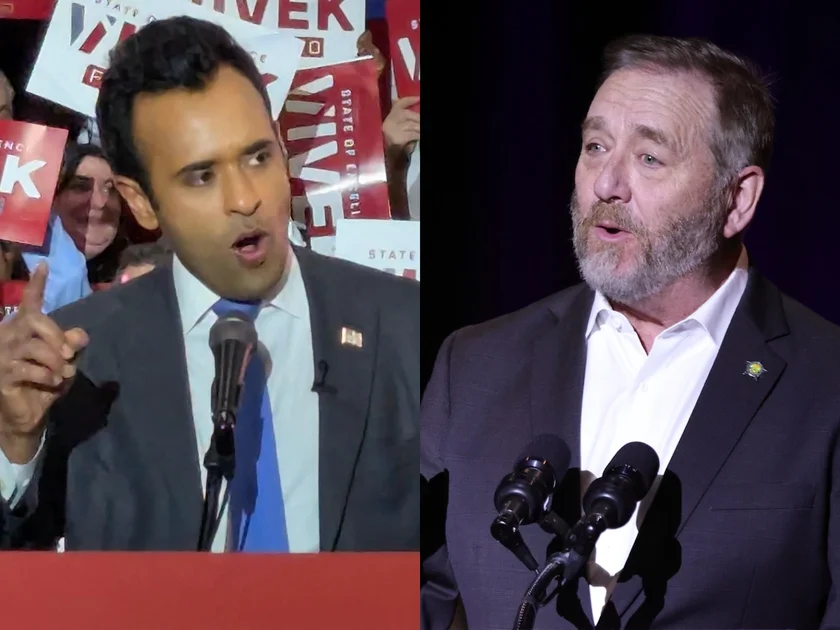
Vivek Ramaswamy's Bad Week: From a Cavs Sweep to Questions About His Ohio Roots
In a span of 24 hours, Ohio gubernatorial candidate Vivek Ramaswamy went from a humiliating courtside moment in Cleveland to fresh scrutiny over his commitment to the state he hopes to lead. On Monday night, the New York Knicks swept the Cleveland Cavaliers in the Eastern Conference Finals, a defeat made personal for Ramaswamy after he posted a "date night" photo from the arena with his wife, Apoorva, writing, "Let's go Cavs…all the way back!" The Knicks proceeded to demolish the Cavs 130-93, ending the series in four games. New York City Mayor Zohran Mamdani, a frequent political rival, swiftly retweeted Ramaswamy's post without comment — a trolling move that delighted social media users, who quickly labeled Ramaswamy a "bad luck charm" and compared him to the "Ted Cruz curse."
But the blowback was not confined to the basketball court. On Tuesday, a new analysis from cleveland.com highlighted a more substantive vulnerability: Ramaswamy has been largely invisible on the campaign trail while his Democratic opponent, Amy Acton, has been crisscrossing the state meeting voters. Compounding the criticism, reporters and political analysts have repeatedly pointed out that Ramaswamy moved his biotech company out of Ohio to Texas — a move one podcast host called "a cardinal sin" for someone asking Ohioans to trust him as governor.
Meanwhile, in a separate political development, Ramaswamy's Trump-era ally Dr. Mehmet Oz visited Ohio on Tuesday to publicly back Governor Mike DeWine on Medicaid fraud — a reminder that Ramaswamy, who has Trump's endorsement, is still navigating a crowded Republican field that includes the sitting governor. The convergence of events — a sports humiliation, a campaign strategy question, and a rival's endorsement — has placed Ramaswamy in an uncomfortable spotlight just six months before the November election.
Ramaswamy's Courtside Curse: The Knicks Sweep and the Political Trolling
The May 26 NBA playoff game at Cleveland's Rocket Arena was supposed to be a moment of local pride for Ramaswamy, a Cincinnati native who has pitched himself as an Ohio champion. Instead, it became a national embarrassment. Ramaswamy posted a photo of himself and his wife smiling during a first-quarter intermission, with the Cavs trailing by 12 points. The image quickly backfired when the Knicks routing intensified, ending the Cavaliers' season and marking the Knicks' first trip to the NBA Finals since 1999.
Social media erupted. One user wrote, "The Cavs really said 'date night' and gave their fans a breakup experience instead." Another bluntly noted, "The Cavs are about as successful as your presidential run." The parody account Ballsack Sports posted, "The Vivek Ramaswamy of Cavs teams… soulless grifters with no heart who pretend to embody the city's values." Other users simply called him a "bad luck charm" and urged him to stay away from sports events.
The most pointed response came from New York City Mayor Zohran Mamdani, who retweeted Ramaswamy's post without any added text. The move was widely seen as a counterattack: last year, a super PAC supporting Ramaswamy put up a billboard in Times Square targeting Mamdani. Mamdani, who has made his love of the Knicks a trademark of his mayoral campaign, also posted a playful jab: "@NYCSanitation I'd like to report a sweep."
Beyond the humor, the incident underscores a recurring theme in Ramaswamy's political career: he often appears to be a spectator in his own narrative. The same critics who mocked him during his 2024 presidential run — where he was frequently described as a performative disruptor — revived those labels. For a candidate trying to prove he is a serious, grounded leader for Ohio, being depicted as a "soulless grifter" and a "bad luck charm" is not the brand he needs heading into a general election.
The Absent Candidate: Acton Is Everywhere, Ramaswamy Is Nowhere
While Ramaswamy was courtside in Cleveland, his opponent Amy Acton was doing what she has been doing for months: holding town halls, meeting with community groups, and answering questions about childcare, healthcare, and education. A cleveland.com analysis published on Tuesday titled "Acton is everywhere. Ramaswamy is nowhere" captured the growing perception gap in the race.
Acton, the former Ohio Department of Health director who gained national prominence during the COVID-19 pandemic, has positioned herself as a grassroots candidate who listens to voters. Her campaign has released specific policy proposals, including a state income tax credit for children up to 18, a refundable earned income tax credit for lower-income households, and expanded childcare subsidies. While the analysis gave Acton only a "C or D" grade for policy detail, it noted she at least offered something concrete.
Ramaswamy, by contrast, offered a vague statement saying he would "work with the General Assembly, business leaders and early childhood partners to identify practical solutions." The podcast hosts gave him an "F." More damning was the recurring question of why Ramaswamy moved his company, Roivant Sciences, to Texas. If he is running on a platform of economic growth and business leadership, the logic goes, how can he sell Ohio to corporations when he did not believe in Ohio enough to keep his own firm there?
"The thing I don't get about Ramaswamy, and I still think that this guy has committed a cardinal sin for a candidate. He moved his company out of the state and now wants to be the governor of the state. That's a nonstarter," said Chris Quinn, editor of cleveland.com, on the Today in Ohio podcast.
Ramaswamy's campaign has defended his record, noting that he remains an Ohio resident and that his business decisions were based on market factors. But the attack has stuck, and Acton has begun to hammer it on the trail. With less than six months until election day, the contrast in visibility and effort could become a defining issue.
Oz and DeWine: A Friendly Visit That Complicates Ramaswamy's Path
Adding to Ramaswamy's challenges, Dr. Mehmet Oz — the Trump-appointed head of the Centers for Medicare & Medicaid Services — visited Ohio on Tuesday to publicly praise Governor Mike DeWine for his handling of Medicaid fraud. Oz and DeWine appeared together at Hopewell Elementary in Dublin, where they highlighted a program that provides vision checks and glasses to needy children. Oz said, "I trust Gov. DeWine," and emphasized the need for partners who believe in making the system work better.
The visit was freighted with political meaning. DeWine, who is term-limited and cannot run again, is facing intense criticism from the right over Medicaid fraud after a series of articles in The Daily Wire exposed potential abuses in the state's home health care program. The Trump administration has targeted states over fraud, and some Republicans have called for tougher enforcement. But Oz's endorsement of DeWine's leadership — and his decision to travel to Ohio alongside him — signals that the Trump administration still values DeWine as an ally, despite the internal GOP pressure.
Ramaswamy, who has Trump's endorsement in the governor's race, now finds himself in an awkward position. He is running against DeWine's legacy in some respects, yet he also needs to show he can work with the same administration that is backing the current governor. The situation is a delicate balancing act: Ramaswamy has criticized establishment Republicans, but the Trump wing of the party is not monolithic. Oz's visit could remind GOP primary voters that DeWine still has powerful friends in Washington, even if his standing in the state is bruised.
For context, Ohio's Medicaid program covers roughly a quarter of the state's population, and fraud has been a chronic problem. DeWine has responded by temporarily pausing new provider approvals and reimplementing GPS tracking measures. But the Daily Wire series has given ammunition to those who argue the state needs a more aggressive reformer — a role Ramaswamy has tried to claim. The question is whether he can do so without alienating the Trump forces that have already signaled their support for him.
Broader Implications: What This Race Says About Ohio Politics and the National Mood
The Ohio governor's race is being watched closely not just for its local stakes, but as a bellwether for the 2026 midterms and the future of the Republican Party. Ramaswamy represents a particular brand of outsider, celebrity-driven politics that relies on media attention and Trump's co-sign. Acton represents a more traditional, policy-focused, and community-rooted approach. The divergence between their campaign styles — one virtual and event-driven, the other hands-on and grassroots — mirrors a national debate within both parties about how to connect with voters.
Ramaswamy's struggles also highlight a vulnerability for any candidate who leans heavily on national media exposure rather than local organizing. The same social media dynamics that helped him build a following during the 2024 presidential race are now being used against him. The Knicks sweep trolling is a small example, but it feeds into a larger narrative: that Ramaswamy is more interested in being seen than in doing the work.
On the other hand, Acton's low-key, high-engagement strategy may not generate the same viral moments, but it builds trust. In a state where voters have grown weary of partisan bickering and celebrity candidates, her approach could resonate — especially if Ramaswamy continues to be defined by his absences and his company's relocation to Texas.
As for the broader picture, the race also tests whether Trump's endorsement alone can carry a candidate through a competitive primary and general election. Ramaswamy has that endorsement, but he faces a sitting governor who, while term-limited, still has institutional support. If Ramaswamy wins, it will validate the theory that Trump's seal of approval is the most powerful force in Republican politics. If he loses, it may suggest that even Trump cannot save a candidate who fails to connect with voters on the ground.
With six months to go, the race is far from over. But as May 26, 2026, showed, Ramaswamy is learning the hard way that politics — like basketball — can be unforgiving when you're on the wrong side of a sweep.
Comments