
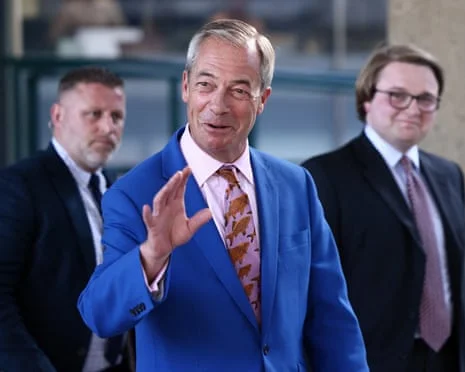
Farage Triggers Clacton By-Election After Resigning as MP
Nigel Farage has formally resigned as the Member of Parliament for Clacton, triggering a by-election expected to take place on August 13, 2026. The Reform UK leader announced his decision to quit and immediately re-stand for his seat during a press conference in London on Tuesday, July 7, framing the contest as a direct appeal to voters to judge his conduct. The move came as the parliamentary standards commissioner opened a second investigation into Farage’s finances, intensifying scrutiny over undeclared gifts and donations.
Lee Anderson, a fellow Reform MP, moved the writ in the House of Commons on Thursday morning, officially confirming the vacancy. Farage stated that he wanted the people of Clacton to be the arbiters of his actions rather than facing what he called a politically motivated inquiry by the establishment and the media. His resignation took effect on Wednesday, July 8, ending his two-year tenure as a sitting lawmaker.
The Core Allegations: Two Standards Investigations
Farage is currently under investigation by the Parliamentary Commissioner for Standards, Daniel Greenberg, over two separate matters. The first involves a £5 million gift from Christopher Harborne, a Thailand-based British cryptocurrency billionaire and major Reform donor. Farage received the money weeks before announcing his candidacy in the 2024 general election. New MPs are required to declare any relevant gifts or donations received up to a year before entering Parliament. Farage initially claimed the money was for personal security costs, but later described it as an “unconditional gift” he could spend however he wished, telling LBC: “I can spend it on Ferraris if I want. I can put it on the horses.”
The second investigation, revealed by Farage during his resignation announcement, concerns allegations that he received financial support from George Cottrell, a close friend and convicted fraudster who served eight months in a U.S. prison for wire fraud. The Sunday Times reported that Cottrell provided assistance to Farage ahead of the 2024 election. If the standards watchdog finds Farage committed a serious breach of declaration rules, he could face suspension from the Commons for ten days or more, which would trigger a recall petition and force another by-election at a time not of his choosing.
Major Parties Boycott the By-Election
Farage’s attempt to reframe the scandal as a fight against the political establishment quickly backfired when all major parties announced they would not field candidates in the Clacton contest. Within hours of his resignation, Labour, the Conservatives, the Liberal Democrats, the Green Party, and Rupert Lowe’s Restore Britain party all declared they would boycott what they variously described as a “media circus,” a “vanity project,” and a “stunt.”
Labour’s ruling executive voted to opt out after a Tuesday night meeting, with a spokesperson saying: “Farage is engulfed in a sleaze scandal and he’s desperately trying to change the subject. It’s pathetic, and the Labour party is not going to indulge it.” A senior ally of Andy Burnham, who is expected to become Labour leader and prime minister later this month, noted the party was wary of expending resources on a by-election that Farage was using to air grievances about the investigations.
The Liberal Democrats went further: leader Sir Ed Davey urged Chancellor Rachel Reeves to refuse to accept Farage’s resignation until the standards inquiry concluded, arguing that “the people of Clacton deserve the facts first.” Under parliamentary rules, an MP wishing to resign must write to the chancellor, who can formally refuse but normally accepts. Ellen Miller, a spokesperson for Restore Britain, said her party would not participate “until after the verdict of the standards commissioner.”
Count Binface Steps In
With the mainstream parties standing aside, the only declared candidate so far is Count Binface, a perennial election novelty candidate known for a satirical platform that includes policies like making London’s Ulez charge payable in loose change. Farage’s campaign risks being reduced to a one-sided affair against a joke candidate, undermining his narrative of a serious battle against a hostile establishment. Reform UK has offered to pay the estimated £250,000 cost of the by-election, a move critics called an attempt to control the narrative.
The Stakes: A Political Provocateur’s Gamble
Nigel Farage is arguably one of the most influential figures in modern British politics. His relentless campaign to take the UK out of the European Union turned Brexit from a fringe cause into reality, reshaping the nation’s political landscape. After seven failed attempts to win a parliamentary seat, he finally succeeded in 2024, representing Clacton under the Reform UK banner. He has since capitalized on anxieties about immigration and social change, tapping into the same populist currents that have boosted allies like U.S. President Donald Trump and European right-wing leaders.
Reform UK currently holds only eight of the 650 seats in the House of Commons, but the party consistently leads opinion polls. It was the big winner in local and regional elections in May 2026, which led to the ouster of Prime Minister Keir Starmer by his own Labour Party. If current trends hold, Farage could become prime minister after the next general election, due by 2029. The by-election in Clacton, therefore, is not just a localized fight—it is a test of whether Farage can weather a financial scandal that would have sunk most traditional politicians.
Why This Matters for British Politics
The decision by all major parties to boycott the by-election reflects a broader strategic calculation: they do not want to hand Farage a platform to play the victim. However, it also risks legitimizing his claim that the system is arrayed against him. By refusing to compete, the established parties are essentially conceding the seat to Farage, allowing him to return to Parliament without facing serious opposition. This could further energize his base and paint his opponents as afraid to face the electorate.
At the same time, the boycott does not resolve the underlying standards investigations. If the parliamentary commissioner finds Farage in breach of the rules after the by-election, he could still face suspension and a second recall process, potentially triggering yet another contest in Clacton within months. This would create a cycle of by-elections that critics say Farage is using to delay accountability.
Broader Implications: The Trump Playbook and Populist Resilience
Farage’s tactics closely mirror those of his ally Donald Trump: attack the media and the establishment, claim victimhood, and turn a personal scandal into a political rallying cry. His resignation and immediate re-candidacy are reminiscent of Trump’s attempts to weaponize investigations against him. By framing the standards probe as a plot to stop a Reform government, Farage is seeking to mobilize supporters who already believe the system is rigged against outsiders.
This strategy has worked for populist leaders elsewhere. In the United States, Trump turned multiple legal indictments into fundraising windfalls and primary victories. Farage’s calculation appears to be similar: force a high-profile vote, dominate the news cycle, and emerge stronger—even if the underlying allegations remain unresolved.
The Risk of a Second By-Election
However, Farage’s gambit carries significant risk. If the standards investigation continues and results in a suspension, the subsequent recall petition could lead to a second by-election that he would not be able to control. At that point, his opponents might decide to compete, seeing him as vulnerable. Moreover, the novelty candidate factor—Count Binface or other satirical figures—could undermine the seriousness of the contest, turning it into a farce rather than a vindication.
The Clacton by-election is scheduled for August 13, though the exact date has not been formally confirmed by the Treasury. Voters will decide whether to return Farage to Westminster or send a message that financial transparency matters. For now, the Reform leader remains defiant, telling supporters: “This is people versus the establishment.” The outcome will test whether, in an era of populist disillusionment, the establishment still has the power to fight back—or whether it has already conceded the field.
For more on how political scandals intersect with global security, read about INTERPOL Operation First Light: 5,811 Arrested, $293M Seized in Global Fraud Crackdown. And for a look at how high-stakes competition plays out in other arenas, see Dybantsa Outduels Peterson as Bulls Summer League Hype Hits Vegas.
Comments