
NASA 'Jellyfish' on Mars Sparks Viral Debate, But Science Points to a Cosmic Ray
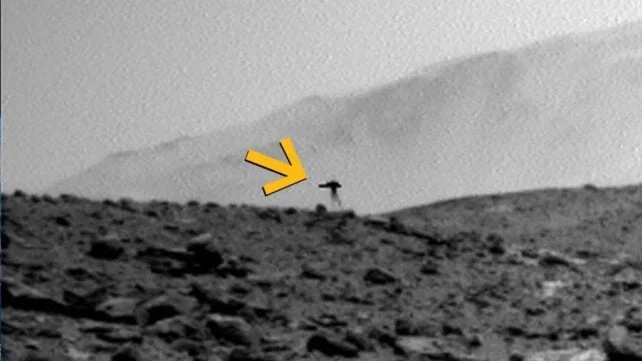
The internet is abuzz with a strange image from Mars that appears to show a ghostly, jellyfish-like silhouette hovering above a rocky ridge. The photograph, originally captured by NASA's Curiosity rover on August 20, 2023, has resurfaced in recent days and is fueling speculation about alien life on the Red Planet. However, scientists and imaging experts are offering a far more mundane — yet still fascinating — explanation: the 'jellyfish' is almost certainly an artifact caused by a cosmic ray striking the rover's camera sensor.
The image, taken by Curiosity's right Navigation Camera (NavCam), shows a small, dark shape on the left side of the frame that some liken to the war machines from H.G. Wells' War of the Worlds. The shape appears to have a domed 'head' and trailing 'tentacles' that just touch the top of a distant hill. Yet the feature is missing from photographs taken just 13 and 25 seconds earlier, and from a subsequent image taken 78 minutes later, proving it is not a permanent part of the Martian landscape.
"What I think happened is a cosmic ray struck the camera at the exact right moment and left this big old artifact in the image," says Dr. Joseph Farah, an astrophysicist quoted by PetaPixel. "It explains why the shape is so weird; just a perfect row of pixels with no anti-aliasing effect. And why it wasn't present just 13 seconds earlier."
This is not the first time that Curiosity has captured such fleeting anomalies, and it likely won't be the last. As humanity continues to explore Mars with sophisticated robotic probes, distinguishing between genuine discoveries and technological glitches is a critical part of the scientific process.
The Viral 'Jellyfish': What the Image Shows
The image in question is a raw, grayscale photo from NASA's Curiosity rover, part of a routine survey of the Gale crater region. It was originally taken on sol 3924 of the mission (August 20, 2023) and went largely unnoticed until it was posted on X (formerly Twitter) by user Kari Sivertzen on August 12, 2026. Within days, the image had spread across social media platforms, eliciting everything from awe to alarm.
In the original image, the 'jellyfish' occupies only about 15 pixels of the frame, making it a very small and subtle feature. Upon cropping and enhancing, the silhouette resembles a creature from science fiction: a rounded top with wispy tendrils extending downward. The fact that it appears to be hovering just above the ground adds to the mystery.
However, the scientific consensus is clear: this is not evidence of extraterrestrial life. The most compelling evidence comes from the rover's own imaging sequence. Curiosity routinely captures multiple images of the same target in quick succession to study changes in lighting and atmospheric conditions. In this case, the rover took three images of the same scene within 38 seconds. The 'jellyfish' appears only in the third frame, which is exactly what one would expect from a sudden, transient event like a cosmic ray strike.
Cosmic Rays: The Usual Suspect Behind 'Alien' Images
Cosmic rays are high-energy charged particles, most of them protons, that travel across the universe at nearly the speed of light. They originate from the Sun, from supernova explosions, and from other high-energy events in our galaxy. When they strike a camera's silicon sensor, they deposit their energy and create a trail of altered pixels, often appearing as bright streaks or dark spots in the resulting image.
On Earth, we are largely shielded from cosmic rays by our planet's magnetic field and thick atmosphere. The atmosphere absorbs or deflected most particles, and the magnetic field redirects others. Mars, however, lacks a global magnetic field and has an atmosphere only 0.5% as dense as Earth's. This leaves the rovers — and any future human explorers — exposed to the full force of space radiation.
According to ScienceAlert, this is a known and expected occurrence in images from Curiosity and its sibling rover, Perseverance. The cameras on these rovers are not heavily shielded, and the detectors are constantly bombarded by cosmic rays. The result is the occasional appearance of 'artifacts' — glitches that can look like anything from a random white patch to a suspiciously shaped figure.
"For an ordinary observer, such defects are easily mistaken for real objects on the surface of Mars or extraterrestrial entities," noted a report from Zamin.uz, a news outlet that covered the story.
Why the 'Jellyfish' Is Not an Alien or a Martian Creature
Several alternative explanations have circulated, ranging from the playful to the paranoid. Some have suggested it could be a fast-moving creature scuttling across the Martian surface, while others have proposed it might be a misidentified rock or a shadow. But all of these fail to withstand scientific scrutiny.
First, the object is absent in images taken seconds before and after. Any physical object on the surface, even a moving one, would likely appear in at least one of the adjacent frames unless it moved extremely fast and then vanished without trace. No evidence of such movement exists.
Second, the shape shows a distinct line of black pixels with no anti-aliasing effect, which is typical of a digital artifact rather than a physical object. The PetaPixel report highlighted this detail, quoting Dr. Joseph Farah, who noted the perfect row of dark pixels as a telltale sign of a cosmic ray strike.
Third, Mars' atmosphere is devoid of life as we know it, and there is no evidence that any airborne organisms could survive there. The planet's thin, carbon dioxide-dominated atmosphere, combined with intense radiation, makes it inhospitable to complex life.
Dr. Farah and other experts point out that while pareidolia — the human tendency to see familiar shapes in random patterns — is a powerful psychological phenomenon, it is not a scientific explanation. The human brain is wired to recognize patterns, which is why we see faces in clouds and jellyfish on Mars. But the scientific process requires rigorous verification.
Technical Explanations: Camera Glitch or Transmission Error?
While cosmic rays are the leading hypothesis, there are other possible technical explanations for the 'jellyfish' artifact. EarthSky notes that a pixel value can be altered at multiple points between the camera sensor and the final image file on Earth. These include electronic noise within the camera's readout circuitry, glitches in the flash memory or flight computer, data corruption during onboard compression, errors during the downlink transmission to Earth, or problems in ground processing.
Each of these stages introduces the possibility of a pixel or cluster of pixels being misread or corrupted, producing a ghostly artifact. However, the fact that the shape appears as a continuous, structured silhouette rather than a random burst of pixels makes a cosmic ray strike more likely. Cosmic rays often leave trails or coronas that can resemble elongated or branched shapes.
The image in question was taken with a long exposure? Actually, Curiosity's navigation cameras typically have short exposure times (a few milliseconds), but a cosmic ray with sufficient energy can still deposit significant charge in the sensor, creating a large artifact.
"Curiosity's cameras operate in a high-radiation environment," explained Amit Surti on Medium, as quoted by EarthSky. "The lack of a global magnetic field on Mars means that the surface is bombarded by galactic cosmic rays and solar energetic particles."
Broader Implications: The Challenge of Exploring Hostile Worlds
The 'jellyfish' incident underscores a broader challenge in space exploration: distinguishing between real discoveries and instrument artifacts. It also highlights the need for robust imaging protocols, such as taking multiple frames of the same target, to confirm the reality of any observed feature.
As NASA and other space agencies plan future missions to the Moon, Mars, and beyond, the reliability of scientific instruments is paramount. The discovery of water ice, organic molecules, or even fossilized microbes would be a monumental finding, but it must be verified beyond doubt. False positives, however harmless in hindsight, can have serious consequences if they lead to premature announcements or misallocation of resources.
Moreover, the viral nature of 'alien' images on social media presents a public communication challenge. The 'jellyfish' is just one in a long line of Martian peculiarities that have captured the public imagination: the 'dragon scale' rocks, the 'mushrooms,' the 'alien doorway' on a hill. Each time, NASA and scientists must carefully explain that the phenomenon is a natural geological or instrumental artifact.
The good news is that the general public's fascination with Mars signals a healthy interest in science and exploration. What we need, however, is a more scientifically literate public that can distinguish between a genuine mystery and a glitch. In the age of deepfakes and AI-generated images, the ability to think critically about visual evidence is more important than ever.
The Lesson for Earth: Blame It on the Cosmic Ray?
For the rest of us, the 'jellyfish' on Mars offers a whimsical reminder that our technology is imperfect, and that the universe is full of energetic particles that can interfere with our gadgets. As PetaPixel humorously noted, "next time an unexpected object appears in your photo, blame it on a cosmic ray hitting your camera."
Indeed, cosmic rays are not limited to space. Even on Earth, professional photographers occasionally see artifacts in their images caused by cosmic rays striking camera sensors, especially at high altitudes or in low-light conditions. The phenomenon is so common that photographers often trade stories of mysterious 'orbs' or 'sprites' that turn out to be radiation-induced.
Note: As with all viral space images, the 'jellyfish' is a wonderful example of how our brains seek patterns. But science tells us that the Red Planet is not home to floating jellyfish. Instead, it's a harsh, radiation-battered world where even our best robots are occasionally tricked by particles and pixels. If anything, this incident reminds us of the extraordinary challenges of exploring another planet — and the importance of keeping our skepticism sharp.
As Curiosity continues its mission in Gale crater, we can expect more strange sightings. Some will be rocks, some will be glitches, and some might just be something new. Only time and rigorous analysis will tell. Until then, keep looking up — and don't forget to check for a technical explanation before declaring "life on Mars."
Comments