
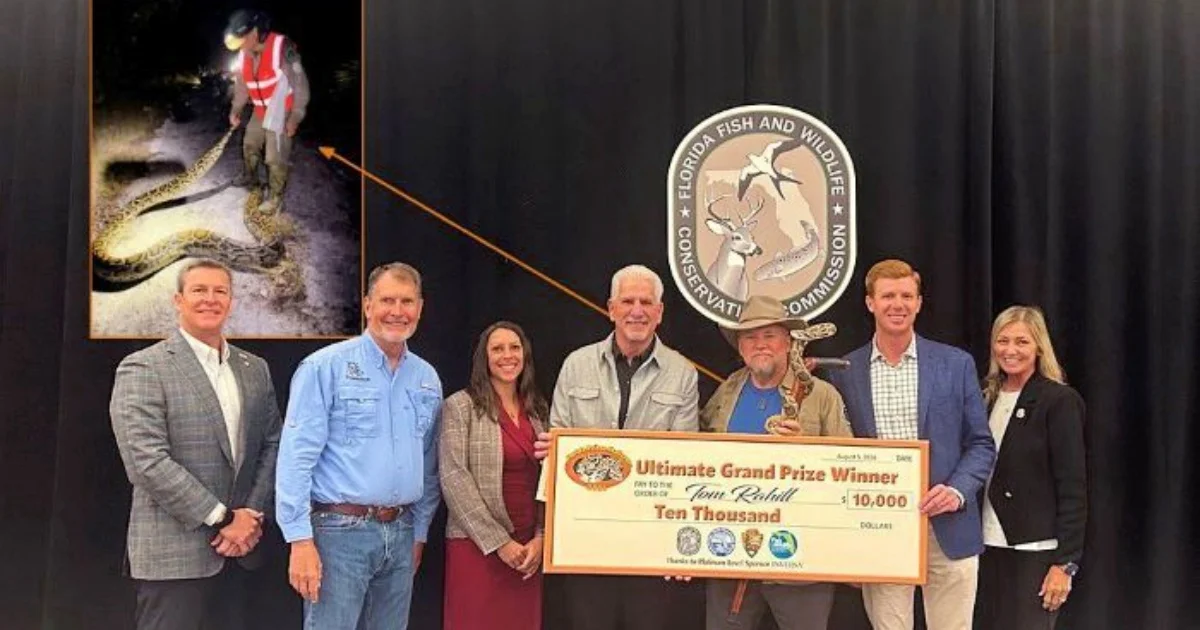
Tom Rahill Captures 96 Pythons to Claim Everglades Hunt Title
Tom Rahill has been named the standout winner of this year's Everglades python hunt after capturing an astonishing 96 Burmese pythons, earning the $10,000 first prize. The competition, which returned to Everglades National Park as one of the open hunting areas this year, drew participants determined to make a dent in the invasive snake population threatening South Florida's fragile wetland ecosystem.
Rahill's record-breaking haul came as hunters were permitted to comb a wide range of locations, including Big Cypress Wildlife Management Area, Everglades and Francis S. Taylor Wildlife Management Area, Frog Pond Public Small Game Hunting Area, Holey Land Wildlife Management Area, Rocky Glades Public Small Game Hunting Area, Rotenberger Wildlife Management Area, and Southern Glades Wildlife and Environmental Area. The return of Everglades National Park as huntable territory is seen as a significant expansion of the effort, giving hunters access to some of the most python-dense terrain in the state.
The announcement of Rahill's victory comes amid a broader technological push to control the invasive population. On the same day, reports highlighted how the South Florida Water Management District and the University of Florida have deployed solar-powered robotic rabbits designed to lure pythons out of hiding using artificial intelligence, heat signatures and scent simulation.
A Hunt With High Stakes
The competition rewards volume and persistence, but wildlife officials stress that the stakes extend well beyond prize money. Burmese pythons have been linked to dramatic declines in native mammal, bird, and reptile populations across the Everglades. For conservationists, each removed snake represents a small victory for the species competing for food and space in the marshes.
"Removing Burmese pythons from this ecosystem is critical to the survival of the native species that call this area home," said Ron Bergeron of the South Florida Water Management District. Nick Wiley, director of the Fish & Wildlife Foundation of Florida, echoed that sentiment: "Each python removed helps conserve the native wildlife that makes the Everglades so extraordinary."
Rahill's 96-python total sets a new benchmark for the competition and underscores how experienced hunters are adapting their tactics to a predator that can be nearly invisible even to trained eyes. The open question left by the hunt is how close other participants came to his count, but his result has already raised expectations for next year's event.
Why Florida Is Deploying Robot Rabbits Against Pythons
While human hunters rack up record catches, researchers are betting on a different kind of solution. The South Florida Water Management District and the University of Florida have teamed up to deploy robotic rabbit decoys in python habitat, a project that sounds like science fiction but is grounded in the harsh reality of wildlife management in the Everglades.
Burmese pythons are ambush predators that blend seamlessly into the vegetation. Even experienced hunters can walk within feet of a python without spotting it. The robot rabbits are designed to reverse that dynamic by giving the snake a reason to come to a known, monitored location.
How the Robot Rabbits Work
The decoys mimic real marsh rabbits, a natural prey species for pythons in South Florida. Each robotic rabbit is built from an ordinary toy rabbit whose stuffing has been replaced with motors, heaters, and electronics. Solar panels supply power in the field, and the devices emit heat, movement, and a scent intended to resemble a living marsh rabbit.
An AI-powered camera monitors the surrounding area. When it detects a python approaching, the system alerts South Florida Water Management District officials, who can then dispatch a trained python removal agent to the location. The rabbits are not released to roam freely; they are placed at fixed monitoring points where pythons are expected to pass through or hunt.
Researchers eventually deployed 120 of the robotic rabbits across South Florida, according to reporting by the Associated Press. Each setup cost around $4,000, including the rabbit, electronics, cameras, and supporting equipment. University of Florida researcher Chris Dutton helped transform the ordinary toys into working decoys.
The technology is being used alongside the annual Florida Python Challenge and other removal programs, not as a replacement. Officials describe it as a scalable alternative to manual patrols across vast swampland, where human hunters can only cover so much ground.
A Defining Moment in Florida's Invasive Species Battle
The combination of record-breaking human hunters and AI-powered robot rabbits reflects a growing shift toward integrating robotics and machine learning into wildlife management. Florida's python problem is so severe that no single approach is likely to solve it. Instead, the state is layering tools: annual competitions that motivate thousands of hunters, trained removal agents, and now autonomous decoys that can work around the clock.
The Scale of the Python Problem
Burmese pythons were introduced to South Florida through the exotic pet trade and have since established a breeding population across the Everglades. They prey on native mammals, birds, and reptiles, and their presence has been linked to severe declines in species such as marsh rabbits, raccoons, and opossums. Because they are cryptic and reproduce quickly, eradication is considered impossible; the goal is now population suppression.
That reality explains why Florida has invested in a multi-pronged strategy. The Florida Python Challenge offers cash prizes to incentivize hunters, while the South Florida Water Management District and partner agencies employ dedicated removal agents. The robot rabbits add a new dimension by using the snake's own hunting instincts against it.
What This Means for Wildlife Management Elsewhere
If the robot rabbit project proves successful, it could serve as a model for other regions grappling with invasive predators. The technology is still in its early stages, but the concept—using artificial intelligence and biomimicry to draw out elusive animals—has potential applications beyond pythons. Conservationists are watching closely to see whether the decoys can deliver a measurable reduction in local python populations.
For now, the focus remains on the Everglades and the hunters like Tom Rahill who are on the front lines. His 96-python haul is a testament to what dedicated individuals can accomplish, but it also highlights the scale of the challenge. Even a record-setting hunter removes only a fraction of the estimated tens of thousands of pythons still lurking in the marsh.
As Florida continues to blend old-fashioned hunting prowess with cutting-edge robotics, the battle for the Everglades has become a testing ground for the future of invasive species control. The snakes are not going away, but neither are the people—and machines—determined to stop them.
The Road Ahead
Officials have not announced how many pythons were removed in total during this year's hunt, but Rahill's victory has already generated momentum for next season. The South Florida Water Management District is expected to continue deploying robot rabbits at strategic sites, refining the technology based on field data.
For hunters, the message is clear: the competition is tough, the prize is substantial, and the ecological stakes are enormous. For researchers, the robot rabbits represent a promising experiment in using AI to outsmart one of the most destructive invasive species in North America. Whether through human persistence or robotic ingenuity, the fight for the Everglades is far from over.
Comments