
Macron’s East Africa Tour Signals Strategic Pivot Away from Post-Colonial Model
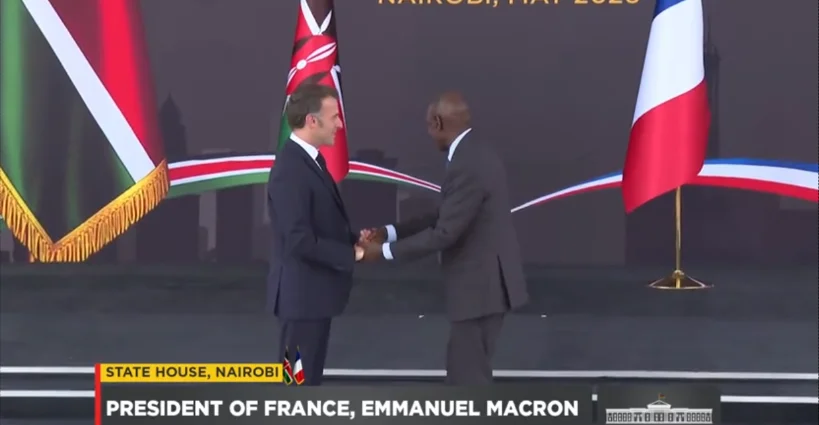
French President Emmanuel Macron is in East Africa this week, co-hosting the Africa Forward Summit in Nairobi alongside Kenyan President William Ruto. The two-day event, which began Monday, brings together around 30 African heads of state and hundreds of business leaders — including Nigerian billionaire Aliko Dangote and TotalEnergies CEO Patrick Pouyanné — to discuss investment in artificial intelligence, renewable energy, infrastructure, and finance.
Macron’s tour began Saturday in Egypt, continues in Kenya, and will conclude Wednesday in Addis Ababa, Ethiopia, where he is expected to hold talks at the African Union headquarters on peace and security. The visit marks the first time Macron has co-hosted a major Africa summit in an Anglophone country since taking office in 2017, underscoring a deliberate effort to expand France’s engagement beyond its traditional Francophone sphere.
Focus on Economic Partnership, Not Patronage
The summit’s agenda deliberately avoids the security-heavy topics that long defined France’s post-colonial relationship with the continent. Instead, discussions center on technology transfer, clean energy projects, and commercial agreements. Several deals between French and Kenyan companies are expected to be signed during the visit, according to Al Jazeera.
Yinka Adegoke, editor of Semafor Africa, reported from Nairobi that the conversation is less about France reclaiming influence than about African countries widening their options in a multipolar world. “For many African governments, France under President Emmanuel Macron has become a more pragmatic partner than it was a decade ago,” Adegoke wrote.
The Limits of French Influence
Despite the diplomatic push, analysts note that France’s comparative advantage in Africa is narrowing. China remains deeply embedded through infrastructure projects and state-backed financing, while Gulf states can deploy capital quickly and at enormous scale. France’s strengths lie in business networks, technical expertise, education, and access to European markets — valuable but not dominant.
Why the Reset Matters: France’s Influence Has Sharply Declined in West Africa
Macron’s East Africa charm offensive comes against a backdrop of serious setbacks for France in its former West African colonies. In the Sahel region, military governments in Mali, Burkina Faso, and Niger have expelled French troops and pivoted toward Russia, accusing Paris of neocolonial meddling and ineffective counterterrorism operations.
Anti-French sentiment has risen sharply alongside political instability and military coups. The vacuum left by French withdrawal has been partly filled by Russian influence, including through the Wagner Group and its successor networks, which exploited anti-French resentment to expand their foothold.
The rest of the continent is watching. African governments increasingly approach global powers transactionally, weighing partners less by history or ideology than by who can deliver investment, technology, and developmental partnerships. France’s ability to adapt to this new dynamic will determine whether its influence stabilizes or continues to erode.
Broader Implications: A New Chapter — or a Tactical Retreat?
Macron’s push to rebrand France as a partner rather than a patron is not entirely new. Since 2017, he has sought to modernize France’s Africa policy, emphasizing economic cooperation over military intervention. But the shift from rhetoric to reality has been uneven. The new restitution law passed days before the summit, which seeks to expedite the return of looted artifacts, is part of that effort — but symbolic gestures alone may not rebuild trust.
“For Africans, the attraction is not necessarily France itself, but the ability to diversify partnerships at a moment when global powers are competing more aggressively for influence across the continent,” Adegoke wrote. That sentiment reflects a broader trend: Africa is no longer a passive arena for great-power competition but an active participant, choosing its partners strategically.
Macron’s Broader Diplomatic Troubles: Criticism Over Middle East Stance
While Macron focuses on Africa, his diplomatic posture elsewhere has drawn scrutiny. A Jerusalem Post opinion piece published over the weekend questioned France’s neutrality ahead of a planned Paris peace conference on the two-state solution, accusing Macron of applying double standards to Israel.
French Minister of the Armed Forces Catherine Vautrin recently said that “France cannot accept either Hezbollah or the IDF,” equating a sovereign democracy with a militia that the European Union classifies as a terrorist organization. Critics argue that such framing undermines France’s claim to even-handed mediation.
Macron has also faced accusations of selectively highlighting Christian persecution — vigorously defending access to the Church of the Holy Sepulchre in Jerusalem while remaining muted on far larger attacks on Christian communities in Nigeria, Burkina Faso, and the Democratic Republic of Congo.
These controversies, while separate from the Africa strategy, are part of the broader context shaping Macron’s international reputation as he seeks to position France as a credible global broker.
What’s Next: Can Macron Succeed?
The outcome of this week’s summit will offer clues about whether Macron’s Africa reset is gaining traction. Success will depend less on grand speeches and more on tangible outcomes: investment commitments, technology transfers, and genuine partnerships that African governments and publics perceive as mutually beneficial.
As African nations continue to diversify their alliances, France must compete not only with China and Russia but also with the United States, the European Union, and emerging powers like Turkey and the Gulf states. The era of exclusive influence is over.
Macron’s visit to East Africa signals that Paris understands this — but whether it can deliver what African partners want remains an open question.
For more on global power shifts, read our coverage of Putin Signals War’s End as Ceasefire Collapses Amid Mutual Accusations and Disclosure Day: Spielberg Film Mirrors Real U.S. UFO File Release Amid Alien Frenzy.
Comments