
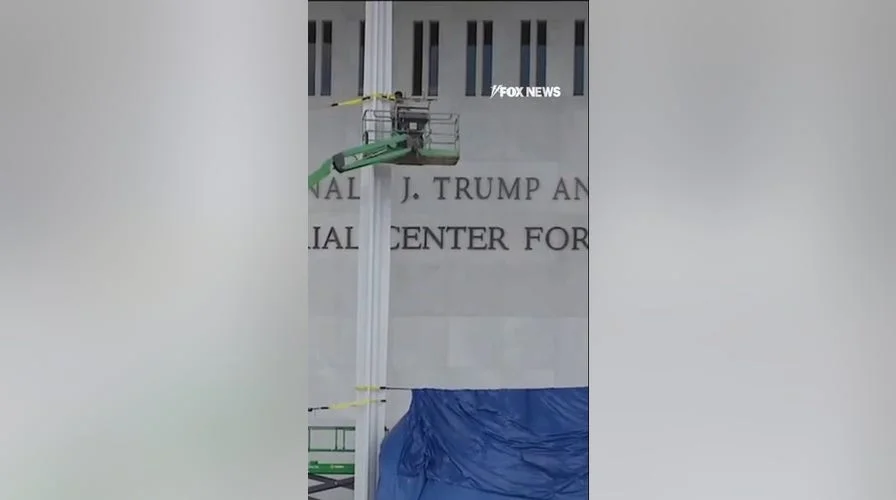
Kennedy Center Orders Immediate Removal of Trump’s Name from Documents and Signage
The John F. Kennedy Center for the Performing Arts has directed its staff to “immediately” remove President Donald Trump’s name from all official documents, email signatures, and digital platforms, following a federal court ruling that declared the 2024 renaming unlawful. The internal memo, issued by the center’s general counsel on Thursday, June 4, 2026, orders that all references to “The Donald J. Trump and the John F. Kennedy Memorial Center for the Performing Arts” be replaced with the original name. Physical signage on the landmark building must be updated by June 12, coinciding with the court’s 14-day deadline.
The directive marks a sharp reversal from the board’s December 2024 decision to add Trump’s name to the facade of the white marble venue, a move that immediately sparked protests and a lawsuit from Democratic Representative Joyce Beatty of Ohio, a Kennedy Center board member. On May 29, U.S. District Judge Christopher Cooper ruled that the renaming was unlawful because it required an act of Congress. He ordered the Trump administration to remove all physical signage bearing the president’s name and to scrub any references to a “Trump Kennedy Center” from official materials.
Spokeswoman Roma Daravi said in a statement, “We are complying with the court’s order while evaluating all legal options to preserve this revitalization and recognize President Trump’s leadership.” However, Trump himself reacted angrily to the ruling, threatening to “completely transfer” the center’s operations to Congress and walking away from his role as chairman of the board. The internal memo took a far less confrontational tone, focusing strictly on compliance with the judicial mandate.
On Friday, June 5, a stream of tourists and locals gathered at the Kennedy Center to take one last look at the Trump signage before its scheduled removal. WTOP News reported visitors posing for photos and filming the lettering. Barbara, a Colorado elementary school teacher visiting with her husband Scott, said she supports the president and wanted to capture the moment: “We very much support President Trump, and we like seeing his name out there for the world to see.” Others, like Bill and Cheri Collins of Georgia, expressed the opposite sentiment: “We came by to watch Donald J. Trump get taken off the Kennedy Center,” Bill said. “We were going to bring a bottle of Champagne just to watch.”
The Legal and Political Battle Behind the Name Change
The renaming controversy dates back to December 2024, when Trump, who had appointed himself a trustee and replaced several board members with supporters, pushed through a vote to add his name to the institution. Within hours, the facade letters read: “The Donald J. Trump and the John F. Kennedy Memorial Center for the Performing Arts.” The move was part of a broader effort by Trump to reshape Washington’s monumental core, including plans for a 250-foot arch near the Lincoln Memorial, a 90,000-square-foot ballroom on the site of the demolished East Wing of the White House, and a promenade to the Lincoln Memorial.
Representative Joyce Beatty filed a lawsuit arguing that renaming a federally chartered memorial required an act of Congress, not a board vote. Judge Cooper agreed, ruling on May 29 that the board exceeded its authority. The decision also temporarily blocked Trump’s plan to close the building for renovations, which had drawn criticism from arts patrons and season ticket holders.
The Kennedy Center opened in 1971 as a living memorial to President John F. Kennedy, who was assassinated in 1963. The center’s board voted in December 2024 to include Trump, a move that many saw as a political power play. Trump’s renovation plans, which included repainting the Reflecting Pool “American flag blue,” were paused by the court order.
Local Reactions and Season Ticket Holders
For local residents, the name removal has been a deeply personal issue. Donna Merz, an Adams Morgan resident, told WTOP she had refused to set foot inside the Kennedy Center since Trump’s name was added to the building. “The minute everything is official, I’ll be back with my season tickets, and coming on at least a monthly basis,” she said. Her sentiment echoed that of many Washingtonians who viewed the renaming as a politicization of a cultural institution.
Tourists visiting the nation’s capital were divided. Some, like the Collins couple, planned to return daily until the name came down. Others, like Barbara and Scott, hoped to preserve a memento of what they saw as a positive contribution. “He’s done a lot to clean up the area and the country, so I really, really appreciate a lot of his efforts,” Scott said.
The scene at the center reflected a broader national debate over the place of Trump’s name in public spaces. Similar disputes have played out across the country, from school names to courthouse dedications, with supporters and opponents clashing over the legacy of the 45th and 47th president.
Broader Implications for Washington’s Monumental Core
The Kennedy Center dispute is part of a wider transformation of Washington’s monumental landscape under Trump’s direction. In addition to the 250-foot arch and the ballroom, Trump announced plans for a new promenade to the Lincoln Memorial. These projects have faced legal challenges and public opposition, with critics arguing that they prioritize presidential vanity over historical preservation.
The court ruling in the Kennedy Center case sets a precedent that could affect similar renaming efforts. Legal experts note that the decision reinforces the principle that changes to federally chartered memorials require congressional approval, a safeguard against unilateral executive action.
Trump’s reaction—threatening to offload the center’s operations to Congress—has raised questions about the future management of the venue. Congress would need to pass legislation to assume control, a process that could take months or years. In the meantime, the center’s board, still stacked with Trump allies, must decide whether to appeal the decision or accept the court’s ruling.
What This Changes: The Future of the Kennedy Center
The removal of Trump’s name effectively restores the Kennedy Center to its original designation, but the institution faces an uncertain future. The board’s Trump-aligned leaders remain legally obligated to comply with the court order, but they have not ruled out an appeal. The June 12 deadline for physical removal is approaching rapidly, and contractors are expected to begin work in the coming days.
For arts patrons, the return to the original name is a relief. Many had boycotted performances and canceled season tickets after the renaming. The center’s programming, including major productions like “Les Misérables,” continued during the controversy, but attendance suffered.
The broader political landscape remains volatile. Trump’s base views the court ruling as an attack on his legacy, while opponents see it as a victory for the rule of law. The judge blocks Trump policy freezing green cards and work permits for travel ban countries earlier this year, part of a pattern of judicial checks on executive action.
Public Polarization and the Role of Cultural Institutions
The Kennedy Center controversy underscores the increasing polarization of cultural institutions. Once seen as apolitical spaces, venues like the Kennedy Center have become battlegrounds for political symbolism. The Trump name removal is likely to fuel further debate over the role of presidential branding in public life.
Similar disputes have arisen at other landmarks, including proposals to rename schools and public buildings after Trump. The Kennedy Center case may set a precedent for how such challenges are resolved in court.
As the June 12 deadline nears, the center will likely see a final surge of visitors eager to capture a piece of history—whether as a keepsake of support or a symbol of resistance. For now, the white marble facade still bears both names, but the clock is ticking on the removal crews’ arrival.
Comments