
Forecasters Warn 2026 Super El Niño Could Shatter Records
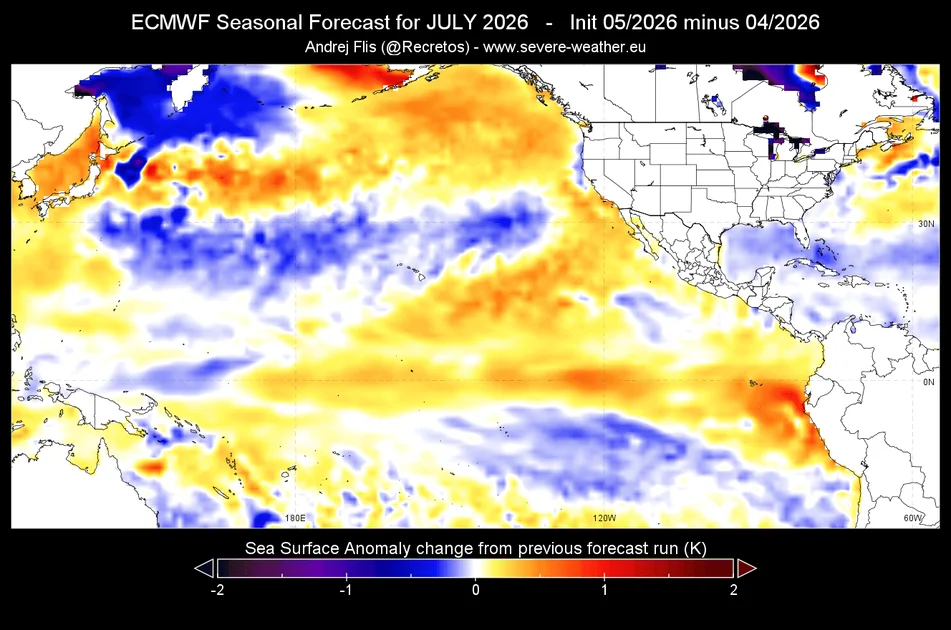
Just weeks after the National Oceanic and Atmospheric Administration (NOAA) confirmed El Niño conditions had emerged in the tropical Pacific, a growing chorus of global climatologists is warning that this event could develop into the strongest on record. The Bureau of Meteorology (BoM) in Australia reported that sea surface temperatures in the key Niño 3.4 region—a primary indicator of El Niño strength—could peak between +2.2°C and above +3.0°C this year, with the agency’s own model projecting a staggering +3.3°C anomaly.
For context, the highest reliable monthly average previously recorded was +2.6°C in January 1983, during the powerful 1982–83 El Niño. Dr. Zhi-Weng Chua, a senior climatologist at the BoM, described the forecasts as “mind blowing” and “astounding,” noting that there is “a realistic chance that the peak anomaly of this event will rank in the top events, with a chance it could rank as the highest.”
The phenomenon, which scientists are already calling a potential “super El Niño,” is being driven by decades of accumulated ocean heat. As Dr. Chua put it, “It’s perhaps not a surprise, given climate change and how oceans have been gathering heat in the last few decades.”
Wildfire Relief Hinges on El Niño’s Delayed Arrival
While the intensifying El Niño raises alarms for global temperatures and extreme weather, it is also offering a glimmer of hope to regions ravaged by wildfires. As of late July 2026, devastating fires continue to burn across Canada and the western United States, with smoke from Canadian blazes drifting as far as Detroit. NOAA research meteorologist Andrew Hoell explained that El Niño’s “helping effect” for the Southern U.S. typically arrives in the wet fall, winter, and spring seasons—which then lead to a milder wildfire season the following summer.
“Unfortunately, the ‘helping effect’ of El Niño in much of the United States won’t be felt until sometime next year,” Hoell said, adding that because the most recent La Niña—El Niño’s cooler, drier counterpart—only recently ended, “we’re still in the crosshairs.”
For now, the western U.S. remains vulnerable. A hot winter and meager snowpack, exacerbated by La Niña’s influence through early 2026, have left vegetation tinder-dry and landscapes primed for ignition. The Los Angeles Times reported that while a very strong El Niño increases the probability of above-average rainfall for Southern California—which could help keep vegetation moist and lower fire potential—that relief will not arrive until next year at the earliest.
The Science Behind the Delay
NOAA’s recent study, which analyzed nearly four decades of El Niño and La Niña oscillations alongside wildfire burn area data, found that the climate pattern’s impact on wildfire risk is not immediate. Instead, it is the cumulative effect of a wetter winter and spring that reduces fuel availability for summer fires. This means that the 2026 wildfire season is already locked in by the preceding La Niña, while the promise of a wetter 2027 is contingent on how long and how strongly the current El Niño persists. Forecasters are watching closely: the BoM’s model suggests El Niño conditions could remain in place at least until the Southern Hemisphere summer of 2026–27.
Global Stakes: Hottest Year on Record by 2027?
The implications of a super El Niño extend far beyond wildfire season. Historically, strong El Niño events have coincided with record-breaking global temperatures, as the phenomenon releases massive amounts of heat from the tropical Pacific into the atmosphere. With global heating already driving ocean temperatures to unprecedented levels, the combination could push the planet into uncharted climatic territory.
Experts are increasingly concerned that 2027—rather than 2026—may become the hottest year on record, as El Niño’s peak warming effect typically lags behind its onset by several months. The Guardian reported that climate scientists are watching the developing system “with increasing alarm,” noting that a strong El Niño “could work in tandem with global heating to deliver the hottest year on record either this year or, more likely, in 2027.”
For Australia, the stakes are particularly high. The BoM has warned that most Australian capital cities have at least an 80% chance of an unusually warm and dry spring, raising the risk of drought, heatwaves, and bushfires. While the bureau stressed that El Niño’s strength does not always correlate directly with the intensity of local impacts, the historical pattern is clear: southern and eastern parts of Australia typically experience hotter and drier conditions during winter and spring under El Niño.
Floods, Droughts, and a ‘Waiting Game’
Meanwhile, other parts of the world are bracing for opposite extremes. El Niño is known to shift weather patterns globally, often bringing heavier rainfall to parts of South America, East Africa, and the southern United States—while triggering drought in Indonesia, northern South America, and southern Africa. In California, forecasters have already warned that a strong El Niño tilts the odds toward a winter of flash floods and landslides, even as it eventually reduces wildfire risk. The duality of the phenomenon was captured by NOAA’s description: “An indicator, not a crystal ball.”
Dr. Chua summed up the mood among climatologists: “We are waiting with bated breath.”
Economic and Infrastructure Risks Loom Large
The potential for a super El Niño carries significant economic consequences. In the United States, billions of dollars are at stake in agriculture, water management, and disaster preparedness. A wet winter in Southern California could replenish reservoirs and ease drought conditions, but it also raises the risk of mudslides in areas scorched by recent wildfires. The Cyclospora Outbreak 2026: Symptoms, Testing, and What to Know Now serves as a reminder that extreme weather can also trigger public health emergencies, as flooding often contaminates water supplies with parasites and bacteria.
In Australia, the agricultural sector is bracing for potential crop failures and livestock losses due to heat and dryness. The energy sector may face increased demand for cooling, while utilities must prepare for potential grid strain. Globally, commodities markets are already reacting: precious metals like silver have seen price surges amid broader geopolitical uncertainty. For context, Silver Price Today 2026: Rallies Past $59 Amid Geopolitical Tensions reflects how investors are hedging against climate-related volatility.
Infrastructure Under Pressure
Transportation infrastructure, from highways to airports, may also be tested. In the U.S., flood-prone regions could see road closures and airport delays. Event planners are taking note, too: the Perseid Meteor Shower 2026: New Moon Promises Perfect Dark Skies for Peak Viewing is expected to draw crowds to remote areas, but sudden storms could disrupt viewing conditions. Even major sporting events are not immune; the World Cup 2026 Closing Ceremony: Star-Studded Show Kicks Off Final could face weather-related challenges if El Niño prolongs its influence into the fall.
A Pattern of Extremes: What Super El Niño Means for the Future
The emergence of a potential record-breaking El Niño in 2026 is not just a single weather event—it is a signal of deeper, long-term changes. Oceans have absorbed more than 90% of the excess heat caused by greenhouse gas emissions, and that stored energy is now being released into the atmosphere through events like this. As Dr. Chua noted, “It shows just how much heat there is in the ocean.”
This El Niño is unfolding against a backdrop of accelerating climate disruption. The previous record-holder, the 2015–16 El Niño, contributed to the hottest year on record at the time—a record that has since been broken multiple times. If the 2026 event exceeds that in strength, the consequences could be far-reaching: more intense heatwaves, stronger storms, deeper droughts, and greater strain on ecosystems and human societies.
The Role of Preparedness
While El Niño is a natural climate oscillation, its impacts are amplified by human-caused global heating. That means adaptation and preparedness are more critical than ever. Communities in fire-prone areas can use the forecast to plan controlled burns and create defensible space. Water managers can adjust reservoir levels in advance of heavy rains. Public health officials can prepare for disease outbreaks linked to flooding, as highlighted by the ongoing Cyclospora Outbreak 2026.
On the positive side, the predictability of El Niño—scientists can now detect its formation months in advance—offers a window for proactive measures. As NOAA’s Hoell put it, the pattern is an indicator, not a crystal ball, but it is an increasingly reliable one.
Looking Ahead: What to Watch in 2027
If current forecasts hold, the 2026 super El Niño will likely persist into early 2027, with global temperatures expected to spike in its wake. That could make 2027 the hottest year ever recorded—surpassing even the sweltering heat of 2024 and 2025. The potential for simultaneous climate shocks, such as a severe drought in Australia while floods hit California, underscores the need for international cooperation and robust disaster response systems.
For now, climatologists will continue to monitor sea surface temperatures, atmospheric pressure patterns, and ocean currents. The next few months will be critical in determining whether this El Niño follows the trajectory of 1983 or sets a new, more extreme benchmark. As one scientist said, “We are waiting with bated breath.”
In a world already grappling with destructive wildfires, rising seas, and record heat, the 2026 super El Niño could be a defining moment—one that tests the limits of both natural systems and human resilience.
Comments