
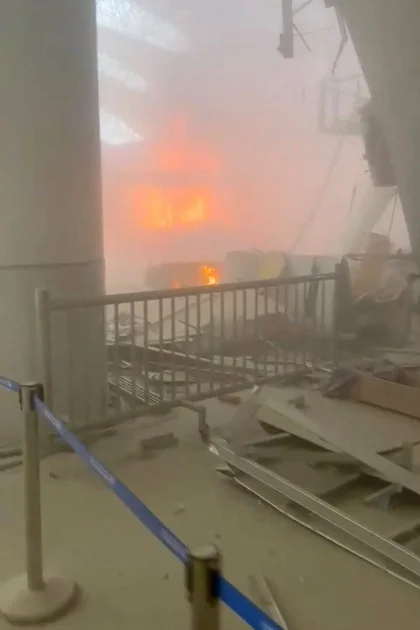
Iran Launches Coordinated Attacks on Kuwait and Bahrain
Iran launched a wave of missiles and drones at Kuwait and Bahrain on Tuesday, June 2, 2026, marking one of the broadest Iranian assaults on Gulf states since the outbreak of hostilities with the United States and Israel in late February. The attacks targeted civilian infrastructure, including Kuwait International Airport, and triggered air raid sirens in Saudi Arabia, though officials there did not immediately confirm an attack.
Kuwait’s Ministry of Foreign Affairs confirmed that one person was killed and several others injured in the strikes. The country’s Ministry of Health later reported that 63 people were injured in the drone attack at the airport, with injuries ranging from fractures and head trauma to smoke inhalation. The Bahrain Defence Force said its air defenses intercepted three missiles and several drones, preventing further casualties.
The U.S. Central Command (CENTCOM) rejected Iranian claims of successful attacks on American bases in the region, stating that a second wave of drones failed to hit U.S. targets in Kuwait. CENTCOM also confirmed that U.S. forces intercepted Iranian missiles and conducted strikes on Iran’s Qeshm Island in response.
Why These Attacks Matter: Oil, Alliances, and the Fragile Ceasefire
The strikes come at a critical juncture in the U.S.-Iran conflict, which began on February 28 when President Donald Trump announced “major combat operations” against Iran, backed by massive joint U.S.-Israeli strikes. A two-week ceasefire was announced in April after initial talks in Pakistan failed to yield a peace deal. Trump later extended the ceasefire indefinitely, maintaining a U.S. naval blockade until negotiations are concluded “one way or the other.”
Tuesday’s attacks on Kuwait and Bahrain — both of which host major U.S. military facilities, including the headquarters of the U.S. Navy’s Fifth Fleet in Bahrain — signal a dangerous escalation. The strikes appear designed to test the limits of the ceasefire and pressure Washington by targeting its closest Gulf partners. Iran had previously focused its military actions against U.S. and Israeli assets, but these attacks bring the war directly to the doorsteps of America’s Arab allies.
The geopolitical stakes are immense. The attacks also drove oil prices to a one-week high, with Brent crude rising 1.09% to $97.05 a barrel and U.S. West Texas Intermediate gaining 1.08% to $94.77. Traders are closely watching the Strait of Hormuz, a critical chokepoint for global oil shipments, which remains a potential flashpoint. Any disruption there could send prices soaring and destabilize energy markets already shaken by the conflict.
The Human Toll and Diplomatic Fallout
Beyond the immediate casualties, the attacks on civilian infrastructure — particularly Kuwait International Airport — have raised concerns about Iran’s targeting strategy. The injuries reported included severe wounds from explosions and amputations, according to Kuwait’s Ministry of Health. Diplomats in the region have warned that the attacks could derail any remaining hope for a negotiated settlement, especially after the failure of the U.S.-Iran talks in Pakistan.
Senior U.S. officials, including Secretary of State Marco Rubio, have been shuttling between Gulf capitals to reassure allies. The attacks also deepen already volatile sectarian fault lines, as Iran Strikes Bahrain Base as War Deepens Sectarian Fault Lines — a dynamic that risks drawing in other regional powers.
Broader Implications: What This Changes
Tuesday’s attacks mark a significant shift in the trajectory of the U.S.-Iran conflict. While the ceasefire had held in a limited form, Iran’s willingness to strike U.S. allies in the Gulf suggests that Tehran is either unwilling to accept the terms of the truce or is seeking to strengthen its negotiating position before any future talks.
The attacks also put the Biden-era diplomatic playbook further in the rearview mirror. The current administration’s strategy of maintaining military pressure while seeking a negotiated end to hostilities appears increasingly fragile. If Iran continues to target U.S. partners, Washington may be forced to escalate its military response — potentially endangering the ceasefire altogether.
For the Gulf states, the strikes are a stark reminder of their vulnerability despite advanced air defense systems. Bahrain’s successful interception of missiles and drones offered some reassurance, but the fact that Iran was able to inflict casualties and damage in Kuwait highlights the limits of deterrence.
Regional Stability and Energy Security
The attacks also have implications for global energy security. The Strait of Hormuz remains the most critical chokepoint, and any Iranian attempt to blockade the strait would trigger a severe oil crisis. While that has not happened yet, Tuesday’s escalation increases the risk. The rise in oil prices reflects market anxiety, and further disruptions could push prices above $100 a barrel, impacting economies worldwide.
The human cost of the conflict continues to mount. While most international attention has focused on military exchanges, the conflict has also ensnared civilians in unexpected ways. In a separate but related development, British Couple Lose Iran Spy Appeal, Hunger Strike in Evin Prison highlights how the broader tensions are affecting individuals caught in the crossfire.
In the coming days, all eyes will be on Washington and Tehran. Will the attacks provoke a U.S. military response that escalates into open war, or will both sides step back and preserve the ceasefire? The world waits, and the Gulf holds its breath.
Comments