
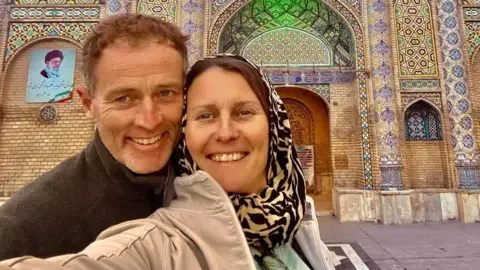
Detained British Couple Lose Appeal, Hunger Strike Intensifies in Tehran Prison
The family of British couple Craig and Lindsay Foreman confirmed on Tuesday that the pair have lost their appeal against a 10-year prison sentence in Iran, in a case that has drawn international condemnation. The Foremans, who were arrested in January 2025 while traveling through Iran on a round-the-world motorcycle trip, were convicted of espionage—charges they vehemently deny.
According to statements released by their legal team and family, the couple was not permitted to attend their own appeal hearing. Lindsay’s son, Joe Bennett, described the process as a serious human rights violation, noting that the couple had been asked to sign documents in Farsi, a language they cannot read, and that they refused to do so. The Iranian Judiciary has not commented on the ruling.
The rejection of the appeal leaves the Foremans with few remaining legal options. Their case has now been referred to Iran’s Supreme Court, but Bennett told the BBC that the family remains unclear on the timeline or the nature of the proceedings ahead. He added that the couple is effectively without legal representation.
Both Craig and Lindsay Foreman are currently on hunger strike inside Tehran’s notorious Evin Prison. Craig is believed to be in his third week without food, while Lindsay began her strike later, after a reported attempt by prison guards to dissuade her. The Mirror reported that guards allegedly faked a heartbreaking letter from her mother in an attempt to break her resolve. Lindsay is now on her 11th day of refusing food.
“They were not permitted to attend their own appeal hearing. It is a serious human rights violation, and it is one more reason why two British citizens, with no other options left, are now starving themselves in protest,” Bennett said in a statement.
The UK Foreign Office expressed disappointment at the appeal decision, reiterating that the government continues to work for the safe return of the couple. A spokesperson said: “We are disappointed by the appeal decision and will continue working to ensure that Craig and Lindsay are returned safely to the UK.”
The Stakes: A Grim Milestone for Two Innocent Travelers
The Foremans’ detention has now stretched beyond 500 days. The couple, both aged 53, were arrested in January 2025 while passing through Iran on a global motorcycle adventure. They were accused by Iranian authorities of spying, a charge the UK government has repeatedly labeled as baseless, insisting they are innocent tourists.
Their imprisonment has been widely viewed as a case of hostage diplomacy, a pattern in which Iran detains foreign nationals or dual citizens to exert political leverage. The British government has publicly stated that the couple is being used as bargaining chips. Bennett has previously criticized the UK’s response, saying the couple feel “abandoned” by the Foreign, Development and Commonwealth Office, and have become “human shields” amid regional tensions.
The conditions inside Evin Prison have been described as hellish. In early May, before their phone cards were confiscated, Lindsay Foreman gave a BBC interview detailing the horror inside the prison, including claims that prisoners were taken from their cells under the false promise of seeing family, only to be executed. The couple’s phone access was cut off as punishment for that interview, severing their last direct link to the outside world.
Bennett told the BBC that his mother and step-father have been pushed to “breaking point.” He described their hunger strike as an act of desperation, not a symbolic gesture. “My mum and Craig are now risking their lives because they feel they have run out of other options,” he said. “Their only agency is to take control of the one thing they can—their body.”
Craig Foreman, a carpenter, and Lindsay, a psychologist, have been held in solitary confinement according to unconfirmed reports, with the family unable to verify their well-being directly.
A Pattern of Leverage and Prolonged Detention
The Foremans’ case echoes previous instances of British nationals being held in Iran. Most notably, Nazanin Zaghari-Ratcliffe and Anoosheh Ashoori were detained for years before their release in 2022, which came after the UK settled a £400 million debt linked to an old tank order. British officials never confirmed a direct link between the debt settlement and the releases, but the timing has fueled perceptions that Tehran uses foreign detainees as diplomatic bargaining chips.
Human rights groups have repeatedly condemned Iran’s practice of arbitrary detention of foreign nationals. Barrister Haydee Dijkstal, part of the Foremans’ legal team in the UK, said: “Craig and Lindsay are innocent tourists who are arbitrarily detained and who have had their fundamental rights severely and consistently violated throughout their detention.”
The ongoing crisis has also drawn attention to the wider trend of states using foreign detainees to extract concessions. The Foremans’ case stands out due to the extreme lengths the couple has taken to protest their detention—a hunger strike that doctors warn can lead to permanent organ damage and death.
Broader Implications: Hostage Diplomacy and the Limits of Legal Systems
The loss of the Foremans’ appeal, combined with their hunger strike, underscores the precarious nature of justice for foreign nationals detained in Iran. The fact that they were not allowed to attend their own hearing, nor given a reason for the rejection, signals a complete breakdown of due process. Their case has now reached the Supreme Court of Iran, but with no clear timeline and no guarantee of transparency, hope for a legal remedy appears slim.
International law and diplomatic pressure have rarely proven sufficient to secure quick releases in such cases. The Foremans’ plight echoes the broader pattern of states using foreign detainees as instruments of geopolitical leverage. Iran has denied these accusations, but multiple cases—including Brittney Griner’s detention in Russia and the imprisonment of U.S. citizens in China—have highlighted a growing global trend of “hostage diplomacy,” where legal systems are weaponized for political ends.
The Foremans’ hunger strike may force a recalibration of diplomatic efforts. Social Security Staffing Cuts Leave Disabled Americans Waiting in Crisis shows how institutional pressures can amplify personal suffering, and similarly, the Foremans’ situation may serve as a critical test of whether the UK government can accelerate negotiations to prevent tragedy.
Bennett has expressed uncertainty over the nature of ongoing talks between London and Tehran. “There may be a solution that they are aware of that they aren’t talking about,” he told the BBC. “We can’t give them any positive updates. That’s the hardest thing.”
The Human Toll
The physical toll of the hunger strike is becoming increasingly dangerous. Medical experts consulted by the BBC and The Mirror have warned that after three weeks without food, the body enters a phase of irreversible damage, including organ failure. Craig Foreman is believed to have entered his fourth week, while Lindsay is behind him but rapidly approaching the same risk threshold.
The emotional burden on the family is immense. Bennett, speaking to multiple news outlets, said he does not know if his mother and step-father are still alive at any given moment. “It’s really tough, I don’t know where to turn now. I’m massively worried for them. But it’s hard because I can’t talk to them,” he said.
Conclusion: A Crisis of Justice and Survival
The Foremans’ case has become a tragic emblem of the intersection between arbitrary detention, diplomatic deadlock, and human survival. The rejection of their appeal closes a legal avenue but opens a more desperate one—the hunger strike, which has now become their only form of protest and leverage.
The international community has largely remained on the sidelines, with the UK government reiterating its commitment to safe return but facing criticism for lack of tangible progress. The Foremans’ family is demanding urgency, while Iran remains opaque.
As the hunger strike enters its most dangerous phase, the world watches a couple risk their lives in a fight for freedom. Whether their sacrifice will move the needle in negotiations remains the unanswered question.
The family has called for immediate diplomatic intervention, urging the UK government to treat the case with the same urgency as other high-profile hostage situations. For now, the Foremans remain alone in Evin Prison, with their bodies as the last bargaining chip.
Comments