
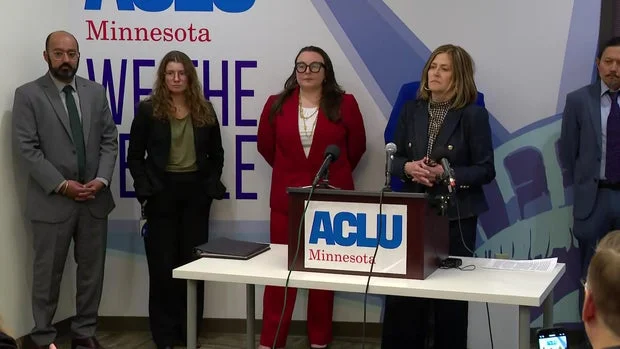
ACLU Files Legal Challenge in Virginia as ICE Misconduct Report Exposes Widespread Abuses
New lawsuit targets Virginia Attorney General Elizabeth Jones over law that penalizes bystanders filming police
The American Civil Liberties Union (ACLU) has entered a major First Amendment battle in Virginia, filing an amicus brief in the case NetChoice v. Jones on July 17, 2026. The lawsuit challenges a state law championed by Attorney General Elizabeth Jones that criminalizes the recording of law enforcement activities, including those carried out by federal immigration agents. The ACLU’s involvement comes just days after the organization released a devastating report documenting over 400 incidents of civil rights abuses by Immigration and Customs Enforcement (ICE) agents during the first year of President Trump’s second term.
The Virginia law, which has been in effect since early 2026, makes it a crime to record police officers without their explicit consent in certain public settings. Critics argue it is a direct assault on the First Amendment and a tool to shield federal agents from accountability. The ACLU, along with the ACLU of Virginia and other digital rights groups, argues in their brief that the law violates constitutional protections for free speech and press, and that it effectively enables the kind of misconduct recently documented by the ACLU’s own research.
The case, currently before the U.S. Court of Appeals for the Fourth Circuit, centers on whether states can criminalize the recording of police in public. The outcome could have sweeping implications for how ICE and deputized local law enforcement are monitored, especially given the Trump administration’s record-breaking deportation campaign. The ACLU’s amicus brief, filed on May 22, 2026, warns that the law could chill vital oversight just when it is most needed.
A Chicago woman’s case highlights the stakes behind the lawsuit
The ACLU’s concerns are not theoretical. On October 10, 2025, Chicago resident Jo-Elle Munchak filmed federal immigration agents detaining a landscaper in the Edgewater neighborhood. After recording the operation, she was boxed in by two federal SUVs, with an agent pointing a long gun at her. Munchak later filed a federal lawsuit seeking to force the Department of Homeland Security (DHS) to disclose the directives behind such confrontations. Her case, reported by ABC7 Chicago on July 17, 2026, underscores a nationwide pattern: federal agents targeting those who document their actions.
Attorneys for Munchak allege that DHS agents have traced the addresses of people filming ICE enforcement and shown up at their homes in acts of intimidation. “A government that targets people who are filming has something to hide,” said Jonathan Manes, senior counsel at the MacArthur Justice Center, who is involved in similar litigation. The Virginia law, if upheld, could give legal cover to such tactics, making it harder for citizens to serve as watchdogs.
The ACLU’s Shocking New Report: Over 1,200 Incidents and a Pattern of Abuse
Widespread civil rights violations across eight states
The ACLU’s report, “Agents of Chaos and Cruelty,” released July 16, 2026, provides the most comprehensive documentation yet of ICE misconduct during President Trump’s second term. Researchers reviewed more than 1,200 immigration enforcement incidents across eight states—Arizona, California, Colorado, Florida, Illinois, Louisiana, Maryland, and New Mexico—and found that over 400 involved misconduct by immigration agents. These included excessive force, racial profiling, and the targeting of U.S. citizens, children, and vulnerable individuals.
The report notes that the incidents examined represent only a small fraction of total enforcement activity in 2025, yet the pattern is unmistakable. “Far beyond Minneapolis, the Trump administration has deployed a national deportation policing force that has committed civil rights violations at a scale and severity without parallel in modern American history—turning schools, bus stops and grocery stores into sites of violence and abuse,” said Naureen Shah, director of policy and government affairs and the report’s author.
High-profile killings and a nationwide surge
The report comes just days after ICE agents shot and killed two men in Texas and Maine, incidents that the ACLU says underscore an “out-of-control” enforcement apparatus. In Houston, ICE shot a man who had lived in the country for 35 years, a father and business owner; in Maine, another man was killed. Senior White House official Tom Homan has admitted that at least half of those currently arrested by ICE have no criminal record. The ACLU’s research identified numerous victims of misconduct, including 782 protestors, journalists, elected officials, clergy, and community observers; 214 children (32 of whom were U.S. citizens); and 155 U.S. citizens.
The Trump administration is ramping up immigration arrests to record-breaking levels, with street arrests at a scale never before attempted. This has turned American streets into “deportation zones,” according to the ACLU, endangering the rights and safety of all citizens.
The Legal Battle Over Recording Police: A First Amendment Flashpoint
Virginia’s law and the ACLU’s amicus brief
The Virginia law at the heart of NetChoice v. Jones is one of the most aggressive in the nation. It imposes criminal penalties on individuals who record law enforcement activities without permission, even in public spaces. The ACLU’s amicus brief argues that this violates decades of First Amendment precedent, which has consistently protected the right to record police officers performing their duties. The brief, joined by the Center for Democracy & Technology, the Electronic Frontier Foundation, and other groups, warns that the law could be used to prosecute journalists, activists, and ordinary citizens who document ICE operations.
“The right to record police is essential to holding them accountable,” the brief states. “Without it, abuses go unseen.” The case could reach the Supreme Court, as similar laws in other states are being challenged.
How Munchak’s lawsuit ties into the broader pattern
Jo-Elle Munchak’s experience is a textbook example of why such recording rights matter. After filming a routine arrest, she was confronted by armed agents, had her identification photographed, and was left with no explanation. Her lawsuit seeks to uncover the directives that led to that confrontation. Meanwhile, in Minneapolis, video evidence shot by bystanders last year debunked the government’s claim that two U.S. citizens killed by ICE agents were “domestic terrorists.” That incident—the deaths of Alex Pretti and Renee Good—highlighted how crucial citizen documentation has become in a climate where the government’s word is no longer trusted.
The ACLU’s report notes that the Minneapolis killings were not isolated: they were part of a pattern of excessive force and intimidation. The Virginia law, if upheld, would make future such documentation a crime, effectively eliminating a key check on police power.
Broader Implications: A Crisis of Accountability and Public Trust
The ACLU’s midterm election push
The ACLU’s report is the first in a series to be published ahead of the 2026 midterm elections, aiming to urge lawmakers to support immigration reform. The organization argues that the current enforcement system is fundamentally broken, with “national deportation policing force” operating with impunity. The report calls for congressional action to limit ICE’s power, end deputization of local police, and require transparency around enforcement operations.
The Trump administration’s approach—simultaneous surges in communities across the country—represents a dramatic escalation from the first term, when operations were more localized. The ACLU warns that the scale of arrests has overwhelmed oversight mechanisms, leaving citizens unprotected.
The Virginia case as a bellwether
NetChoice v. Jones is not just about Virginia. It is part of a national struggle over who gets to watch the watchers. If the law is struck down, it would reinforce the First Amendment’s protection of recording in public, strengthening the hand of activists and journalists. If it is upheld, other states may follow suit, creating a patchwork of laws that could make it nearly impossible to document federal enforcement.
The case also highlights the tension between state and federal authority. Virginia’s law applies to all law enforcement, including federal agents, which raises questions about preemption and interstate jurisdiction. The ACLU’s brief argues that the law interferes with the public’s right to gather information about government actions—a right the Supreme Court has recognized as fundamental.
What this means for the average American
For ordinary citizens, the confluence of these events means that merely filming a police encounter could now be a crime or lead to personal harassment. The ACLU’s research shows that ICE agents have already traced addresses of people who recorded them, showing up at their homes. The Virginia law would make the initial recording itself illegal, removing the legal basis for any subsequent lawsuit.
As the 2026 midterms approach, the debate over immigration enforcement and First Amendment rights will only intensify. The ACLU hopes that its report and legal actions will galvanize voters to demand accountability—before the next ordinary citizen filming a morning arrest becomes the next headline.
For more on how similar legal battles are reshaping Silicon Valley, see our coverage of OpenAI Faces Apple Lawsuit as Silicon Valley Unspoken Rule Collapses. And for a look at how the Justice Department’s focus has shifted, read about Kent Police Hunt Most Wanted Fugitive as Mercy for Crash Driver Sparks Debate.
Comments