
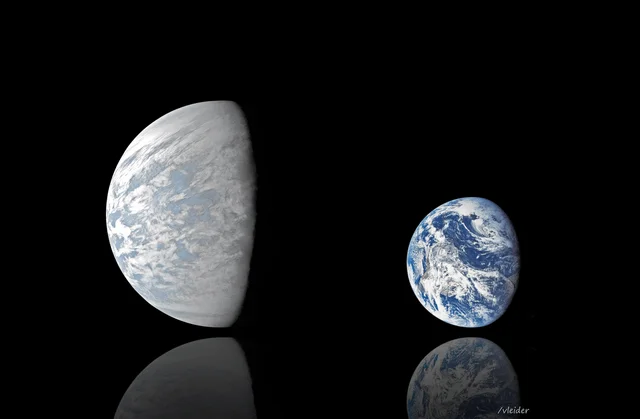
Historic Discovery: First Atmosphere Found on Rocky Planet in Habitable Zone
In a breakthrough that reshapes the search for life beyond Earth, astronomers have confirmed the existence of an atmosphere around LHS 1140b -- a rocky exoplanet orbiting in the habitable zone of its star, just 49 light-years away. This marks the first time scientists have definitively detected an atmosphere on a terrestrial world in the region where liquid water, and therefore life, could potentially exist.
Published in the journal Science on July 16, 2026, the study led by Dr. Collin Cherubim, formerly of Harvard University, used spectral data from the Magellan Clay telescope at Las Campanas Observatory in Chile to identify helium escaping from the planet's upper atmosphere. The detection was made possible by the instrument WINERED (Warm Infrared Echelle Spectrograph to Realize Extreme Dispersion), which observed the planet in 2024.
"This is the first observationally confirmed atmosphere on a rocky planet in the habitable zone outside of our solar system," said Dr. Cherubim. "It also marks the first direct identification of an atmospheric species for any rocky exoplanet, whether in a habitable zone or not."
LHS 1140b, first discovered in 2017, has a mass 5.6 times that of Earth and a radius 1.73 times larger. It orbits a small, quiet red dwarf star in the constellation Cetus once every 24.7 days. The star, LHS 1140, is about 5 billion years old and relatively inactive, with few flares that could strip away a young planet's atmosphere.
A Variable but Promising Atmosphere
The discovery did not come without surprises. The team observed clear signs of helium escaping from the planet's atmosphere in 2024, likely driven by heating from stellar X-rays and extreme ultraviolet radiation. However, follow-up observations in 2025 showed no escaping helium, indicating that the atmospheric loss is variable.
"It is a rare privilege to witness the atmosphere of an extrasolar planet change on such short, human timescales!" said Dr. Shreyas Vissapragada, an astronomer at Carnegie Science Observatories and co-author of the study.
Combining these observations with evolutionary models, the researchers concluded that LHS 1140b likely has a highly layered atmosphere. The upper layer is dominated by helium and poor in hydrogen, while heavier molecules such as water vapor are trapped closer to the surface. This structure suggests the planet could retain a stable, life-friendly environment over billions of years.
Crucially, the team found no evidence of an atmosphere on LHS 1140c, the planet's sibling. This contrast places the two worlds on opposite sides of what astronomers call the "cosmic shoreline" -- a theoretical boundary between planets that hold onto their atmospheres and those that lose them to space. LHS 1140b, it appears, sits on the life-friendly side.
Why This Discovery Matters
The search for exoplanets has advanced rapidly since the first discovery in 1992. Today, over 6,200 exoplanets are known, ranging from scorching gas giants to frozen super-Earths. But for astrobiologists, the holy grail has always been a rocky planet in the habitable zone with a confirmed atmosphere.
"Twenty years ago we wondered whether other terrestrial-type planets even existed," said Professor Robin Wordsworth of Harvard University, a co-author of the study. "Then we learned they're common, and found some in the habitable zone. The next question was whether any of them had managed to keep an atmosphere. Now we know at least one has."
Until now, atmospheres had been detected only around gas giants or sub-Neptunes, or around rocky planets outside the habitable zone. LHS 1140b bridges that gap, offering the first concrete evidence that terrestrial worlds in the Goldilocks zone can hold on to their gaseous envelopes.
Key Characteristics of LHS 1140b
The planet receives about 42% of the stellar irradiation that Earth gets from the Sun, giving it an equilibrium temperature of 226 K (minus 47 degrees Celsius). While cold by Earth standards, researchers note that a thick atmosphere with greenhouse gases could warm the surface above freezing, allowing liquid water to exist.
Dr. Cherubim described LHS 1140b as having all the basic ingredients for habitability: a rocky composition, a temperature that supports liquid water, and an atmosphere to prevent water from escaping and shield the surface from harmful radiation. The star's low flaring activity further boosts the planet's prospects.
However, the planet is not an Earth twin. It is tidally locked, meaning one side always faces its star, creating a permanent day side and night side. It may also hold far more water than Earth, and its atmosphere is likely very different in composition. These differences make it a unique laboratory for studying alternative habitable environments.
Broader Implications for Exoplanet Science
This discovery comes at a time when the field of exoplanet research is transitioning from detection to characterization. The James Webb Space Telescope (JWST), which has already captured direct images of a Saturn-sized exoplanet, continues to provide unprecedented data on distant worlds. Ground-based instruments like WINERED are complementing space-based observations by focusing on specific atmospheric signatures, such as escaping helium.
The variable nature of the atmospheric escape on LHS 1140b offers a rare window into planetary evolution. Scientists can now watch in real time how a rocky world interacts with its star, shedding gas and potentially changing its climate over years rather than eons.
"This really puts LHS 1140b at the forefront as the best, most promising, exciting laboratory for studying astrobiology and habitability outside of our solar system," said Dr. Cherubim.
The Search for Life Continues
While the discovery of an atmosphere is a critical milestone, it does not prove life exists on LHS 1140b. Future observations will aim to detect biosignature gases -- such as oxygen, methane, or ozone -- that could indicate biological activity. The detection of helium in the upper atmosphere is a key step, but it does not directly reveal what lies closer to the surface.
Astronomers plan to use both ground-based telescopes and space observatories like JWST to probe deeper into the planet's atmospheric layers. Finding water vapor, carbon dioxide, or other molecules would strengthen the case for habitability.
In parallel, the study of LHS 1140c, which appears to lack an atmosphere, helps scientists understand what factors determine whether a planet retains its gaseous envelope. This comparative planetology is essential for predicting which of the thousands of known exoplanets might be worth closer study.
What Changes After This Discovery
The confirmation of an atmosphere on LHS 1140b shifts the conversation in astrobiology from theoretical possibility to empirical fact. It provides a concrete target for future missions and instruments, and it validates the methods used to study distant worlds.
For the public, the discovery brings the search for extraterrestrial life closer to home. LHS 1140b is relatively nearby in cosmic terms -- just 49 light-years away -- and its star is bright enough for detailed spectroscopic studies. This means follow-up observations are feasible within the current generation of telescopes.
The planet's location in the habitable zone, combined with its atmosphere, makes it a prime candidate for the first direct detection of a habitable environment beyond Earth. It also offers a testing ground for theories about planetary evolution, atmospheric escape, and the conditions necessary for life.
A New Era of Exploration
As astronomers continue to refine their techniques, more discoveries are expected. The James Webb Space Telescope is already revolutionizing the study of exoplanet atmospheres, and future observatories like the Extremely Large Telescope (ELT) will provide even sharper views.
The detection of helium in LHS 1140b's atmosphere was only possible because the planet is losing gas -- a process that makes its upper atmosphere detectable from Earth. As instruments improve, scientists hope to find other rocky planets with more stable, Earth-like atmospheres.
"We are standing at the threshold of a new era in exoplanet science," said Dr. Vissapragada. "Every planet we study teaches us more about the diversity of worlds out there and the potential for life."
The discovery also highlights the importance of sustained investment in both ground-based and space-based astronomy. Without the Magellan Clay telescope and its specialized instruments, the detection might have remained out of reach.
Looking Ahead: The Next Steps
Researchers are already planning a comprehensive observational campaign for LHS 1140b. Upcoming studies will focus on detecting water vapor, carbon dioxide, and other molecules in the lower atmosphere. These measurements will help determine the planet's surface conditions and whether liquid water could exist.
In a related development, scientists are also examining other nearby red dwarf systems for signs of atmospheres on rocky planets. The success with LHS 1140b suggests that similar detections may soon follow for worlds like TRAPPIST-1e or Proxima Centauri b.
"An atmosphere is essential for a planet to support life as we know it," concluded Dr. Cherubim. "Now we know that at least one rocky world in the habitable zone has managed to hold on to that essential ingredient."
Comments