
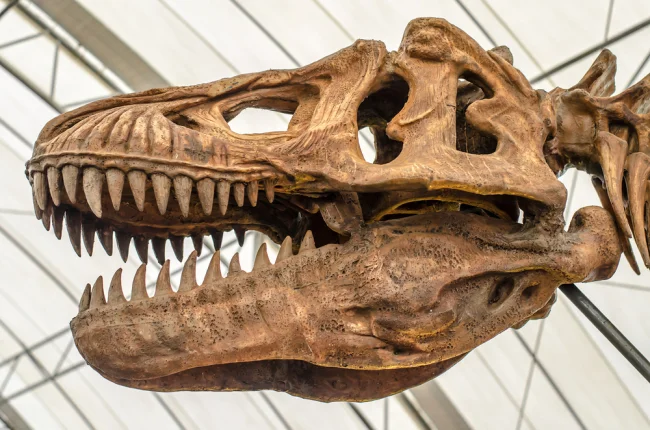
T. rex ‘Gus’ Goes Under the Hammer: A $30 Million Spectacle with Scientific Stakes
On Tuesday, July 14, 2026, a spectacular 67-million-year-old Tyrannosaurus rex skeleton nicknamed “Gus” will go under the gavel at Sotheby’s annual natural history auction in New York. Standing 3.8 meters (12.5 feet) tall and mounted in a predatory pose, Gus is one of the largest and most complete T. rex specimens ever discovered. With a pre-auction estimate of $20 million to $30 million, the fossil is poised to challenge the current record for a dinosaur sold at auction—the stegosaurus Apex, which fetched $44.6 million in 2024.
Discovered in 2021 on a ranch in Harding County, South Dakota, by the commercial excavation outfit Theropoda Expeditions, Gus was found by field prospector Cole Jacobs, who spotted a metatarsal bone poking out of the ground on the very first day of the search. The excavation took three years and was conducted with permission from the landowner, Gary “Gus” Licking, who passed away before the work was completed. The skeleton’s cheery name honors him.
Key facts at a glance
- Specimen: Tyrannosaurus rex, approximately 67 million years old.
- Size: 3.8 meters tall, mounted in a predatory pose.
- Estimate: $20 million to $30 million (could exceed $44.6 million record).
- Seller: Theropoda Expeditions, a commercial fossil hunting company.
- Location: Sotheby’s, New York, July 14, 2026.
- Dilemma: Scientists warn that private sales remove irreplaceable fossils from public research.
The auction has drawn sharp criticism from palaeontologists, who argue that the growing trend of selling dinosaur fossils to wealthy private collectors is a “big headache” for science. As one University of Birmingham expert put it, a fossil not in a recognized museum collection “cannot be studied and is therefore lost to research.”
Why the Gus Auction Is Different: From Museum Trophies to Billionaire Trophies
The sale of Gus is not an isolated event but part of a broader, accelerating shift in the fossil market. In 1997, Sotheby’s hosted its first dinosaur auction—a niche event where the winning bid for Sue the T. rex was $8.36 million, paid by the Field Museum in Chicago. Back then, the primary buyers were institutions. Today, that landscape has flipped: the super-rich now compete with—and increasingly outbid—museums for the most spectacular specimens.
According to Cassandra Hatton, global head of natural history at Sotheby’s, the fossil hunting world is a high-risk, high-reward pursuit. “People die on excavations,” she said, noting that for many commercial hunters, a T. rex is the ultimate prize. The legal framework in the United States allows landowners to sell fossils found on their property, which has fueled a booming industry of commercial digs. Countries like Brazil and others have much stricter laws, but in America, the fossil trade is largely unregulated.
The stakes for science
- Loss of research data: Fossils that vanish into private hands are inaccessible to scientists, blocking studies on anatomy, evolution, and behavior.
- Rising costs: Museums, already cash-strapped, can rarely compete with billionaires. The Apex stegosaurus sale for $44.6 million in 2024 set a daunting precedent.
- Legal gray areas: While the Gus sale appears legal, experts like Prof. Stephen Brusatte of the University of Edinburgh stress that legality doesn’t equal ethical suitability.
The auction also raises questions about the role of commerce in paleontology. Some argue that commercial diggers are the ones finding fossils that would otherwise remain buried and unknown—saving them from a “second extinction.” Others counter that the profit motive encourages secrecy, undermines scientific collaboration, and prioritizes marketability over scholarly value.
The Broader Implications: A Fossil Trade That’s Booming—and Dividing Experts
The Gus auction is the latest flashpoint in a long-running debate: should scientifically important fossils be treated as commodities or cultural heritage? The answer, for now, is both—and that tension is only growing.
Since the record-breaking sale of Apex in 2024, the market for dinosaur fossils has exploded. Prices that were once unimaginable—$30 million for a T. rex, $44 million for a stegosaurus—are becoming normalized. Auction houses now market these ancient remains as luxury goods, complete with glossy catalogs and private previews for potential buyers.
The investor angle
Wealthy collectors increasingly view rare fossils as alternative assets—a hedge against inflation or a trophy for private estates. Some purchase them for display in corporate headquarters or private museums, while others simply lock them away. The problem, scientists say, is that once a fossil enters a private collection, its scientific value is effectively zero.
Even when collectors do lend specimens to public institutions, those arrangements are temporary and subject to whims. The only guarantee for long-term research is public ownership in a museum with open access policies.
Counterarguments from the trade
Defenders of private fossil sales point out that commercial operations finance expensive excavations that universities cannot afford. Without the lure of profit, many fossils would never be discovered. “Fossil hunters should be rewarded for their discovery of dinosaurs lost to science,” one Sotheby’s representative argued. In the case of Gus, the landowner’s family and the excavation team will share the proceeds—a windfall that could fund future digs.
There is also the question of curation. Private collectors sometimes steward specimens well, funding preparation and display that cash-strapped museums cannot. However, critics counter that no private collection can replicate the educational and scientific value of an institutional one.
A Precarious Precedent: What Gus’s Sale Means for the Future of Paleontology
The sale of Gus will set a new benchmark for T. rex fossils—and potentially widen the gap between the world’s richest individuals and the scientific community. If Gus sells for more than $30 million, it will surpass Sue’s adjusted modern price by a wide margin, reinforcing the idea that the “king of the dinosaurs” is now a luxury asset.
The Chinese and Middle Eastern factor
In recent years, wealthy buyers from China and the Middle East have emerged as dominant forces in the fossil auction market. Some purchase fossils for private museums in their home countries, where ownership laws are lax. This has sparked concern among Western scientists that rare fossils are leaving public reach forever.
Possible policy responses
- Strengthening export controls on scientifically significant fossils.
- Creating tax incentives for private collectors to donate or loan specimens to institutions.
- Increasing public funding for museum acquisitions, so they can compete at auction.
None of these solutions are easy, particularly in the US where landowner rights are constitutionally protected. However, some states have begun to tighten regulations on fossil exports, and the debate is gaining traction in scientific journals and parliamentary committees.
A moment of decision
“As a scientist it still concerns me,” said Brusatte, referring to the legality of the auction. “But it also presents an opportunity for public dialogue.” The question now is whether the story of Gus will end in a billionaire’s foyer or—through a last-minute intervention by a wealthy donor or institution—in a museum where future generations can study it.
For now, all eyes are on Sotheby’s New York. The hammer will fall, and with it, the fate of Gus—and perhaps the direction of paleontology for years to come—will be decided.
This article is part of our ongoing coverage of the intersection of science, commerce, and the fossil trade. For earlier reporting on the commercial fossil boom, read T. rex Fossil ‘Gus’ Heads to Auction, Sparking Debate Over Science vs. Commerce.
Comments