
Meteorite That Hit New Jersey Home Reveals Salty Secrets from an Alien World
Nearly two years after a meteorite crashed through the roof of a home in Hillsborough, New Jersey, scientists have published groundbreaking findings about the rock — and what they discovered has been described as nothing less than “alien world chemistry.”
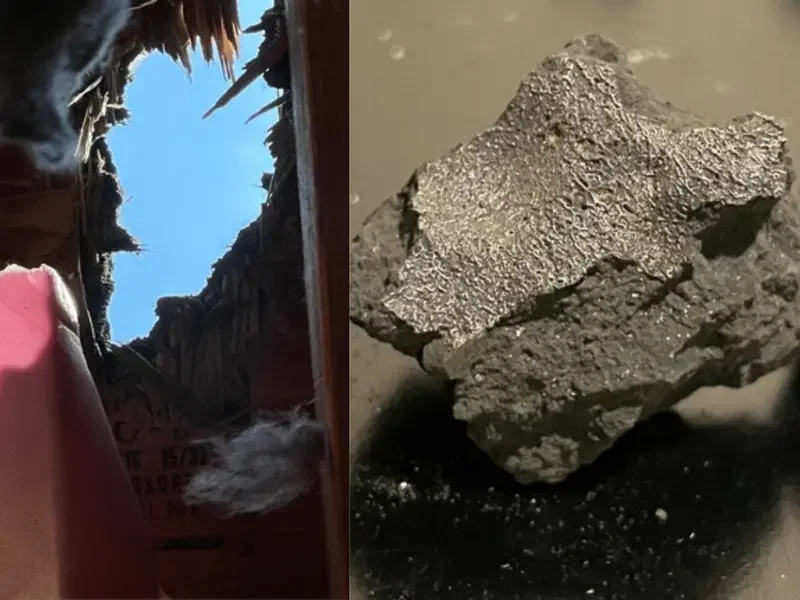
The meteorite, which struck the house in July 2024, has been identified as a rare CM1/2 carbonaceous chondrite, a primitive space rock that predates the formation of most planets in our solar system. According to a study published Wednesday in the journal Science Advances, the meteorite contains concentrated salty fluids, prebiotic organic molecules, and extraterrestrial amino acids — some of the fundamental building blocks of life.
“I was at home at the time, heard a loud crash and found a hole in the ceiling of the master bedroom,” the homeowner recalled. “I smelled a strong sulphur-like odor and saw many black fragments along with debris and black dust that covered my bed, carpet and surrounding areas.”
The homeowner’s presence of mind proved crucial. Using disposable gloves and aluminum foil, he collected the fragments and stored them in glass jars, then patched the roof before rain could contaminate the fragile porous stone. That quick action preserved the meteorite in a condition so pristine that researchers at the SETI Institute and NASA called it one of the most scientifically valuable meteorites ever recovered.
Weighing just over two pounds (about one kilogram), the meteorite is the only recovered fragment from a larger fireball that streaked across the daytime sky on July 16, 2024, triggering a sonic boom felt across New York City and New Jersey. Observers in five states — New York, New Jersey, Connecticut, Rhode Island and Pennsylvania — reported seeing the blazing rock. Newark Liberty International Airport’s Doppler weather radar even detected a cloud of fragments falling over Staten Island and into New Jersey.
Scientists were able to trace the meteor’s path back to its origin low in the asteroid belt, using footage from doorbell cameras and other devices. This detective work, combined with the pristine sample, allowed researchers to conduct a forensic analysis that revealed something never before seen on a carbonaceous chondrite.
A Brine Like No Other
Lead author Peter Jenniskens, a meteor astronomer at the SETI Institute and NASA’s Ames Research Center, explained that the fragments contained preserved bits from near the surface of a primitive asteroid where it “experienced concentrated salty fluids — a process not previously known from this type of proto planet world.”
That concentrated salty fluid, or brine, is a key discovery. The high salt concentration can keep phosphate suspended in solution and can even spark chemical reactions between certain materials. Brines are known to “create molecules crucial to life on Earth,” the researchers noted.
The meteorite also contained a suite of soluble organic compounds, including magnesium organic compounds — found in blood and used in photosynthesis in living organisms — and amino acids. Most of these amino acids are “rare or nonexistent in life on Earth, so they are truly extraterrestrial,” said study coauthor Dr. Danny Glavin, senior scientist for Sample Return at NASA’s Goddard Space Flight Center.
“We detected a complex suite of amino acids, the fundamental building blocks of proteins, in water extracts of the Hillsborough meteorite,” Glavin added.
Collectively, the findings suggest that similar carbonaceous chondrite meteorites may have delivered organic matter to the early Earth, potentially seeding the chemical reactions that eventually led to life.
“We are thrilled that nature delivered such a precious asteroid sample on our doorstep,” said Denton Ebel, curator at the American Museum of Natural History in New York City, which will receive some of the fragments for permanent display.
Why This Discovery Matters: The Quest to Understand Life’s Origins
The Hillsborough meteorite is only the second observed fall of a CM1/2 carbonaceous chondrite ever recorded, making it extraordinarily rare. These primitive meteorites are considered time capsules from the early solar system, containing material that has remained largely unchanged for more than 4.5 billion years.
Most other meteorites collected on Earth have been found weeks or years after they fell, exposed to rain, soil, and microbial activity that can alter or destroy delicate organic compounds. In this case, the homeowner’s immediate collection and careful preservation — using gloves, glass jars, and foil — meant scientists could study the organic chemistry in an almost pristine state.
“The preservation by the homeowner was exceptional,” Jenniskens said. “The meteorite is porous and sucks in water from the air. Had they not patched the roof before the evening rain, the sample would have been heavily contaminated.”
The discovery of brines on this type of meteorite is also significant because it points to the presence of liquid water on the parent asteroid billions of years ago. The salts indicate that as the water evaporated, it left behind concentrated brines that could have facilitated chemical reactions necessary for organic molecule formation.
Cosmochemist Queenie Chan, a coauthor of the study, noted that it is possible that other asteroids made of carbonaceous chondrite “delivered organic matter to the early Earth.” The findings bolster a long-standing hypothesis that the building blocks of life arrived via comets and asteroids rather than evolving entirely on Earth.
Rare Opportunity for Science
The meteorite’s trajectory, captured by ground-based cameras and a residential doorbell camera, allowed the American Meteor Society and scientists to trace it back to a specific region of the asteroid belt. That sort of cosmic provenance is rare, and it adds immense value to the scientific analysis.
“This is only the second observed fall of such a meteorite, making it one of the most scientifically valuable meteorites ever recovered,” according to a news release from the SETI Institute.
The first CM1/2 meteorite observed falling was the Murchison meteorite, which landed in Australia in 1969. That meteorite also contained amino acids and organic compounds, but the Hillsborough meteorite’s pristine condition gives researchers a clearer window into the original chemistry.
Some of the organic molecules found in the meteorite may have been created by the brine or by earlier strikes on the parent asteroid. The study’s authors emphasize that the chemistry inside the meteorite is “alien” — not a product of terrestrial contamination — and reflects processes that occurred in space long before the rock arrived in New Jersey.
Broader Implications: Rewriting the Cosmic Recipe for Life
The Hillsborough meteorite is more than a scientific curiosity; it provides a tangible link between the chemistry of the early solar system and the emergence of life on Earth. If carbonaceous chondrite meteorites can carry concentrated brines, organic precursors, and amino acids, then they may have been the delivery vehicles that turned a sterile planet into a living one.
This understanding could reshaped how scientists think about the potential for life elsewhere in the universe. If water, salts, and organic molecules can combine on primitive asteroids to form prebiotic compounds, then similar processes may be happening on other planetary bodies — on Mars, on the icy moons of Jupiter and Saturn, or even on exoplanets in distant star systems.
The study’s findings come at a time when space agencies are actively hunting for signs of past or present life beyond Earth. NASA’s OSIRIS-REx mission recently returned samples from the asteroid Bennu, which is also a carbonaceous chondrite. The Hillsborough meteorite’s highly preserved organic chemistry will help scientists interpret those returned samples more accurately.
Connecting the Dots
While the Hillsborough meteorite’s discovery is rooted in a single stroke of cosmic luck — a rock hitting one home out of millions — the scientific payoff is global. Fragments of the meteorite will now be studied by researchers around the world, and some will go on public display at the American Museum of Natural History, where visitors can see physical evidence that our planet’s chemistry — and ultimately our own biology — may have come from the stars.
The findings also add weight to a broader scientific consensus: that life’s ingredients are common throughout the universe, and that Earth was not a special, isolated chemical laboratory. Instead, our planet was likely seeded by organic-rich material from asteroids and comets.
“The collection of ‘alien world chemistry’ inside the meteorite suggests that CM-type carbonaceous chondrite meteorites may have brought organic materials to Earth that later resulted in organic life,” the researchers concluded.
For now, the homeowner who found a hole in his ceiling and black dust on his bed has contributed more to planetary science than most professional researchers ever do. His careful handling of a once-in-a-lifetime event has given humanity a direct look at the cosmic raw materials that set the stage for life as we know it.
In a year already marked by major space missions and discoveries, the Hillsborough meteorite stands out as a reminder that sometimes the most profound scientific treasures come not from billion-dollar spacecraft, but from a simple crash in a quiet New Jersey neighborhood.
Comments