
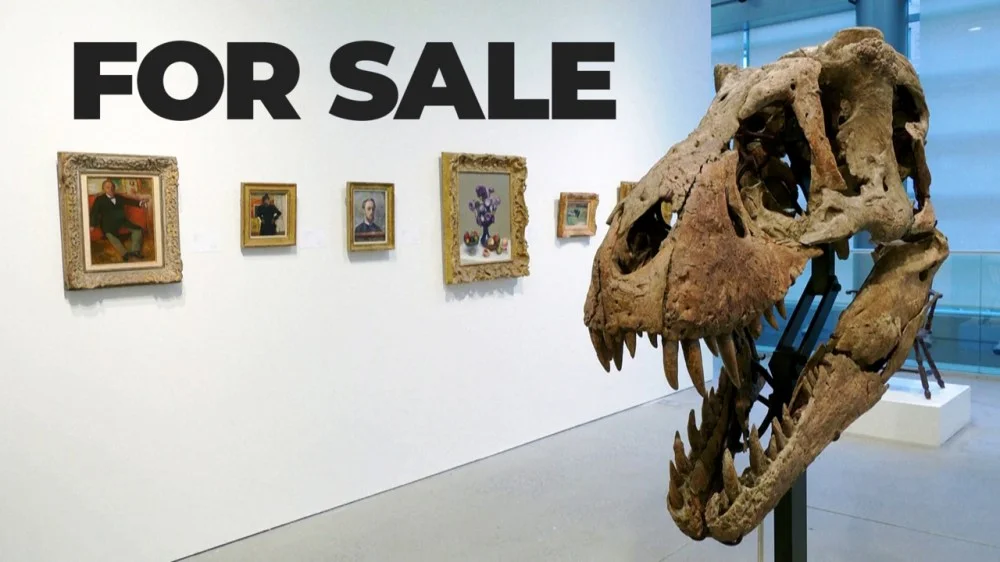
A Record-Breaking Auction for a Prehistoric Giant
The world’s most complete Tyrannosaurus rex fossil to hit the auction block in nearly three decades will go under the hammer on July 14, 2026, at Sotheby’s in New York. Nicknamed “Gus,” the 38-foot-long skeleton is expected to sell for between $20 million and $30 million, with bidding starting at $19 million. If it reaches the high estimate, it would become the most expensive dinosaur fossil ever sold, surpassing the $8.36 million paid for the T. rex “Sue” in 1997.
Discovered in the Hell Creek Formation in Harding County, South Dakota, Gus is approximately 61 to 63 percent complete by bone count, with 183 fossilized bones. The skeleton includes an exceptionally well-preserved skull, rare belly ribs, and a complete pelvis. Scientists have also documented healed fractures and bite marks from another tyrannosaur, suggesting Gus survived violent encounters during its life.
Named after the late rancher Gary “Gus” Licking, who spent years collecting bone fragments on his 6,500-acre property, the fossil was excavated over three summers starting in 2021 by commercial paleontology firm Theropoda Expeditions. Licking died a year into the dig, but his widow, Dana Licking, continued to support the project. The reconstruction took nearly five years before the skeleton was mounted in a lifelike hunting pose.
Why the Sale Matters: Science vs. Private Ownership
The auction has reignited a long-standing debate in paleontology: should scientifically significant fossils be sold to private collectors or reserved for public museums and research institutions? While Sotheby’s argues that fossil hunters deserve compensation for their discoveries, many scientists worry that Gus could disappear into a private collection, inaccessible to researchers and the public.
Cassandra Hatton, global head of natural history at Sotheby’s, defended the auction, noting the risks fossil hunters take. “People die on excavations,” she told BBC News. For many commercial hunters, the T. rex is the ultimate prize. But critics point to the precedent set by “Stan,” another T. rex that sold for $31.8 million in 2020 and now resides in a private museum in the United Arab Emirates, where scientific access has been limited.
This tension is not new. In 1997, Sue was purchased by the Field Museum in Chicago with support from corporations and foundations, ensuring it remained in the public domain. Gus, however, is being sold without any such guarantee. The auction house has not disclosed whether any museums are bidding, but the price tag virtually excludes most public institutions, which operate on tight budgets.
New Research Reshapes the T. rex’s Story
At the same time Gus is making headlines, new scientific research is reshaping how we understand the very species it represents. A study published in PeerJ in 2026 analyzed bone tissue from 17 tyrannosaur individuals and concluded that T. rex may have taken 35 to 40 years to reach its full adult size — far longer than earlier estimates of rapid growth in their twenties.
Lead author Holly Woodward and her colleagues used osteohistology, the study of bone microstructure, to examine growth marks in femora and tibiae. The findings suggest that the towering predator most people picture — the deep skull, heavy jaws, and bone-crushing bite — was the animal’s final life stage. For most of its life, a T. rex was a smaller, more slender predator, not the giant of museum mounts and Jurassic Park films.
This research adds depth to the public fascination with Gus. If the growth model is correct, Gus itself likely spent decades as a subadult before reaching its final 38-foot length. The specimen’s healed injuries also hint at a violent adolescence, with bite marks from other tyrannosaurs suggesting territorial or predatory confrontations.
Broader Implications: The Commodification of Prehistory
The sale of Gus sits at the intersection of science, commerce, and cultural heritage. As billionaires and private collectors increasingly compete for rare fossils, the line between preserving natural history and commodifying it blurs. Sotheby’s natural history auctions have grown from niche events for museums into high-stakes spectacles attracting the world’s wealthiest.
Some paleontologists argue that the high prices actually stimulate fossil discoveries. Commercial hunters often finance digs through the promise of future sales, unearthing specimens that might otherwise remain buried. Others counter that the science of paleontology suffers when key specimens vanish into private hands, their data becoming inaccessible.
The controversy also echoes broader debates about public trust in institutions. For example, public health controversies — such as the recent cyclospora outbreak linked to political figures — highlight how information control can shape public perception. Similarly, when fossils like Gus disappear from public view, humanity loses a piece of its shared natural history.
What Comes Next for Gus
As the auction date approaches, the fate of Gus remains uncertain. Will it join the ranks of Sue, a beloved public exhibit, or follow Stan into private obscurity? The answer may depend on whether a wealthy donor, corporation, or museum consortium steps forward. For now, the fossil stands in Sotheby’s showroom in New York, a silent witness to a very human conflict — one between the desire to own a piece of the past and the duty to share it with the world.
Comments