
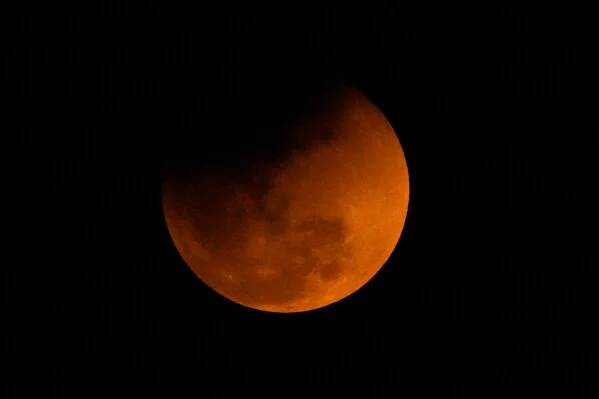
Blood Moon Partial Eclipse Peaks Tonight: A 96.2% Deep Eclipse That Looks Almost Total
Stargazers across North America are in for a rare treat tonight (August 21, 2026) as a deeply shadowed partial lunar eclipse unfolds in the night sky. While the event is technically a partial eclipse, the Moon's disk will be 96.2% covered by Earth's darkest shadow, rendering it visually indistinguishable from a total lunar eclipse for most casual observers. The moment of maximum eclipse occurs at 12:12 a.m. EDT on August 28, but the lunar disk will already be noticeably shadowed during the nights leading up to it, offering a precursor to the main event.
According to data from EclipseWise and the Five Millennium Canon of Lunar Eclipses, this eclipse is the deepest partial lunar eclipse since September 2024 and will remain the deepest until January 2028. The event is a key highlight of the August night sky, coming just a week after the full Sturgeon Moon, which occurs at 12:19 a.m. EDT on August 28. The eclipse is visible in its entirety from most of North America, with the Moon high in the sky during the overnight hours, providing prime viewing conditions for millions.
Why 96% Looks Like a Blood Moon: The Science of Earth's Shadow
A lunar eclipse occurs when the Sun, Earth, and Moon align in a straight line, with Earth positioned directly between the Sun and the Moon. During a total lunar eclipse, the entire Moon passes through Earth's umbra, the darkest part of its shadow. This eclipse, however, stops just short: a thin sliver of the Moon's northern limb will remain in direct sunlight, while the rest darkens to a coppery red.
That red hue is the result of Rayleigh scattering, the same atmospheric phenomenon that makes sunsets red. Sunlight passing through Earth's atmosphere is refracted, with blue light scattered away and red light bent toward the Moon. The more dust and clouds in Earth's atmosphere, the darker and redder the eclipse appears. At 96.2% coverage, only a sliver of the Moon remains bright, making the red glow overwhelmingly dominant to the naked eye.
For observers not using a telescope or binoculars, the eclipse will appear essentially total. The bright sliver along the northern limb will be subtle, and many skywatchers will go the entire event without noticing it. This near-total appearance is what fuels the popular "blood moon" label, even though the technical classification is a partial eclipse.
The Finale of a Rare Almost-Tetrad: Three Totals and a Near-Miss
The August 2026 eclipse is not just a standalone event; it is the closing act of a remarkable 18-month sequence of lunar eclipses known as an almost-tetrad. A true tetrad consists of four consecutive total lunar eclipses, each separated by roughly six months. Between 2025 and 2026, skywatchers witnessed three total eclipses: on March 14, 2025; September 8, 2025; and March 3, 2026. August 28, 2026, was supposed to be the fourth, but the Moon's orbit places it just shy of full immersion in Earth's umbra.
This almost-tetrad has captured the attention of astronomers and enthusiasts alike because of its rarity. The three consecutive totals in under two years are already a statistical anomaly; the fourth event falling just 3.8% short of totality adds a dramatic cliffhanger. For many, the August eclipse is a bittersweet finale — a near-miss that leaves the series incomplete in technical terms but visually satisfying in practice.
Saros 138: A 1,460-Year Cycle Approaching Totality
The August 28 eclipse is also a milestone for its Saros cycle, a period of roughly 18 years and 11 days that governs the recurrence of eclipses. This eclipse is member 29 of 82 in Saros 138, a series that has been producing eclipses for over a millennium. According to eclipse calculations, this partial eclipse has the largest umbral magnitude of any partial eclipse in the entire 1,460-year lifespan of the series. In other words, no other partial eclipse in Saros 138 will come as close to totality as tonight's.
The next eclipse in this Saros, in September 2044, will be the first total eclipse the series has ever produced. That means tonight's near-total event is the final dress rehearsal before the series crosses fully into totality. Astronomers are using this eclipse to refine models of Earth's shadow and lunar dynamics, data that will be crucial when the 2044 total eclipse occurs.
How to Watch the Blood Moon Tonight: Times, Equipment, and Tips
The partial eclipse begins at 10:02 p.m. EDT on August 27, with maximum coverage at 12:12 a.m. EDT on August 28. The eclipse ends at 2:22 a.m. EDT, giving observers over four hours of spectacle. The Moon will be well-placed in the southern sky, making it visible from all of North America, as well as parts of South America, Europe, and Africa.
No special equipment is needed to enjoy the event. The blood moon is easily visible to the naked eye, but binoculars or a small telescope will reveal the subtle color gradient across the lunar surface. For photography enthusiasts, a tripod and a camera with a telephoto lens can capture the red hue, though longer exposures will be needed as the eclipse progresses.
For those who miss the peak, a partial eclipse is still visible for the entire duration, with the reddish tint deepening as the Moon moves deeper into the umbra. The next lunar eclipse visible from North America will be in January 2028, but it will be a much shallower event, making tonight's near-total spectacle a must-see.
The 2025-2026 Eclipse Season: A Rare Double for North America
The almost-tetrad has been a boon for North American observers. All four eclipses — three totals and one near-total — were fully or partially visible from the continent, a rare occurrence given the frequency of lunar eclipses. The March 2026 total eclipse, in particular, was widely photographed, with images of the blood moon splashed across social media and news outlets. That event, which occurred on March 3, was the third total eclipse in the sequence and was visible across the Americas, Europe, and Africa.
The August eclipse carries the emotional weight of a finale, but it's also a scientific opportunity. Astronomers are using the event to study the opacity of Earth's atmosphere, as the brightness and color of the eclipse can reveal levels of volcanic ash and atmospheric dust. The 2026 event comes after a period of relatively low volcanic activity, so scientists expect a brighter-than-average eclipse, with a vivid copper-orange coloration.
Beyond Tonight: The Future of Lunar Eclipses and Skywatching Trends
The almost-tetrad of 2025-2026 has fueled a surge in public interest in astronomy. Social media platforms have seen a spike in eclipse-related content, and planetariums across the U.S. have reported sold-out viewing events. This cultural moment is part of a broader trend toward skywatching and space fascination, driven by the success of missions like Artemis and the James Webb Space Telescope.
For amateur astronomers, the near-total eclipse is a reminder that technical classifications sometimes fail to capture the visual reality. The 96.2% coverage is a statistical detail; the enduring memory will be a blood-red Moon hanging in the night sky, closing a rare sequence of celestial events. The next chance to see a near-total eclipse from North America will be in 2028, but for many, tonight's event will be the benchmark against which future eclipses are measured.
As the almost-tetrad ends, astronomers look ahead to the next major event: the September 2044 total eclipse from Saros 138, the first in that series. That eclipse will be visible from North America and will mark the culmination of a cycle that began in the 16th century. For now, though, tonight belongs to the nearly-total blood moon — a skywatching experience that blends scientific accuracy with pure awe.
Comments