
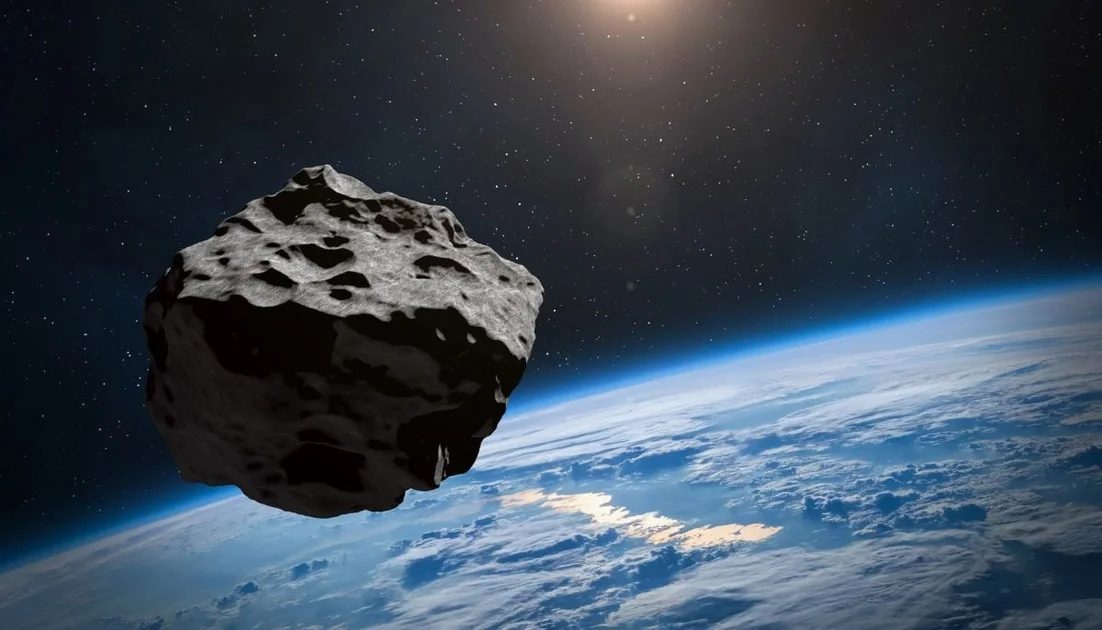
Asteroid 2026 JH2 Completes a Safe, Record-Breaking Flyby of Earth
On Monday, May 18, 2026, a newly discovered asteroid designated 2026 JH2 made a close but perfectly safe approach to Earth, passing within approximately 56,000 miles of our planet. The object — estimated to be between 50 and 100 feet across (15 to 30 meters) — came significantly closer than the Moon, which orbits at an average distance of about 239,000 miles.
NASA’s Jet Propulsion Laboratory confirmed that current trajectory calculations show no evidence of any impact risk. The asteroid, classified as an Apollo-type near-Earth object (NEO), was identified just days before its approach by astronomers at five observatories, including Farpoint Observatory in Kansas and Mount Lemmon Observatory in Arizona. The live broadcast of the flyby, organized by the Virtual Telescope Project, began at 5:45 p.m. ET, allowing astronomy enthusiasts to watch the event in real time.
“There is no need to worry or cancel any plans,” ABC7 Los Angeles reported, citing NASA statements. The asteroid’s brightness-based size estimate remains preliminary, as scientists have only tracked the object 24 times since its discovery, refining its orbit and physical characteristics.
Why This Flyby Stands Out
While small asteroids routinely pass through Earth’s neighborhood several times each year, 2026 JH2’s approach is notable for its proximity. Its minimum distance of 56,000 miles is roughly one-quarter of the distance to the Moon, placing it among the closest recorded flybys of 2026. According to WIRED Italia, among all tracked NEOs set to pass near Earth in the coming months, 2026 JH2 is predicted to come the closest.
The asteroid is comparable in size to Chicago’s Cloud Gate sculpture (commonly known as “The Bean”), which is 66 feet long. Objects of this size typically enter Earth’s atmosphere and break apart once every few decades, but in this case, the trajectory kept it well clear of any danger.
The Discovery and Tracking of a Fast-Moving Space Rock
Astronomers first spotted 2026 JH2 using a network of ground-based telescopes dedicated to detecting and monitoring NEOs. The discovery was made possible by coordinated observations from multiple facilities, including the Catalina Sky Survey in Arizona and the Farpoint Observatory in Kansas. These observatories scan the night sky for moving objects, often detecting them just days or weeks before a close approach.
Tracking a newly discovered asteroid over a short observational arc — in this case, only 24 data points over several days — leaves some uncertainty in its exact path. NASA’s Sentry impact monitoring system, however, has consistently ruled out any chance of collision for the foreseeable future. Engineers at JPL continue to refine the orbit as more observations come in.
Apollo-Class Asteroid: What It Means
2026 JH2 is classified as an Apollo-type NEO. According to NASA, Apollo asteroids have orbits larger than Earth’s path around the Sun, and their trajectories cross Earth’s orbit. This classification is derived from the object’s semi-major axis (greater than one astronomical unit) and its perihelion (shortest distance to the Sun) of less than 1.017 astronomical units. All such objects with a perihelion under 1.3 AU are considered NEOs and are routinely tracked by space agencies worldwide.
The asteroid’s size estimate — between 50 and 100 feet — is based on its apparent brightness and assumptions about its surface reflectivity. If the surface is darker than average, the asteroid could be larger; if brighter, it may be smaller. Future radar observations, if possible, could provide a more precise measurement.
The Broader Context: A Busy Year for Near-Earth Objects
2026 JH2’s close approach comes amid a year of heightened public interest in asteroid flybys. In fact, similar events are not rare. In the past year alone, several small asteroids have passed even closer. For instance, the small asteroid 2025 TF came within roughly 260 miles of Earth’s surface, a far more dramatic approach though still harmless.
According to WIRED, “its passage, while noteworthy, is not rare; in fact, in the past year, many objects have come as close if not closer.” The sheer number of NEOs — now tens of thousands cataloged — means that flybys like this happen multiple times annually.
How Scientists Monitor Potential Threats
NASA’s Planetary Defense Coordination Office (PDCO) oversees the detection and tracking of potentially hazardous asteroids (PHAs) — those larger than about 460 feet that come within 4.6 million miles of Earth. While 2026 JH2 is smaller than that threshold, it still qualifies as a NEO, and its close pass serves as a reminder of the importance of continued vigilance.
International collaboration is key. Observatories in the U.S., Europe, and elsewhere share data through the Minor Planet Center, allowing rapid orbit refinement. The more observations collected, the more accurately future positions can be predicted. In the case of 2026 JH2, additional tracking over the next few days will help narrow down its trajectory and provide a clearer picture of its long-term path.
Where to Watch and What to Expect
For those with access to a telescope, 2026 JH2 was visible as a fast-moving faint dot in the night sky during its closest approach on Monday evening. The Virtual Telescope Project provided a free live stream starting at 5:45 p.m. ET, which allowed viewers worldwide to see the asteroid in real time. The object moved rapidly against the background stars, a sight that amateur astronomers find both exciting and educational.
“We may not notice them, but it’s not usual for a bus-size asteroid to pass through our earthly neighborhood several times every year,” ABC7 noted. This regularity underscores the fact that while such events attract headlines, they are an expected part of Earth’s cosmic environment.
Looking Ahead: What 2026 JH2 Tells Us About Planetary Defense
The safe passage of 2026 JH2 highlights both the strengths and gaps in current asteroid detection systems. On one hand, the asteroid was discovered only days before its closest approach — a reminder that not all objects are found years in advance. On the other hand, the fact that it was detected at all, and that its trajectory was predicted accurately enough to rule out any impact, demonstrates the effectiveness of existing survey programs.
Investments in next-generation telescopes, such as the Vera C. Rubin Observatory in Chile (expected to begin full operations in the coming years), will dramatically increase the rate of NEO discoveries. This will provide longer lead times for potential threats and reduce the likelihood of surprises.
A Sobering Perspective Amid the Spectacle
While 2026 JH2 poses no danger, its discovery just before close approach serves as a reminder that Earth is not completely insulated from cosmic impacts. The Chelyabinsk event in 2013 — when a 65-foot asteroid exploded over Russia, injuring over 1,200 people — came without any warning. That object was about the same size as 2026 JH2.
Had this asteroid’s trajectory placed it on a collision course, its size would have been sufficient to cause significant local damage if it entered the atmosphere. Such scenarios underscore why continuous monitoring and international cooperation are essential.
General Trends: The Growing Awareness of Space Rocks
Public fascination with asteroids has grown steadily over the past decade, driven by high-profile missions like NASA’s DART (which successfully altered an asteroid’s orbit in 2022) and OSIRIS-REx (which returned samples from asteroid Bennu). This year, events like EDC Las Vegas 2026 capture global attention, but space rocks quietly remind us of the dynamic nature of our solar system.
The scientific community continues to emphasize that the vast majority of known NEOs pose no threat. However, as detection capabilities improve, the number of close approaches publicized will likely increase. This is a sign of progress, not danger. Each flyby provides data that helps refine models of asteroid orbits, compositions, and physical properties.
In the coming months, several more close approaches are expected, though none as close as 2026 JH2. Amateur astronomers and casual observers alike are encouraged to follow the live streams offered by the Virtual Telescope Project and other organizations, which make these celestial events accessible to all.
Conclusion and Final Thoughts
The close flyby of asteroid 2026 JH2 on May 18, 2026, was a textbook example of how modern astronomy detects, tracks, and characterizes NEOs. While the asteroid’s size and proximity generated news headlines, its passage was entirely safe and relatively common in astronomical terms. The event reinforced the value of dedicated sky surveys and international data sharing, which are the foundation of planetary defense.
As technology advances, humanity’s ability to spot and track such objects will only improve. For now, Earth remains safe — and the skies remain full of wonders waiting to be discovered.
This article was updated on May 19, 2026, to reflect the successful completion of the flyby.
Comments