
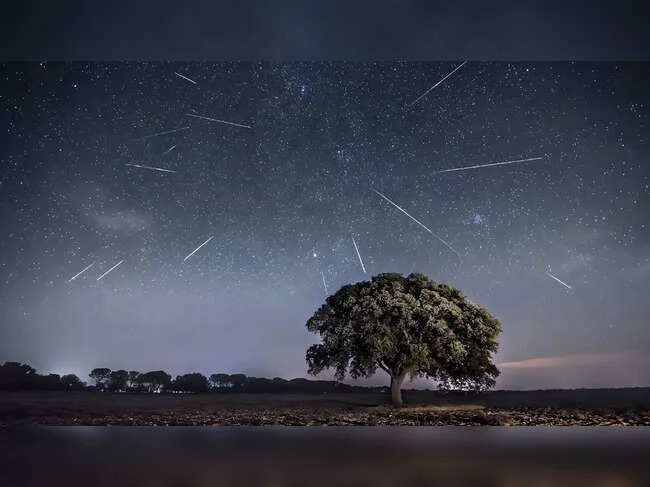
The Lyrids Are Back — and the Sky Is Cooperating
For skywatchers across the Northern Hemisphere, this week offers one of the most accessible and historically significant astronomical events of the year. The 2026 Lyrid meteor shower is currently active and approaching its annual peak, delivering streaks of light that have captivated human observers for more than two and a half millennia. The celestial display, which began around April 14, is expected to reach maximum intensity in the overnight hours of Tuesday into Wednesday morning — making the nights of April 22 and 23 prime windows for observation.
This year's edition comes with a notable advantage: minimal lunar interference. The crescent moon is dim enough and sets early enough that it is unlikely to wash out fainter meteors, giving observers cleaner, darker skies during the most active hours. That combination of timing and conditions makes 2026 a particularly favorable year for catching the Lyrids at their best. Lyrids Meteor Shower Peaks This Week With a Moonless Sky Offering Prime Viewing Conditions
What the Numbers Say: How Active Is This Shower?
Typical Rates and Rare Outbursts
Under standard conditions, the Lyrid meteor shower produces between 10 and 20 meteors per hour — a respectable rate for a major annual shower, though not among the most prolific in the calendar. What sets the Lyrids apart from more predictable events is their documented capacity for sudden outbursts. Historical records show episodes where rates have spiked to as many as 100 meteors per hour, transforming a modest display into a spectacular one with little advance warning.
These outbursts are irregular and difficult to forecast with precision, which means any given year could yield a routine show or an extraordinary one. While astronomers do not currently predict a major outburst for 2026, the possibility cannot be entirely ruled out — and it is part of what keeps experienced stargazers coming back annually.
Timing and Geography
The best viewing window begins after local midnight and extends into the pre-dawn hours, when the radiant point — the area of the sky from which meteors appear to originate — climbs highest above the horizon. Observers in the Northern Hemisphere are at a structural advantage, as the radiant lies within the constellation Lyra, which rises prominently in the northeastern sky during the late-night hours of April. Southern Hemisphere viewers can also catch some meteors, though the rates are lower due to the radiant's lower position in the sky from those latitudes.
A Meteor Shower With Ancient Roots
Over 2,500 Years of Recorded Sightings
The Lyrids hold a distinction that no other regularly observed meteor shower can claim in quite the same way: they are among the oldest continuously documented astronomical phenomena in human history. Written accounts of the shower date back more than 2,500 years, with early records found in ancient Chinese astronomical texts. That the same celestial event observed by scribes in antiquity is visible tonight from a backyard or a hillside is, by any measure, a remarkable thread of continuity between the ancient world and the modern one.
This historical depth gives the Lyrids a cultural weight that goes beyond their scientific interest. Generations of observers — farmers, navigators, philosophers, and poets — looked up at roughly the same display that contemporary skywatchers will see this week, albeit without the benefit of knowing where those lights actually came from.
The Comet Behind the Show
The scientific explanation for the Lyrids was not established until the 19th century. The shower originates from the debris trail left by comet C/1861 G1 Thatcher, a long-period comet discovered by astronomer A.E. Thatcher in 1861. Comet Thatcher follows an extremely elongated orbit around the sun, completing a single revolution approximately every 415 years — meaning it has not been visible from Earth since the 19th century and will not return until around the year 2276.
Despite the comet's absence, its legacy endures. As it traveled through the inner solar system over many past orbits, it shed a stream of dust and rocky particles along its orbital path. Each April, Earth passes through this debris field. The particles — most no larger than a grain of sand — enter the atmosphere at high velocity and incinerate due to friction with the air, producing the brief but brilliant streaks of light that define a meteor shower.
"A meteor looks like a trail of light in the sky. What you tend to detect is the motion against the background," San Diego City College astronomer Lisa Will explained to the Associated Press, capturing the visual experience that draws casual observers and dedicated enthusiasts alike.
How to Watch the 2026 Lyrids
Practical Viewing Tips
No special equipment is needed to observe the Lyrid meteor shower — telescopes and binoculars are actually counterproductive, since they narrow the field of view and reduce the chance of catching a meteor in the frame. The naked eye remains the best instrument for this kind of observation.
The most important variables are darkness and patience. Light pollution is the primary obstacle for urban observers. Finding a location away from streetlights, illuminated buildings, and dense city centers makes a significant difference in how many meteors are visible. Parks on the edge of cities, rural roads, or elevated terrain with unobstructed sightlines to the northeast all provide better conditions than a lit suburban backyard.
Once outside, allow at least 15 to 30 minutes for your eyes to adapt to the darkness — a process known as dark adaptation, during which the eye's sensitivity to low light increases substantially. Lying flat on a reclining chair or a sleeping bag and looking broadly at the sky, rather than fixing on a single point, gives the best chance of catching meteors as they flash across the field of view. Avoiding screens, particularly smartphones, is important since even brief exposure to bright light resets the dark adaptation process.
Meteors will appear to radiate from the constellation Lyra in the northeastern sky, though they can streak across any part of the visible sky. The radiant is a perspective effect — like standing in a snowstorm and seeing flakes seem to come from a single point ahead — so observers do not need to stare directly at Lyra to see the shower.
Weather and Local Conditions
Cloud cover remains the wildcard for any meteor-watching event. Observers in areas where skies are forecast to be clear overnight on April 22 into April 23 are in the best position. Unlike solar eclipses or planetary conjunctions, meteor showers are extended events — the Lyrids remain active through late April — so a clouded-out night can sometimes be compensated by trying again on an adjacent evening, though the peak rates will have passed.
What Comes Next: The Eta Aquarids Are on the Horizon
For observers who miss the Lyrids or want more, the next major meteor shower of the year is already approaching. The Eta Aquarids, associated with debris shed by Halley's Comet, typically peak in early May. The Eta Aquarids are generally more prolific than the Lyrids, producing rates of 40 to 85 meteors per hour under good conditions, and they particularly favor Southern Hemisphere observers due to the radiant's position in the sky.
The sequence of spring and early summer meteor showers represents a kind of astronomical calendar — recurring events tied to Earth's path through specific debris streams, each with its own character, history, and viewing geometry. The Lyrids, as the first major shower of the spring season in the Northern Hemisphere, function as the traditional opening act of this annual cycle.
The Broader Significance of Annual Meteor Showers
Meteor showers occupy a distinctive space in contemporary science communication and public engagement with astronomy. Unlike many astronomical phenomena that require expensive equipment, travel to specific locations, or technical expertise, meteor showers are inherently democratic events. They are visible to anyone with a clear sky, some patience, and a willingness to stay up past midnight.
This accessibility has made annual showers like the Lyrids, the Perseids in August, and the Geminids in December into reliable focal points for public interest in space science. NASA and affiliated organizations consistently report spikes in public engagement with astronomy around peak shower dates, and social media platforms amplify the communal experience of watching the same sky simultaneously from different parts of the world.
At the same time, the Lyrids serve as a reminder that some of the most enduring subjects of human curiosity are not technological achievements or recent discoveries but phenomena that predate recorded history — lights in the sky that ancient civilizations tried to interpret and that modern science has explained, without fully exhausting their capacity to inspire wonder. The comet that created them will not return for another 250 years. But its dust continues to burn, night after night, every April, right on schedule.
Comments