
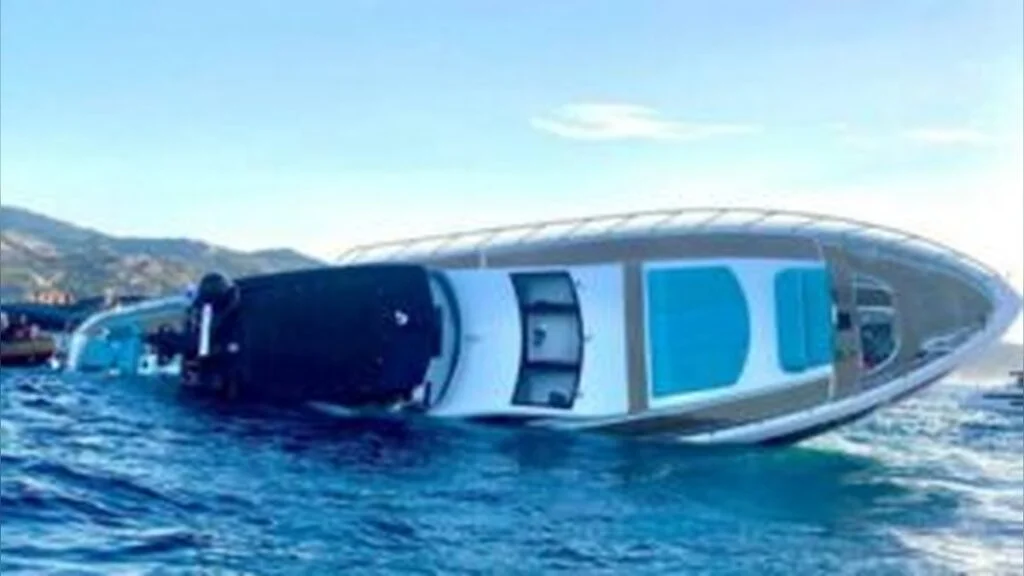
Angiola II Yacht Sinks Off Sardinia Four Days After Delivery
The luxury superyacht Angiola II sank off the coast of Sardinia on Tuesday evening, just four days after its new owner took delivery following an extensive refurbishment. The 98-foot vessel, valued at approximately £3.8 million, capsized in the waters off Porto Cervo, between Cappuccini Island and Capo Ferro, after suffering an apparent engine failure that triggered a fire and allowed water to flood the hull.
Video footage captured the dramatic final moments of the yacht, showing it tipping onto its side before gradually slipping beneath the surface of the Mediterranean. All fourteen people aboard were rescued without injury, according to reports confirmed by the Italian Coast Guard. Twelve were picked up by a nearby vessel, while the owner and a friend stayed aboard until a patrol boat arrived and transported them to Poltu Quatu.
The La Maddalena Coast Guard spent nearly three hours trying to stabilize the situation before allowing the yacht to sink in a controlled manner. The vessel now rests on the seabed at a depth of approximately 7 metres (23 feet) and is expected to remain there until specialist recovery equipment can be brought in.
A New Beginning That Ended in Disaster
The sinking marks a particularly cruel twist for the yacht's new owner, an Italian national who had only taken possession of the vessel days earlier. Agenzia Marittima De Felice, which brokered the sale, announced the deal in July, describing the buyer as a long-time enthusiast of the Amer Yachts brand. The timing of the incident—so soon after a handover that should have marked the start of a new chapter—has cast a shadow over what was meant to be a celebratory delivery.
The Angiola II was launched by Italian shipbuilder Permare in July 2020 under its Amer Yachts brand, the sixth hull in the Amer F100 series. The yacht is designed to accommodate up to ten guests in five cabins and had reportedly undergone a thorough refurbishment before delivery to its latest owner. The precise nature of that refurbishment and whether any warranty or insurance issues will arise from the sinking remain unclear at this time.
Initial reports suggest that a mechanical failure in the engine room may have led to a fire around the seals, which in turn allowed seawater to enter the vessel. The exact cause of the sinking, however, has not been officially established by investigators. The Coast Guard's decision to allow the yacht to sink in a controlled manner suggests that the damage was beyond what could be contained with onboard pumps, but the full sequence of events is still under review.
The Broader Risks of Yacht Ownership and Delivery
This incident underscores the inherent risks that come with yacht ownership, particularly in the delicate period immediately following delivery or major refit work. While luxury yachts are engineered to rigorous standards, the combination of new systems, post-refit shakedown issues, and the unpredictability of the sea can create conditions where even minor failures escalate quickly. The timing here—just four days after handover—raises questions about the thoroughness of sea trials and the checks performed before the vessel was signed over to its owner.
The sinking also highlights the logistical and environmental challenges of recovering a vessel that goes down in shallow waters. The Angiola II is now resting in just 7 metres of water, a depth that makes salvage feasible but still complicated, especially given the yacht's size and weight. Specialized equipment will need to be brought in to lift the vessel, a process that could take days or even weeks. In the meantime, the wreck poses a potential hazard to navigation and a risk of fuel or oil leakage into the sensitive Mediterranean marine environment.
Questions About Refurbishment Quality and Inspections
The Angiola II's sinking has inevitably led to questions about the quality of the refurbishment work and the adequacy of inspections conducted before delivery. Refits of this scale involve multiple contractors, complex systems integration, and significant pressure to meet delivery deadlines. While most yachts emerge from such processes without issue, the maritime industry has seen a number of incidents in recent years where newly delivered or recently refitted vessels have suffered failures during early voyages.
Agenzia Marittima De Felice, which handled the sale, has not yet issued a statement regarding the sinking. The shipbuilder Permare, known for its Amer Yachts brand, is also likely to face questions from the new owner, insurers, and potentially regulators about the circumstances leading up to the incident. The fact that an engine failure could escalate so rapidly into a fire and then a sinking will likely prompt a detailed technical investigation.
A Cautionary Tale for the Luxury Yacht Market
The loss of the Angiola II serves as a stark reminder that even the most expensive and well-built vessels are not immune to catastrophic failure. For the luxury yacht market, which operates on a premium of exclusivity and safety, an incident like this is particularly unwelcome. The market has been booming in recent years, with sales of superyachts ranging from £1 million to over £100 million remaining robust. But incidents like this can shake buyer confidence and lead to tighter scrutiny of pre-delivery procedures.
For the new owner, the financial loss is significant, but the emotional impact may be even greater. Taking delivery of a custom or refurbished yacht is the culmination of months or even years of planning and investment. Watching it disappear beneath the waves just days later is a scenario no owner imagines when they step aboard for that first celebratory cruise. The fact that everyone aboard escaped unharmed offers some consolation, but the memory of that roll onto its side and the slow descent into the sea will be hard to shake.
Salvage Operation and Future Implications
Attention now turns to the salvage operation, which will be critical for both environmental and legal reasons. The yacht will need to be raised, drained of any remaining fuel and fluids, and then either restored or scrapped depending on the extent of the damage. Maritime authorities may also want to examine the vessel to determine the precise cause of the sinking, which will be important for insurance claims and any potential legal action against the shipbuilder or the company that performed the refurbishment.
The incident has also reignited broader conversations about maritime safety and preparedness for emergencies at sea. Even with modern navigation systems, communication tools and safety protocols, the sea remains a hostile environment where things can go wrong quickly. The crew of the Angiola II and the nearby vessels that came to their aid acted swiftly, preventing what could have been a tragedy. But the sinking itself will be studied by marine engineers and safety experts as an example of how quickly a mechanical failure can spiral out of control.
In the meantime, the Angiola II rests in its shallow grave off the coast of Sardinia, a sobering sight for local sailors and a reminder of the fragile line between luxury and disaster. The recovery operation will be watched closely not only in Italy but across the global yachting community, eager for answers and for reassurance that what happened to this vessel is not a harbinger of broader systemic issues.
Lessons From the Water
This event, while isolated, fits into a pattern of recent maritime incidents that have raised questions about vessel maintenance and rapid ownership transitions. Whether it is a cargo ship losing power in a busy shipping lane or a superyacht sinking off a Mediterranean resort, the fundamentals remain the same: a failure at sea amplifies quickly when something goes wrong. The Angiola II incident will likely prompt insurance companies to review their policies on post-delivery and post-refit coverage, possibly leading to stricter requirements for sea trials and mechanical inspections before a vessel is handed over to a new owner.
For the wider industry, the message is clear: luxury and safety must go hand in hand. A yacht is not just a status symbol but a complex machine operating in one of the most unforgiving environments on earth. The next time a new owner takes the helm of a freshly refurbished vessel, they may think twice before setting off without a full understanding of the machine they are trusting with their lives. The Angiola II is now a footnote in maritime history, but the lessons from its sinking will echo for some time.
As the sun sets over Porto Cervo and the waters calm above the sunken yacht, the investigations and the salvage effort continue. For the owner, the friends aboard, and the crew who helped save them, the memory of that evening will linger. For the rest of us, it is a reminder that the sea gives no guarantees, no matter how much money is spent to conquer it.
Comments