
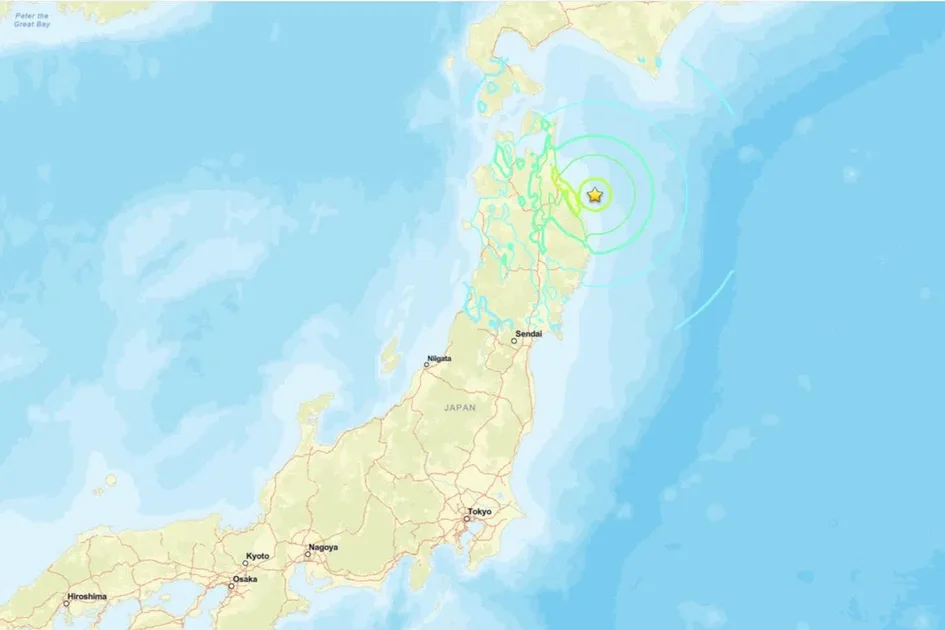
Powerful 6.9-Magnitude Earthquake Strikes Off Northern Japan
A powerful earthquake measuring 6.9 on the Richter scale struck off the coast of Iwate Prefecture in northern Japan on the morning of June 25, 2026, sending strong tremors across the northeastern Tohoku region. The earthquake occurred at approximately 7:30 a.m. local time, according to the Japan Meteorological Agency (JMA), which recorded the epicenter in the Pacific Ocean about 91 kilometers east of Hachinohe, at a depth of around 50 kilometers.
The JMA initially reported that the seismic intensity in the town of Hashikami in Aomori Prefecture reached upper 6 on the Japanese scale, the second-highest level, while neighboring Hachinohe registered lower 6. The U.S. Geological Survey (USGS) confirmed the magnitude at 6.9. Despite the strength of the shaking, officials reported no immediate casualties or significant structural damage. The JMA also stated that no tsunami was generated by the quake, alleviating fears that often accompany offshore seismic events in this tectonically active region.
Emergency response teams quickly mobilized across affected prefectures to assess infrastructure and ensure public safety. East Japan Railway Co. (JR East) temporarily suspended both northbound and southbound services on the Tohoku Shinkansen bullet train line between Tokyo and Shin-Aomori stations as a precaution. The Japanese government set up an emergency response office at the crisis management center of the Prime Minister’s Office to coordinate monitoring and recovery efforts.
Residents of coastal towns from Iwate to Aomori reported feeling prolonged shaking. Social media posts geotagged to the region described items falling from shelves and windows rattling, but there were no widespread reports of power outages or fires. The earthquake also drew attention due to its close timing with a separate 7.1-magnitude tremor that struck Venezuela on Wednesday evening, collapsing buildings in Caracas and underscoring a period of heightened global seismic activity.
Why This Earthquake Matters: A Region on High Alert
Japan is one of the most seismically active countries in the world, sitting atop the Pacific Ring of Fire where several tectonic plates converge. The country experiences around 1,500 earthquakes per year, most of them minor. However, the 6.9-magnitude quake off Iwate carries particular significance due to its proximity to the Tohoku region, which was devastated by the 2011 Great East Japan Earthquake and subsequent tsunami that killed nearly 20,000 people and triggered the Fukushima Daiichi nuclear disaster.
The memory of that catastrophe remains fresh, and Japanese authorities have since implemented rigorous building codes, early warning systems, and regular public drills. The fact that Thursday’s quake did not cause major damage or a tsunami is a testament to those preparations. The depth of the quake—about 50 kilometers—likely helped reduce surface shaking intensity and tsunami risk. Still, any significant tremor in this region causes heightened vigilance.
The earthquake struck at a time when other natural disasters were making headlines globally. A severe heatwave in parts of Europe and the United Kingdom was already causing disruptions, including school closures and transportation issues. The coincidence of these events has renewed discussions about infrastructure resilience and disaster preparedness in the face of climate change and geological unpredictability.
Seismic Activity and Public Safety
The response to the quake highlights the efficiency of Japan’s disaster management systems. Within minutes of the tremor, the JMA issued real-time updates, JR East halted bullet train services, and the government set up a central command post. These protocols are designed to prevent loss of life even when damage is minimal. For residents of Tokyo and Sendai who felt the shaking, the event served as a reminder to review emergency supplies and family evacuation plans.
Infrastructure and Transportation Disruptions
The suspension of the Tohoku Shinkansen line caused delays for thousands of commuters and travelers. JR East stated that inspections of tracks and overhead cables would be conducted before resuming full service. The bullet train network is a vital artery connecting Tokyo with the northeastern cities, and its quick shutdown demonstrates the sensitivity of modern transportation infrastructure to seismic events.
Railways in Japan are equipped with seismometers that can automatically trigger emergency braking when P-wave signals are detected. This system has been credited with preventing derailments during past quakes. No reports of injuries or damage to rolling stock emerged from Thursday’s event, and service was expected to resume later in the day following safety checks.
In addition to rail disruptions, road traffic was briefly impacted in coastal areas as a precautionary measure, with some bridges inspected for structural integrity. Ports and airports in the region operated normally, and no major industrial facilities reported anomalies. The government’s emergency response office continues to monitor aftershocks, which are likely in the coming days.
Global Context: Separate Quakes in Venezuela and Japan
The earthquake in Japan occurred just hours after a 7.1-magnitude quake struck Venezuela near the Caribbean coast, collapsing buildings in the capital of Caracas. The USGS reported the Venezuelan quake’s epicenter was west of Moron, at a depth of only 13 kilometers—far shallower than the Japan event, which contributed to its destructive power. While the two earthquakes were unrelated, their proximity in time has sparked scientific and public curiosity.
Seismologists note that while large earthquakes can sometimes trigger distant seismic events through stress transfer, the distance between Japan and Venezuela—over 14,000 kilometers—makes correlation extremely unlikely. The simultaneous occurrence is likely coincidental, driven by the fact that both regions lie on active plate boundaries. The Pacific Ring of Fire runs through Japan, while Venezuela sits near the boundary of the Caribbean and South American plates.
The global news cycle, already dominated by political developments such as the ongoing negotiations between the U.S. and Iran over nuclear inspections and the economic impact of tariffs, paused to cover the seismic events. For citizens in both affected countries, the quakes underscore the importance of individual preparedness. As Japan’s experience shows, even when warnings and safety measures work perfectly, the shock of a major tremor can be profound.
Broader Implications: Lessons from Japan’s Resilience
Japan’s ability to withstand a magnitude 6.9 quake without significant casualties or infrastructure collapse is not accidental. The country has invested heavily in earthquake engineering, public education, and early warning systems since the 2011 disaster. Buildings are designed to flex rather than break, and households are stocked with emergency kits. Schools conduct regular drills, and the media plays a crucial role in broadcasting safety information.
This resilience contrasts with the devastation seen in Venezuela, where building codes are less strictly enforced and emergency services are strained by economic challenges. The divergent outcomes highlight how socioeconomic factors influence disaster vulnerability. For Japan, the priority remains maintaining vigilance. The JMA continues to warn that aftershocks could occur in the weeks ahead, potentially of magnitudes up to 5 or 6.
The earthquake also underscores the interconnectedness of infrastructure systems. The temporary halt of the Shinkansen line, while precautionary, affected supply chains and travel plans. Similar disruptions have been noted in other crises, such as the recent heatwave-induced electrical failures that suspended Wimbledon qualifying matches and forced school closures across England. These events, from seismic shakes to extreme weather, place increasing pressure on aging infrastructure globally.
As climate change alters weather patterns and geological forces continue to shape the planet, the need for adaptive, resilient systems becomes more urgent. Japan offers a model; however, even advanced economies face challenges. For instance, the management of school closures during heatwaves in the UK, as seen with Education Secretary Phillipson facing backlash over teacher confidence, shows that disaster response is as much about leadership as technology.
Looking Ahead: Preparedness and Public Awareness
In the aftermath of Thursday’s quake, Japanese authorities are urging residents to remain cautious. Aftershocks are expected and could be strong enough to cause additional damage to already weakened structures. The government has also reminded citizens that tsunami warnings can be issued quickly if underwater landslides occur. For now, the all-clear has been given, but the psychological impact of a shaking that recalls the 2011 disaster is not easily shaken off.
For the international community, the event provides an opportunity to assess best practices in earthquake preparedness. While no nation can prevent earthquakes, investments in early warning systems, strict building codes, and public education can dramatically reduce death tolls. The lack of casualties in this event stands in stark contrast to the losses from the 2011 quake, demonstrating how far Japan has come.
As global media coverage shifts, the earthquake will likely fade from headlines, but its lessons remain. Every tremor is a reminder that human civilization is built on a dynamic planet, and resilience is not a one-time achievement but an ongoing process. The world will watch for aftershocks, but more importantly, it will watch how Japan continues to lead in turning geological risk into manageable challenges.
Comments