
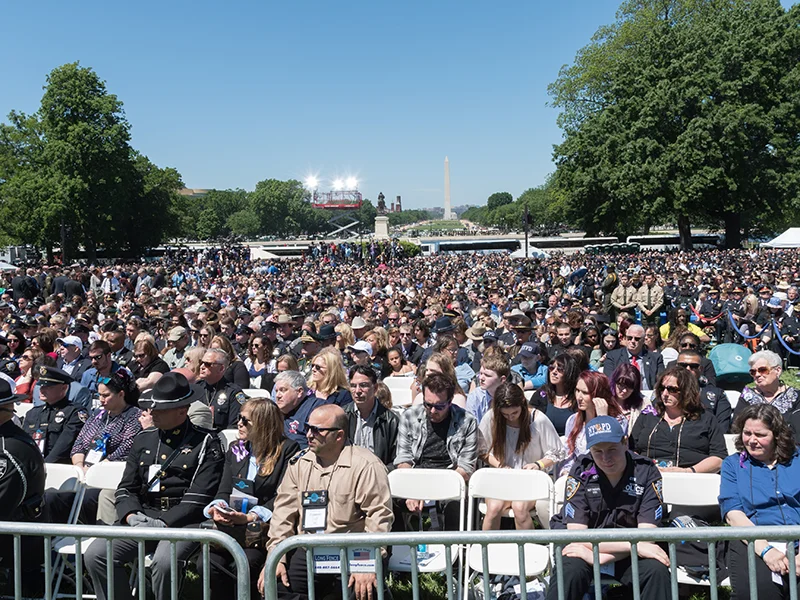
President Proclaims Peace Officers Memorial Day 2026
On May 11, 2026, President Donald Trump issued a formal proclamation designating Peace Officers Memorial Day and Police Week 2026. The document, published by the White House, honors law enforcement officers who have died or been injured in the line of duty and extends gratitude to their families. The proclamation arrives amid ongoing national debates over policing, public safety, and immigration enforcement.
The White House statement highlights recent crime statistics, claiming that on-duty law enforcement officer deaths have fallen to an 80-year low. It also asserts that crime in the nation’s capital has dropped to the lowest level ever recorded, with significant reductions in rapes, robberies, aggravated assaults, shooting deaths, traffic fatalities, and overdose deaths.
Presidential proclamations for Peace Officers Memorial Day have been a bipartisan tradition for decades, typically issued during the first full week of May. This year’s document, however, is notably more political than many of its predecessors, directly linking the administration’s law-and-order agenda to improved safety outcomes.
Policy Context: From ‘Lawlessness’ to ‘Law and Order’
The 2026 proclamation frames the current public safety environment as a direct result of policy reversals enacted since the president returned to office. It explicitly criticizes what it describes as “Biden-Harris administration” policies, including “sanctuary state” laws, cashless bail programs, and soft-on-crime approaches that it claims placed officers in unnecessary danger.
“Before I took office, America was gripped by a left-wing-fueled lawlessness that shook the very foundations of our society,” the proclamation states. It alleges that officers were “hindered, and even punished, for carrying out the mission they had sworn to uphold.” Since returning to office, the president reports directing federal resources into high-crime cities, ending sanctuary policies, and empowering police to operate without what he calls “dangerous impediments.”
Several legislative and executive actions are cited as evidence of this shift. The proclamation references the Working Families Tax Cuts Act, signed in the summer of 2025, which includes a provision eliminating federal taxes on overtime pay—a benefit aimed directly at law enforcement personnel working extended hours. An executive order titled “Taking Steps to End Violence and Restore Safety” is also mentioned as part of the administration’s broader strategy.
The timing of the proclamation coincides with ongoing public attention on policing issues. Across the Atlantic, similar tensions over free speech, public order, and police powers have played out in major cities. For instance, the Met deploys 4,000 officers for rival London protests amid hate speech crackdown, illustrating how law enforcement capacity and civil liberties remain contested topics globally.
Broader Implications and Trends
The 2026 observance occurs against a complex backdrop. While the White House touts historically low officer deaths and falling urban crime rates, critics have questioned whether statistical declines are attributable solely to federal policy changes or reflect broader national trends that began earlier. The proclamation’s language also highlights a persistent partisan divide over public safety strategies, with the current administration explicitly rejecting the approach of its predecessor.
Peace Officers Memorial Day has traditionally served as a moment of bipartisan unity, with leaders from both parties pausing to remember fallen officers. This year’s proclamation, however, uses the occasion to advance a specific policy narrative, presenting the current moment as a victory for a particular law-and-order agenda. The document does not mention any specific officers by name, nor does it reference the approximately 60,000 line-of-duty deaths recorded in U.S. law enforcement history.
Beyond the immediate political messaging, the proclamation underscores a broader trend: the increasing politicization of crime data. Claims about crime reductions or increases are frequently contested along partisan lines, with different administrations interpreting similar statistics through opposing frameworks. The 80-year low in officer deaths, if confirmed by independent sources, would represent a significant milestone regardless of political interpretation.
For the families of fallen officers and the broader law enforcement community, the annual observance carries weight that transcends partisan debate. The proclamation reaffirms the nation’s commitment to supporting the families of the fallen, those injured in the line of duty, and the “hundreds of thousands of courageous men and women who continue to wear the badge.”
As Police Week 2026 continues, events in Washington, D.C., and across the country will honor individual officers whose names have been added to the National Law Enforcement Officers Memorial. These ceremonies, organized by groups such as the National Law Enforcement Officers Memorial Fund, typically draw thousands of attendees regardless of the political climate.
Conclusion
Peace Officers Memorial Day 2026 arrives at a moment when public safety policy is both a major political wedge issue and a subject of measurable debate. The White House proclamation uses the occasion not only to honor fallen officers but to reinforce a narrative of successful policy reversal. Whether those claims hold up under independent scrutiny will likely remain a subject of discussion well beyond this year’s observance.
In the meantime, the day itself remains a solemn reminder of the risks law enforcement officers take daily. As the proclamation concludes, “our grateful country joins them in honoring the memory of the fallen officers who gave their lives protecting their fellow citizens.”
This year, that message is wrapped in a political context that makes the annual tribute as much about the future of American policing as about the past.
Comments