
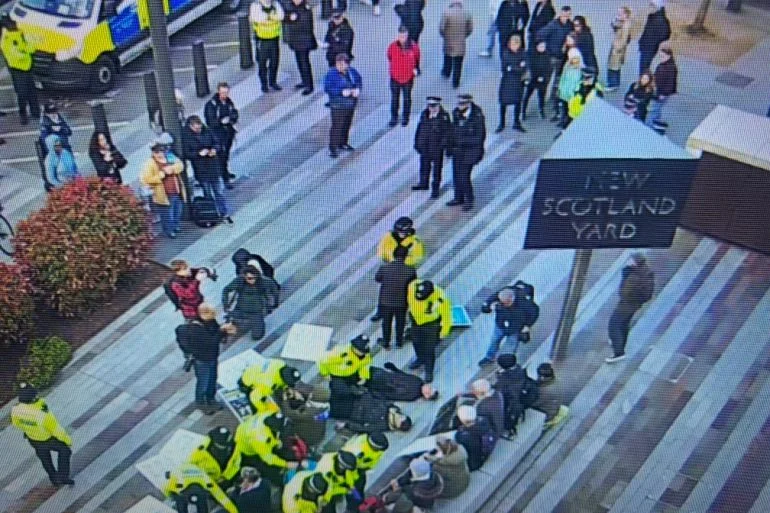
Metropolitan Police launch unprecedented operation for Saturday’s rival protests
London is bracing for one of the most volatile weekends in recent memory as the Metropolitan Police deploy more than 4,000 officers to police two rival demonstrations scheduled for Saturday, May 16. The so-called “Unite the Kingdom” rally, led by far-right activist Tommy Robinson, will take place alongside the annual Nakba Day march in support of Palestinian rights, with the FA Cup final at Wembley adding further strain on the capital’s policing resources.
Deputy Assistant Commissioner James Harman confirmed that officers will operate under a “zero tolerance” policy toward hate speech and disorder, with live facial recognition technology deployed for the first time at a public protest in London. The cost of the operation is estimated at £4.5 million.
“This will be one of the busiest days for policing in London in recent years,” Harman told reporters. The force has imposed strict conditions on both marches, including designated routes, time limits, and a groundbreaking clause making organizers and speakers personally responsible for any unlawful speech.
Tens of thousands of participants are expected at each event. The Unite the Kingdom march will gather on Kingsway from 11am, moving through Aldwych, Strand, Trafalgar Square, Whitehall, and ending at Parliament Square by 6pm. The Nakba 78 march will start at Exhibition Road at noon, proceeding through Knightsbridge and Piccadilly to Pall Mall.
Facial recognition and armed units on standby
Live facial recognition cameras will be used in Camden, where Unite the Kingdom supporters are expected to gather before the main event. The technology will compare faces of passersby against a police watchlist. Harman stressed that the measure is targeted and will not be used against pro-Palestine marchers.
Armed police units, helicopters, drones, dog units, police horses, and armoured vehicles will all be available. Every officer deployed will be equipped with riot gear. The force has also activated dispersal powers and enhanced authority to search individuals and remove face coverings.
Why this weekend matters: far-right mobilization, counter-protests, and football
The convergence of three major events in a single day creates a uniquely high-risk environment. The Unite the Kingdom rally, renamed this year as “Unite the Kingdom, Unite the West,” is the second such gathering organized by Tommy Robinson, whose real name is Stephen Yaxley-Lennon. The first rally in September 2025 drew more than 100,000 attendees and featured remote remarks from Elon Musk.
Saturday also marks Nakba Day, the annual commemoration of the displacement of Palestinians in 1948. The Palestine Solidarity Campaign is organizing the Nakba 78 march, which will bring thousands of pro-Palestinian demonstrators onto the streets. The two marches will be kept physically separate by police to minimize the risk of clashes.
Meanwhile, tens of thousands of football fans will travel to Wembley for the FA Cup final, raising concerns that hooligans may attempt to join the Unite the Kingdom march. Police chiefs have acknowledged the risk of violence and disorder linked to football-related elements.
International far-right figures barred from entry
In a significant pre-emptive move, the Home Office has barred seven far-right activists from entering the UK to attend the rally. Among those refused entry are Belgian politician Filip Dewinter, Dutch commentator Eva Vlaardingerbroek, American candidate Valentina Gomez, and Catalan influencer Ada Lluch. All were scheduled speakers and some had addressed the previous Unite the Kingdom event.
Valentina Gomez, who gained notoriety for Islamophobic and homophobic remarks, claimed at the 2025 rally that “rapist Muslims” were “taking over” the UK with the support of Labour Prime Minister Keir Starmer and the Metropolitan Police. Also barred is MAGA influencer Joey Mannarino, who previously called for the deportation of “parasites who are raping their way through America, Europe and the United Kingdom.”
The ban underscores the transnational nature of the far-right movement, with Robinson having spent earlier this year touring the United States, meeting conservative influencers, speaking at the University of Florida, and even visiting the U.S. Department of State. His stated aim was to “generate excitement” for the London rally.
New hate speech powers tested in real time
One of the most notable aspects of this weekend’s policing operation is the use of new legal powers targeting hate speech at protests. For the first time, police have imposed conditions that make event organizers legally responsible for the content of speeches delivered by invited guests.
“These conditions make the organisers responsible for ensuring that speakers they invite don’t break the law by using these events to platform unlawful extremism or hate speech,” Harman said. “Both the speakers and the organisers will face consequences if that happens.”
Police have warned that they will intervene immediately if hate speech occurs, and that dispersal orders and arrests will follow. The move reflects growing concern about the use of large public rallies to broadcast Islamophobic, antisemitic, and other forms of hate speech without accountability.
The Metropolitan Police cannot legally ban either protest under current legislation unless they lack the resources to contain the risk of serious disorder. In this case, senior officers believe they can keep the events separate and manageable, albeit with extreme measures.
Historical context: from EDL to Unite the Kingdom
Tommy Robinson, formerly leader of the English Defence League, has evolved from a street-level far-right organizer into a figure with international reach. The Unite the Kingdom brand represents a rebranding of his activism, framed as a patriotic movement focused on opposing Islamization and mass immigration.
Robinson’s rhetoric has echoed a broader transatlantic playbook, drawing on narratives of national decline and demographic replacement. These themes resonate strongly with American far-right figures, including those recently barred from the UK. The rally has attracted speakers from across Europe, including members of the Alternative for Germany (AfD), the Danish People’s Party, and Vlaams Belang.
Civil society groups, including the Center for the Study of Hate and Extremism, have described the rally as “the epitome of transnational far-right mobilization.” The involvement of U.S. influencers, European politicians, and Canadian activists reflects a coordinated effort to unify far-right movements across borders.
Broader implications: technology, free speech, and public order
Saturday’s events raise fundamental questions about the balance between the right to protest, public safety, and the use of new surveillance technologies. The deployment of live facial recognition at a political demonstration is a first for the Met, and civil liberties groups have already signaled legal challenges.
Critics argue that such technology risks chilling free expression and disproportionately targeting minority communities. The police counter that it is a precision tool aimed at known offenders on a watchlist, but watchdogs have questioned its accuracy and accountability.
The new hate speech powers also test the limits of the law. While the government has expressed support for cracking down on extremism, legal experts caution that holding organizers responsible for third-party speech could deter legitimate protest and empower authorities to suppress dissent.
These developments come at a time when the UK is already grappling with polarized public discourse, rising hate crimes, and a strained police force. The Met’s willingness to spend £4.5 million and deploy thousands of officers for a single day underscores how resource-intensive modern public order policing has become.
A test case for future protests
The outcome of Saturday’s operation will likely shape how British policing handles large-scale, ideologically opposed demonstrations in the future. If the combination of facial recognition, enhanced powers, and speaker liability succeeds in preventing violence and hate speech, other forces may adopt similar measures. If it leads to legal challenges or accusations of overreach, it could spark a broader debate about protest rights in the digital age.
For now, Londoners and visitors are advised to avoid the affected areas and expect significant disruption. Football fans heading to Wembley, in particular, are urged to plan travel carefully.
Conclusion: a day of high stakes for London
Saturday, May 16, represents a convergence of forces—far-right mobilization, pro-Palestinian solidarity, sporting fervor, and cutting-edge policing technology—that will test the fabric of public order in a diverse and vibrant city. The Metropolitan Police have made clear they will not tolerate hate speech or violence, but the ultimate test will be on the streets.
As two large demonstrations move through central London, the world will be watching. The use of facial recognition, the application of new speech regulations, and the management of potential clashes will set precedents that could reverberate far beyond the capital.
In an era of rising extremism and technological surveillance, the question is not just whether London can keep the peace this weekend, but at what cost to civil liberties and the right to protest.
Comments