
Trump Attends Solemn Dover Ceremony as Fourth Service Member Identified
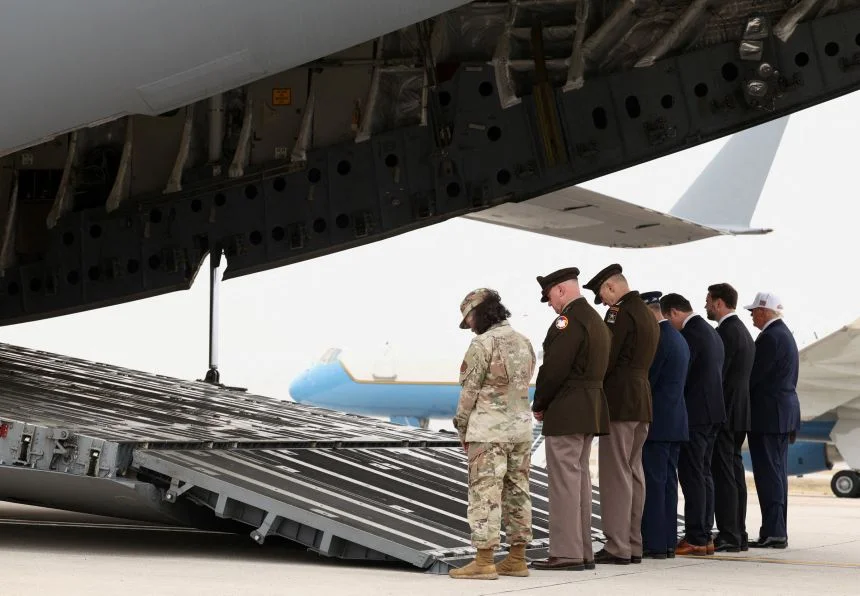
President Donald Trump traveled to Dover Air Force Base in Delaware on Wednesday to attend a dignified transfer ceremony for four U.S. service members killed in the ongoing war with Iran. The somber event, held under gray skies, marked the third time Trump has participated in such a ritual since hostilities escalated in late February.
The president saluted as Army carry teams moved flag-draped transfer cases containing the remains of 1st Lt. Tyler James Feehan of Ewa Beach, Hawaii; Pvt. Isabella Gonzales; Sgt. Michael Emmanuel Swinton; and Sgt. Angel S. Rampersad of Ozone Park, New York. Rampersad, 28, was identified earlier Wednesday as the service member believed killed in an Iranian attack on Muwaffaq Salti Air Base in Jordan on July 17. She had initially been listed as missing before remains were recovered and verified.
Trump told reporters before boarding Air Force One that the ceremony is "one of the hardest things to do as a president but it has to be done." He defended the war, claiming the fallen soldiers had "said very strongly" that "we cannot let Iran have a nuclear weapon." Asked what he would tell grieving families, the president replied, "All I'm going to say is, we love you. We love your child."
A Nation in Mourning
The dignified transfer brought the total number of U.S. service members killed since the war began to 18, according to Pentagon figures. New York Gov. Kathy Hochul paid tribute to Rampersad on social media, saying her heart was "with her family, loved ones, and the soldiers who stood beside her as they grieve this unimaginable loss." New York City Mayor Zohran Mamdani called Rampersad's courage and sacrifice "a loss felt not just in Queens, but across all five boroughs."
War Escalates on Multiple Fronts
Wednesday's ceremony unfolded against a backdrop of intensifying conflict. The U.S. military conducted an 11th consecutive night of airstrikes on Iranian targets, while Tehran responded by attacking American bases and allied facilities across the Middle East. Iran has also targeted commercial shipping in the Strait of Hormuz, prompting Trump to issue a stark threat: he will "bomb and destroy" an Iranian bridge or power plant for every new attack on a vessel in the strategic waterway.
"If you look at the militarization of the Strait of Hormuz, that's never happened before," said Republican Sen. Rand Paul, who offered an unqualified criticism of the war on Tuesday. "The Iran war has not been a success. By any objective measure, we're worse off than we were before the war."
Economic Shockwaves
The conflict has rattled global energy markets. Iraq, a key OPEC member, has lost over $40 billion in revenue since the war began, mostly due to a sharp decline in oil exports. Iraqi Oil Minister Bassem Mohammed Khudair said the country used to deposit $7–8 billion monthly into state coffers, but "today, we do not exceed $1.5 billion." Iran's blockade of the Strait of Hormuz has choked shipments and forced production cuts across the region, driving oil prices sharply higher over the past two weeks.
Broader Implications of a Prolonged Conflict
The repeated dignified transfers at Dover underscore the human cost of a war that shows no signs of abating. Each ceremony renews public attention on service members killed overseas, a politically sensitive ritual that presidents have used to honor the fallen. Yet the frequency of these events — three since March — reflects a conflict that has already surpassed initial expectations in duration and casualty count.
Senator Paul's criticism, rare from a member of the president's own party, signals growing unease within Republican ranks over the direction of the war. That sentiment may deepen as the Pentagon faces funding shortfalls and the White House struggles to articulate an exit strategy. In the meantime, the White House has framed the conflict in existential terms: preventing Iran from acquiring a nuclear weapon. The president has called the war a necessary shield against a nuclear-armed Tehran.
What This Changes
The third dignified transfer at Dover marks a grim milestone. Each return of remains to American soil hardens the political stakes and sharpens the debate over whether the war is achieving its objectives. For military families, it represents an irreversible loss. For President Trump, it is a recurring reminder of the weight of command. And for the broader public, these ceremonies — repeated with sobering regularity — are becoming a defining image of a conflict that has already cost 18 American lives and destabilized a vital global waterway.
This article is part of our ongoing coverage of international conflicts and their impact on global security. For related stories, see our report on a United Airlines Flight Makes Emergency Landing at Military Base as Storm Hits Phoenix.
Comments