
The 2026 Tour de France Opens Under a Record Heat Threat
The 2026 Tour de France is set to begin Saturday in Barcelona, with Tadej Pogačar aiming for an unprecedented fifth yellow jersey. Yet the race’s biggest headline is not the rivalry with Jonas Vingegaard or the debut of teenage sensation Paul Seixas, but the looming threat of a 44°C heatwave that could force the first-ever stage cancellation due to extreme weather in the event’s 113-year history.
Temperatures across southwestern Europe have already spiked to dangerous levels in late June, and forecasts predict a return of scorching conditions as early as Sunday, when the peloton faces Stage 2 — a 168-kilometer coastal route from Tarragona to Barcelona. “It’s something that’s very much on our mind,” Thierry Gouvenou, the Tour’s technical director, told reporters. “It’s not the first time we have faced this, but this time it’s worse because of what we have already experienced in May and June.”
The Tour has been derailed in the past by wars, strikes, and COVID-19, but never by heat. The prospect of altering or scrapping stages represents an unprecedented logistical and reputational challenge for organizers, who must balance rider safety against global broadcast schedules that demand finishes during the hottest part of the day. The stakes are seismic for a race that markets itself as the pinnacle of cycling endurance.
A Race Defined by Climbs and Courage
The 2026 route covers 3,321 kilometers and 54,450 meters of vertical gain — making it the third-most demanding Tour in two decades. Riders will face 21 stages, starting with a 19.6-kilometer team time trial through Barcelona that ends on a punishing climb up Montjuïc. That innovation — each rider now gets their own time instead of the whole team sharing the same finishing time — reshapes the opening skirmish into a high-stakes lead-out exercise rather than a pure coordination drill.
Four stages are designed for outright sprinters, and two more could finish in bunch kicks, but the bulk of the route consists of hilly, intermediate stages that suit breakaway specialists and all-rounders. The second week is expected to be the crucible, with the race’s decisive battles unfolding in the high mountains of the Pyrenees and Alps during the final week.
Pogacar vs. Vingegaard: The Defining Rivalry
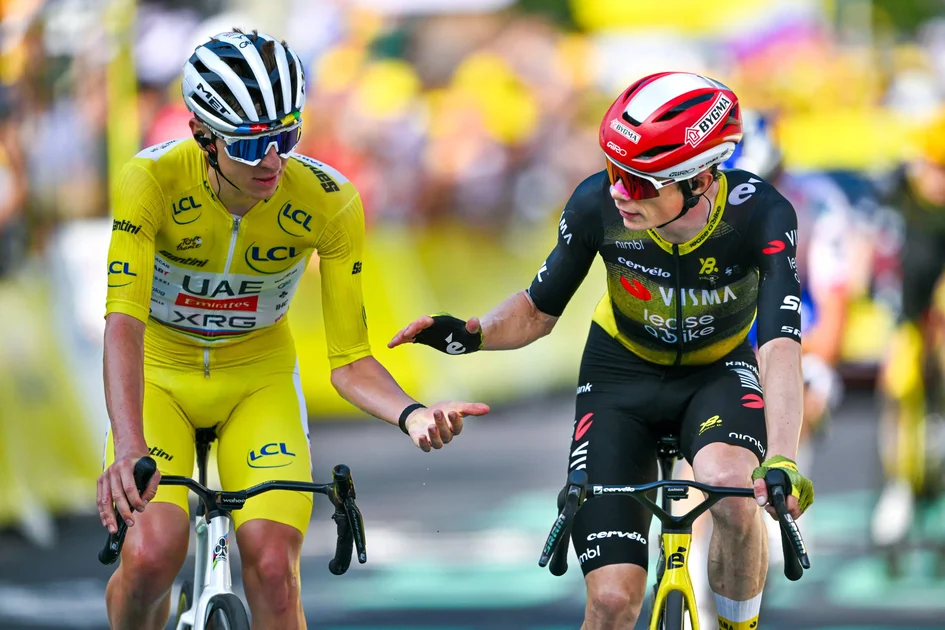
On the starting line, all eyes are on two riders. Tadej Pogačar, the 27-year-old Slovenian for UAE Team Emirates XRG, stands on the threshold of history. A victory in Paris would give him five yellow jerseys, tying the all-time record held by Jacques Anquetil, Eddy Merckx, Bernard Hinault, and Miguel Indurain. After a dominant 2025, in which he won his fourth Tour with ruthless efficiency, Pogačar added Milan-San Remo to his palmares in March and came within meters of winning Paris-Roubaix in April. He then crushed the field at the Tour de Suisse in June, signaling that he has shed his only known weaknesses — heat and tactical impulsiveness.
“Pogačar is a rider in his prime,” wrote Jacob Whitehead in The Athletic’s comprehensive preview. The Slovenian is the overwhelming favorite.
But standing in his way is Jonas Vingegaard, the two-time Tour winner who has rebuilt his career after suffering major injuries in a 2024 crash at the Tour of the Basque Country. The 29-year-old Dane has since won the 2025 Vuelta a España and the 2026 Giro d’Italia — completing two of the three Grand Tours in the space of nine months. Team Visma-Lease a Bike insists Vingegaard is in “career-best form,” though Pogačar did not race in either the Vuelta or the Giro, making direct comparisons tricky. What is clear is that Vingegaard has developed another gear for acceleration, honed during his long recovery. If the race becomes a slugfest in the high Alps, the Dane’s climbing pedigree could threaten the Slovenian’s coronation.
The Seixas Factor
Beyond the two titans, French cycling is abuzz with the emergence of Paul Seixas, a 19-year-old climber described by some as the country’s next great hope. While Seixas is not yet expected to win overall, his presence signals a generational shift. The French have not produced a Tour winner since Bernard Hinault in 1985, and Seixas’s debut has drawn comparisons to a young Pogačar. His performance in the opening mountain stages will be closely watched.
Heat Stroke and the Short-Circuit Threat
The heat crisis adds a medical dimension that cycling cannot ignore. At the Tour de Suisse in June, Italian rider Elisa Longo Borghini suffered heatstroke and lost nearly 10 minutes to rivals, struggling to remember the finish. “Heatstroke is an extremely serious emergency,” said Emilio Magni, medical director of XDS Astana. “The temperature regulation systems in the brain begin to fail. Then cardiac activity, circulation, and the dilation of blood vessels are affected. It is like a short circuit.”
Professional cycling’s extreme weather protocol currently allows for additional feeding stations, cold-drink motorbikes, and extended time limits. But these measures were designed for heat in the 35°C range — not the 44°C that some weather models are predicting for parts of Spain and southern France. The Tour’s technical team has discussed earlier start times, but international TV contracts lock the race into afternoon finishes, when the sun is most brutal.
Gouvenou acknowledged the tension: “In the past, we have opened the feed zone from start to finish. But the key moments must happen in the heat of the day for television.”
What Cancellation Would Mean
Cancelling a stage — or shortening it — would be a first for the Tour. The precedent would ripple through professional cycling, forcing other Grand Tours to adopt heat contingency plans. It would also raise uncomfortable questions about the sustainability of summer sports in a warming world. The Tour’s organizers have already faced criticism for not moving the race to cooler months; the 2026 edition may force a reckoning.
The same heatwave has already caused disruptions in other parts of Europe. As France Braces for Second July Heat Wave Amid Record June Canicule Deaths reported, the continent is in the grip of an unprecedented heat event that has overwhelmed hospitals and canceled outdoor events. The Tour is not immune.
Team-by-Team: Who Can Challenge?
Beyond the podium favorites, several teams arrive with clear objectives. Alpecin-Premier Tech brings a dual threat: Jasper Philipsen, aiming to add to his 10 stage wins and reclaim the points jersey, and Mathieu van der Poel, the world’s best bike handler who can win on any terrain except the highest mountains. Van der Poel recently ran Pogačar close in the Tour de Suisse time trial and is expected to animate the early breakaway stages.
Bahrain Victorious relies on Lenny Martinez, a pocket-sized French climber with a legendary grandfather: Mario Martinez won the King of the Mountains jersey in 1978. Lenny is still maturing but has shown flashes of brilliance, including a stage win at Paris-Nice.
Caja Rural, this year’s debutants, will aim to feature in daily breakaways and hope sprinter Fernando Gaviria can produce a miracle in mass finishes. Their recent form — five riders in the winning move at the Spanish national championship — suggests they will be aggressive.
Uno-X Mobility and Pinarello-Q36.5 (home to Tom Pidcock) round out a diverse peloton. World Cup Bracket 2026: Round of 16 Takes Shape as Heavyweights Advance may be dominating global sports headlines, but the Tour remains the most grueling test of human endurance on the calendar.
What This Tour Changes
The 2026 Tour de France arrives at a crossroads for professional cycling. The sport is grappling with climate change in real time — not as a theoretical future, but as a present danger that forces race cancellations. If the Tour, with its enormous commercial and cultural weight, cannot guarantee a safe window for racing in July, the entire summer calendar may need to shift.
Moreover, the Pogačar-Vingegaard battle is rewriting the definition of greatness. If Pogačar wins a fifth title at 27, he will be in the conversation for the greatest cyclist of all time — not just in terms of palmares, but dominance. If Vingegaard completes a calendar-year Grand Tour hat trick, he will be the first Dane to do so and will have done it coming back from a career-threatening injury.
The race also marks a turning point for French cycling. Seixas represents hope after decades of disappointment. If he can stay with the leaders in the Pyrenees, the home crowd’s roar may carry him further than his legs alone.
Finally, the heat crisis may force structural reforms. Earlier start times, shorter stages, or even a permanent shift to a September schedule are no longer unthinkable. The Tour de France has always prided itself on tradition. But tradition cannot outrun a heatwave.
As the peloton rolls out of Barcelona on Saturday, the 2026 Tour de France promises not only epic sporting drama but a defining test of resilience — for riders and the sport itself.
Comments