
A Celestial Spectacle Unfolds Across the Northern Hemisphere
The most anticipated astronomical event of 2026 delivered on its promise on Wednesday evening, August 12, as a total solar eclipse traced a dramatic path across the northern Atlantic and into Europe. For a few breathtaking moments, day turned into twilight for observers in a narrow corridor that sliced through eastern Greenland, western Iceland, northern Spain, and northeastern Portugal. Millions of people flocked to the Iberian Peninsula, where skies were clear for the first total eclipse since 1912, to witness the moon completely obscure the sun's disk.
The eclipse began its European journey in the early evening, with Iceland being among the first to experience the totality. In Spain, the climax was reached at approximately 21:32 Romanian time (20:32 CEST), where the sun was fully covered by the moon's shadow. The spectacle transformed the late afternoon into an eerie dusk, with the corona—the sun's outer atmosphere—becoming visible to the naked eye. In the Spanish province of Palencia, a group of Romanian astronomers and enthusiasts, including professor Alexandra Tătaru and renowned eclipse photographer Cătălin Beldea, had positioned themselves at the Ermita de Nuestra Señora de Carejas to capture the event.
For Tătaru, the moment carried deep personal significance. It was, as she wrote on social media, a return "under the moon's shadow" 27 years after witnessing her first total eclipse in Romania in 1999. The 2026 event was a bookend to a lifetime of skywatching, shared with a new generation of observers.
A Partial, Yet Breathtaking, View from Romania
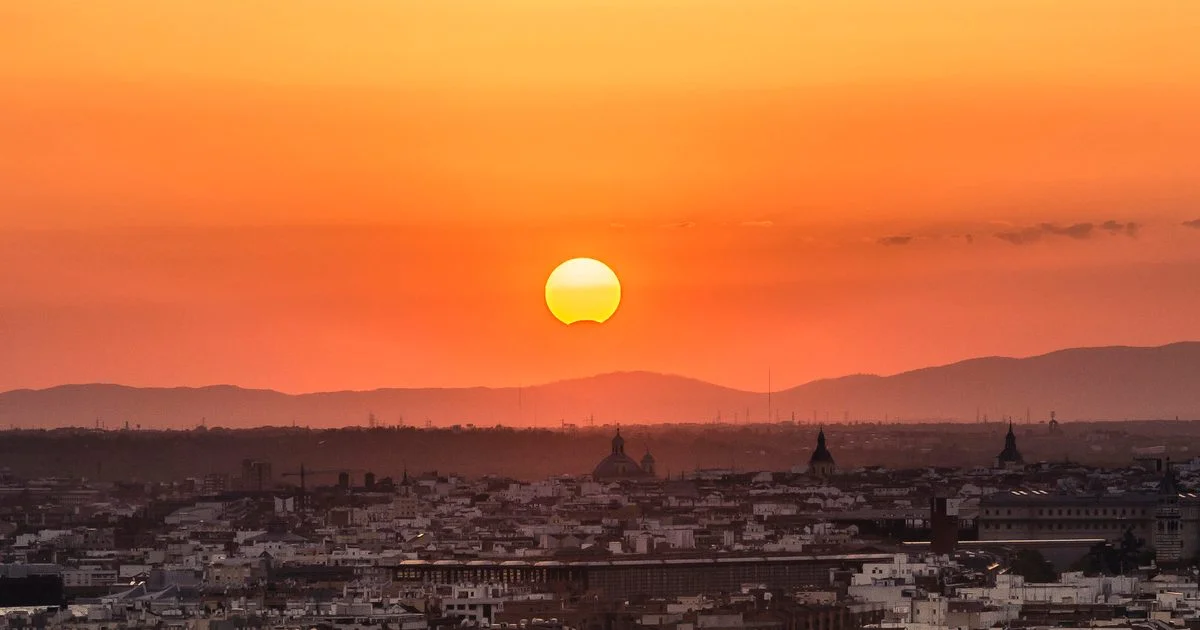
While the total phase was visible only from a select few locations, many more were treated to a significant partial eclipse. In Romania, skywatchers were positioned at the very edge of the eclipse's visibility zone. The event unfolded in the western and northwestern parts of the country, beginning at around 20:20 local time and continuing until sunset. This timing created a uniquely photogenic scenario: a "bitten" sun sinking below the horizon.
"It will be a Sun 'eaten' by the Moon at sunset, and it is spectacular," explained Adrian Șonka, an astronomer at the Amiral Vasile Urseanu Observatory in Bucharest. "It is not a show like a concert, with flames and fireworks. It is something calming, that you look at beautifully. But a sunset 'eaten' a little by the Moon is an image you do not see every day, not even every year, and maybe not even once in a lifetime."
The degree of solar coverage varied significantly across Romania. The best views were reserved for those in the far west. The absolute maximum coverage was reported in Beba Veche, the westernmost point of the country, where the moon covered an estimated 38% of the sun. Other cities in the west, such as Oradea, Satu Mare, Arad, and Salonta, saw coverage between 31% and 33%. In central areas like Cluj-Napoca and Timișoara, the coverage fell to around 20-25%. Further east, the spectacle diminished rapidly, with cities like Brașov seeing only a minor grazing of the sun, and much of the eastern half of the country missing the event entirely as the sun had already set.
Hundreds of people gathered in fields and observatories across the western counties of Timiș, Bihor, and Satu Mare to share the experience. In the village of Luncareț, Timiș County, a few hundred people gathered in an open field, and the event was broadcast live by local media.
The Science and Significance of a Total Solar Eclipse
A total solar eclipse is one of nature's most profound demonstrations of celestial mechanics. It occurs when the moon passes directly between the Earth and the Sun, completely blocking the Sun's bright face. The perfect alignment is a cosmic coincidence of scale: the Sun is roughly 400 times larger in diameter than the Moon, but it is also about 400 times farther away. This makes their apparent sizes in the sky nearly identical, allowing the moon to perfectly cover the sun's disk.
The event is more than just a visual spectacle. For scientists, it remains a crucial opportunity to study the sun's corona—the ultra-hot, tenuous outer atmosphere that is normally invisible against the brilliant blue sky. Observations during totality allow researchers to study the dynamics of the corona, solar winds, and the origins of space weather, which can impact satellites and power grids on Earth.
For the public, the event serves as a powerful reminder of humanity's place in the cosmos. Historically, eclipses were shrouded in fear and superstition, often seen as omens of war or the displeasure of gods. Today, they are anticipated with precision and celebrated as unifying global moments. The 1999 eclipse, which crossed Romania, is still vividly remembered by a generation who now share that passion with their children.
This year's event also highlighted the growing accessibility of astronomical observation. Live streams from the European Space Agency (ESA) and other partners allowed millions of people beyond the path of totality to watch the event in real-time, cementing the role of digital platforms in democratizing scientific engagement.
The 'Iberian Trilogy' and the Future of Eclipse Tourism
The 2026 total eclipse marks the beginning of a remarkable era for the Iberian Peninsula. According to astronomical calculations, this is the first of a trio of major solar eclipses that will cross Spain and Portugal. A total eclipse is slated for August 2, 2027, followed by an annular eclipse in January 8, 2028. This cluster of events has turned the region into a hotspot for "eclipse tourism," a niche but growing sector of the travel industry.
Unlike other natural events, eclipses are predictable to the second, allowing for meticulous planning. Hotels and campsites along the path of totality had been booked for months, if not years, in advance. Local governments prepared special viewing areas, while amateur astronomers transported expensive equipment from across the globe. The economic impact on communities in northern Spain is significant, as thousands of visitors bring revenue to rural areas that normally see little tourism.
The 2026 event also served as a test case for dealing with the hazards of improper viewing. Looking directly at the sun during a partial eclipse can cause permanent eye damage. Public health campaigns, running for weeks prior, emphasized the use of certified eclipse glasses that block harmful ultraviolet and infrared radiation. The near-universal compliance in Spain was credited with preventing what could have been a mass casualty incident of retinal burns.
Beyond the tourism, the eclipse has injected new enthusiasm into science education. For many young people, it was their first direct encounter with a major astronomical event. School groups organized observation sessions, and science centers used the occasion to launch new curricula on solar physics. The event builds on a broader cultural trend where astronomical phenomena—from meteor showers to supermoons—now generate mainstream media attention and social media engagement.
Weather and Viewing Conditions: A Stroke of Luck
The success of Wednesday's viewing largely hinged on cloud cover. Early in the day, forecasts were uncertain for the critical sky areas over Spain, which experienced a dynamic weather pattern. However, as the afternoon wore on, an area of high pressure cleared the skies across much of the northern Iberian plateau, providing unobstructed views for the 20-minute window of partial phases and the 1-2 minutes of totality.
In contrast, observers in Iceland faced a less fortunate situation. Despite being on the centerline of the eclipse, a thick layer of low clouds obscured most of the event, a familiar occurrence for the North Atlantic island. Live streams from the region showed only dark clouds where the sun should have been. Nevertheless, the spectacle was still visible in the country's western fjords, where breaks in the clouds allowed brief glimpses of the waning sun.
In Romania, the approaching sunset presented its own challenge. The low altitude of the sun near the horizon meant the light had to travel through a thicker layer of the atmosphere, which dims the sun's intensity and makes observation somewhat easier on the eyes, but also introduces atmospheric distortion. For the "sunset eclipse," the show was more subtle but no less moving. The combination of the reddened, refracted light of the setting sun and the dark silhouette of the moon created a unique “double sunset” effect for observers in the west of the country, where the horizon was mostly clear.
A Global Shared Experience
The eclipse was visible—in part or in total—across a wide swath of the Northern Hemisphere. From eastern Canada and Greenland to Western Europe and parts of northern Russia, the moon took a bite out of the solar disk. While the path of totality was narrow, the partial phase extended for thousands of kilometers, giving millions the chance to witness the celestial alignment.
The world’s media coverage turned the event into a live, global affair. As the umbra (the moon's dark inner shadow) raced eastward across the Atlantic at over 2,400 kilometers per hour, news organizations on three continents provided live updates. The footage from the ESA and NASA satellites showed the shadow moving over the Earth's surface, offering a breathtaking view from above.
In Spain, the event was treated almost as a national holiday, with open-air viewing events in all major cities. Social media was inundated with images of the "diamond ring" effect—the last flash of sunlight before totality—and the glowing corona. Hashtags like #EclipseTotal and #Eclipse2026 trended on X and Instagram for hours.
For the broader astronomy community, this eclipse was also a vindication of the predictive powers of modern physics. The timing of the eclipse, calculated to fractions of a second, was confirmed within two seconds of the forecast. Such precision underscores the reliability of humanity's understanding of gravitational dynamics.
Looking to the Horizon: What's Next?
As the skies darken over Spain on August 12, 2026, attention turns to the next act in this celestial trilogy, with the next total eclipse on August 2, 2027, promising to be even more spectacular. That event will pass over the southern tip of Spain and across North Africa, offering a longer duration of totality—up to 6 minutes and 23 seconds in some areas—compared to the 4 minutes and 30 seconds observed on Wednesday.
For Romania, the next chance to see a significant total eclipse will come on September 3, 2081, a date far in the future but one that enthusiasts will mark. In the meantime, several annular and total eclipses will be visible from nearby countries, ensuring that the region's skies remain a destination for travelers.
The 2026 eclipse has underscored a simple truth: despite the chaos of daily life, the universe brings us moments of exquisite order and beauty. For two hours on Wednesday evening, millions of people, perhaps for the first time, looked up and recognized the profound, silent ballet of the solar system. That is a lesson that transcends any single event, and one that will linger well after the sun has returned to full brilliance.
Comments