
Tommy Robinson Detained at Heathrow Under Counter-Terrorism Laws
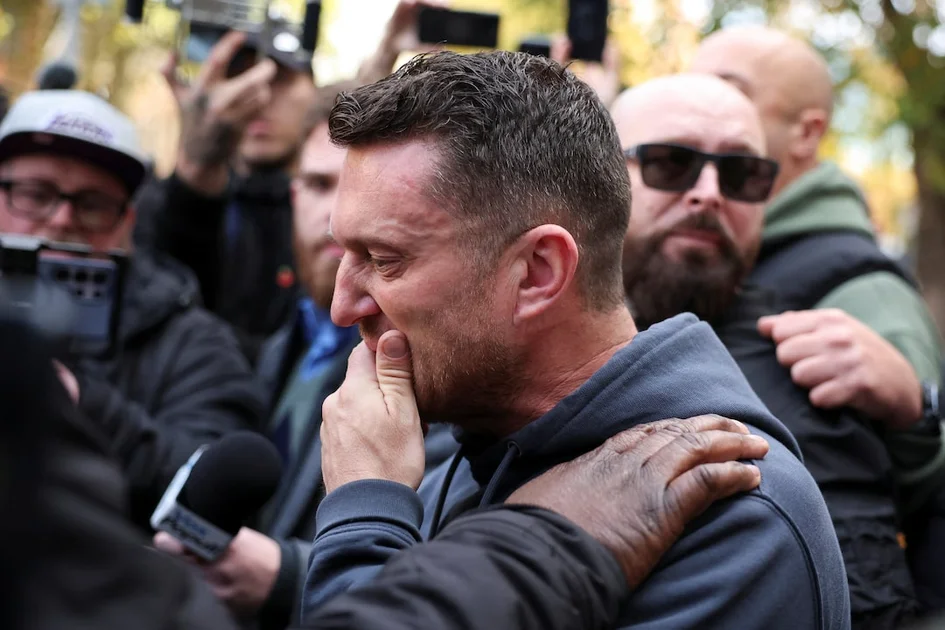
Far-right activist Tommy Robinson was stopped and detained by police at Heathrow Airport on Saturday under the Counter-Terrorism and Border Security Act 2019, marking the latest flashpoint in a week of escalating racial tensions across the United Kingdom. Robinson, whose real name is Stephen Yaxley-Lennon, was held for nearly three hours and had both his iPhone and Samsung Galaxy phones seized under Section 3 of the act, according to posts made on his social media accounts.
The detention occurred as he returned from a trip to Moscow, where he had been photographed with Errol Musk, father of billionaire Elon Musk. The Metropolitan Police declined to comment on the specific grounds for the stop, but the legislation grants officers at ports and borders the power to stop, question, search, and detain individuals suspected of travelling to plan, prepare, or carry out hostile acts.
Robinson’s spokesperson immediately framed the detention as a politically motivated attack on free speech and investigative journalism. In a statement posted on X, the spokesperson said: “They likely want to see who he is talking to, and maybe find out who his sources are, sources who will expose politicians for their part in the rape of a generation of British girls. This is an attack on free speech, this is an attack on investigative journalism, nothing more nothing less.”
Robinson himself used social media to appeal for donations to fund his legal defence, a move that critics argue is a familiar pattern following each detention. Searchlight magazine noted wryly that Robinson was “detained at Heathrow at lunchtime, fundraising by teatime,” and suggested he was already planning his next trip to Ayia Napa.
A Week of Rising Tensions and Unrest
The detention comes against a backdrop of severe civil unrest across the United Kingdom, particularly in Northern Ireland and Southampton. The unrest was triggered by a series of violent incidents involving migrants, which have been amplified by Robinson and other far-right figures on social media.
On Monday, a Sudanese national, Hadi Alodid, 30, was charged with attempted murder after a knife attack in north Belfast in which a man in his 40s, Stephen Ogilvie, suffered catastrophic injuries including the loss of his left eye and deep cuts to his head, face, and back. A graphic video of the attack went viral, and Robinson posted details of planned demonstrations across Britain and Northern Ireland on X. Elon Musk shared Robinson’s post to his 240 million followers, further amplifying the message.
The aftermath saw three nights of violent disorder in Northern Ireland. On Tuesday, mobs set homes, a bus, and cars on fire in Belfast, with people targeted based on their race. Water cannons were deployed in County Antrim on Wednesday after police were pelted with bricks, and a Department for Infrastructure vehicle was set ablaze. Twelve police officers were injured on Wednesday evening alone, and foreign national healthcare workers were subjected to threats and intimidation.
By Thursday night, the Police Service of Northern Ireland reported a “much calmer” situation with only “lower level disturbances.” Assistant Chief Constable Ryan Henderson confirmed that three arrests were made, bringing the total to 19 since the violence began. Ogilvie remained in an induced coma but his condition was said to be improving.
In Southampton, Robinson had previously led protests following the death of 18-year-old Henry Nowak while in police custody. Body-worn footage of the incident sparked clashes between rioters and police, leaving 13 officers and a police dog injured. Robinson has used these events to position himself as a voice against what he calls the “British political elite’s indifference to migrant crime,” a message that resonates with a significant portion of the public.
The Legal and Political Dimensions
This is not the first time Robinson has been detained under counter-terrorism legislation. In July 2024, he was stopped by police at the Channel Tunnel in Folkestone while driving to Benidorm in Spain and refused to provide the PIN for his phone, arguing that the device contained confidential journalistic material. He was later cleared of a terror charge. Saturday’s detention at Heathrow, however, carries additional weight given the current climate of unrest.
The Counter-Terrorism and Border Security Act 2019 was introduced to give border forces greater powers to intercept individuals suspected of involvement in terrorism-related activity. Critics, including Robinson’s supporters, argue that the law is being used as a tool to silence political opponents rather than to prevent actual violence. HotAir commentator David Strom wrote that it is “coming to the point where you are more likely to be detained and prosecuted in the United Kingdom for just noticing that many migrants commit horrendous crimes than the migrants themselves.”
Robinson’s defenders point out that his activism consists of speaking out against mass migration and highlighting crimes committed by migrants, rather than inciting violence. They argue that the violence seen in Belfast and Southampton is a reaction to the crimes themselves, not to Robinson’s commentary. The knife attack in Belfast, for instance, involved a Sudanese asylum seeker who had entered the UK via the Irish border after flying to Dublin from Paris. Alodid was granted leave to remain in the UK until 2028.
Opponents, however, argue that Robinson’s amplification of these incidents deliberately stokes racial hatred and puts minority communities at risk. Searchlight magazine described the unrest as part of a “pogrom” and emphasised that Robinson’s actions are part of a broader pattern of incitement. The magazine, which has a long history of monitoring far-right activity, noted that Robinson’s trip to Moscow to meet with Errol Musk would naturally attract increased security service attention.
Broader Implications for Free Speech and Public Order
Robinson’s detention raises fundamental questions about the balance between free speech, national security, and public order in the United Kingdom. The government’s use of counter-terrorism legislation to detain a political activist—even one with a history of controversial statements—has drawn sharp criticism from free speech advocates and civil liberties groups.
Supporters of the government’s action argue that the law is being applied correctly. Section 3 of the 2019 act is designed to stop individuals who may be planning hostile acts, and the police have a duty to investigate when there is reasonable suspicion. The fact that Robinson’s phones were seized suggests that authorities believe he may be in communication with individuals involved in planning violence or that he possesses information relevant to ongoing investigations.
However, the lack of transparency around the specific grounds for detention fuels suspicion that the law is being weaponised. Robinson’s detention also follows a pattern seen in other cases where individuals with controversial views on immigration have been targeted by the state. In 2024, a district judge cleared Robinson of a terror charge, suggesting that the authorities may be overreaching.
What This Means Going Forward
The detention of Tommy Robinson at Heathrow is unlikely to be the end of the story. Robinson has a track record of using such incidents to galvanise his support base and raise funds. His legal defence fund is already attracting donations, and his narrative of persecution at the hands of a corrupt elite resonates deeply with his followers.
At the same time, the civil unrest in Northern Ireland and the protests in Southampton show that tensions are running high. The government faces a difficult balancing act: it must maintain public order and prevent further violence, but it must also avoid creating martyrs or appearing to suppress legitimate dissent. The use of counter-terrorism powers against a high-profile activist risks further polarising an already divided country.
In the longer term, Robinson’s detention may accelerate the political radicalisation of his supporters, while also emboldening those who call for stricter controls on far-right activity. The situation in Northern Ireland remains fragile, with the potential for further outbreaks of violence if tensions are not addressed.
For now, the focus remains on Heathrow, where Robinson’s phones are being examined and his legal team prepares for what could be a protracted legal battle. Meanwhile, the broader debate about migration, crime, and free speech in Britain shows no signs of abating.
Comments