
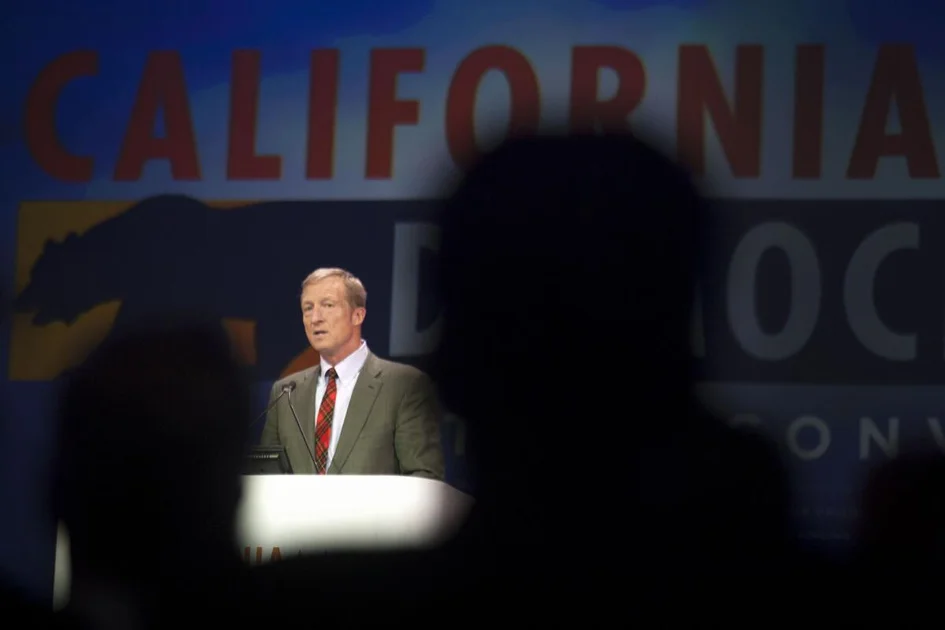
Billionaire's Airwaves Blitz Fails to Lift Him Past 15%
Tom Steyer, the billionaire climate activist and Democratic candidate for California governor, has poured an unprecedented $200 million into his campaign, saturating the state’s airwaves with ads and paying social media influencers to amplify his message. Yet as the June primary approaches, Steyer remains stuck at 15% in the latest state Democratic Party poll, trailing front-runners Xavier Becerra (21%) and Trump-endorsed Republican Steve Hilton (22%).
The numbers defy the spending. Steyer, worth an estimated $2.4 billion, has outspent every other candidate by a wide margin, but his progressive platform—including support for a wealth tax and deep climate commitments—has not broken through. In an effort to seem relatable, Steyer recently flew Southwest Airlines from Burbank to San Francisco, dressed in his trademark white Nikes and jeans, with no entourage. Passengers barely noticed him.
Meanwhile, a formal state investigation threatens to complicate his narrative. California’s Fair Political Practices Commission (FPPC) has opened a probe into Steyer’s campaign over allegations that paid influencers failed to disclose sponsorships, potentially violating a 2023 law requiring transparency in political influencer content. The complaint was filed by supporters of rival Xavier Becerra, highlighting the growing friction in the primary’s final weeks.
The Influencer Machine: $1 Million and a Regulatory Gap
Steyer’s campaign has spent over $1 million on social media efforts, including more than $123,400 in direct payments to at least eight influencers and $870,000 to a digital agency, Group Project Digital, that recruits creators to produce daily pro-Steyer videos. The biggest single payout: $100,000 to Texas-based Latino influencer Carlos Eduardo Espina, whose 14.3 million TikTok followers make him a coveted asset for Democratic campaigns.
But the transparency law signed by Governor Gavin Newsom in 2023 has proven toothless. Critics call it a “Wild West,” as the law carries no real penalties and the FPPC can take years to resolve cases. In one example, influencer Isaiah Washington allegedly accepted $10,000 from Steyer’s campaign without proper disclosure, prompting the current investigation.
“This is where the ‘Wild West’ analogy becomes useful,” said Dan Schnur, a political science professor and former FPPC chair, to CalMatters. “The law was intentionally designed with no real penalties.”
The lack of enforcement has allowed a grey market to flourish. While some creators, like political commentator Eric Cheng with 36,000 TikTok followers, say they will not endorse a candidate for money, others have quietly accepted payments without disclosing them. Jaz Roche, a Pennsylvania-based influencer, posted 34 pro-Steyer videos in ten days without mentioning she was paid, according to a state investigation.
Becerra-Steyer Rivalry Intensifies
The influencer fight is just one front in a bitter battle between the two leading Democrats. Becerra, the former U.S. Health and Human Services Secretary, has pulled ahead in polls, buoyed by support from establishment figures and recent funding from Mark Zuckerberg’s Meta, which threw $950,000 into a pro-Becerra PAC. The move signals that Silicon Valley’s elite are abandoning San Jose Mayor Matt Mahan—who remains stuck in single digits—and consolidating behind Becerra as the most viable Democrat.
Steyer, by contrast, has struggled to convert his spending into momentum. His wealth tax proposal and climate record should resonate with the state’s liberal base, analysts say, but his image as a billionaire outsider may be a liability. A recent American Prospect analysis noted: “By rights, Steyer should be doing better. He should be picking up support from dropping candidates like Katie Porter. In fact, however, Steyer looks stuck.”
The Bigger Picture: Money vs. Message in California Politics
Steyer’s struggles underscore a broader shift in California’s political landscape. The state’s top-two primary system means that only one Democrat is likely to emerge from the June election to face Republican Steve Hilton in November. That makes the race a high-stakes game of elimination, and Steyer’s failure to consolidate the progressive vote has left a door open for Becerra.
But the influencer controversy also signals a new frontier in campaign finance. Social media has become a dominant tool for reaching voters, especially younger ones, and campaigns are spending heavily to “inundate the internet,” as Schnur put it. Yet the regulatory framework is lagging, leaving voters in the dark about who is truly funding the content they see.
For comparison, similar disclosure issues have arisen in other areas of California culture. Just as the Chaka Khan Honored by Library of Congress as National Recording Registry Adds Her Music highlights the importance of protecting artistic legacy, the Steyer case raises questions about protecting electoral integrity in the digital age.
What Comes Next
With less than two weeks until the primary, Steyer shows no signs of slowing his spending. His campaign continues to flood the airwaves and social feeds with ads. But unless he can turn the influencer probe into a rallying cry or find a way to break through voters’ attention, his $200 million gamble may end with a third-place finish. The FPPC investigation, meanwhile, could set a precedent for how California polices the murky world of paid political influence—or it could become yet another example of how little the state’s rules matter.
For now, Steyer remains a paradox: a billionaire who can’t buy a breakout, a progressive who can’t escape his own wealth, and a candidate flying commercial in a race where first class has already been booked.
Comments