
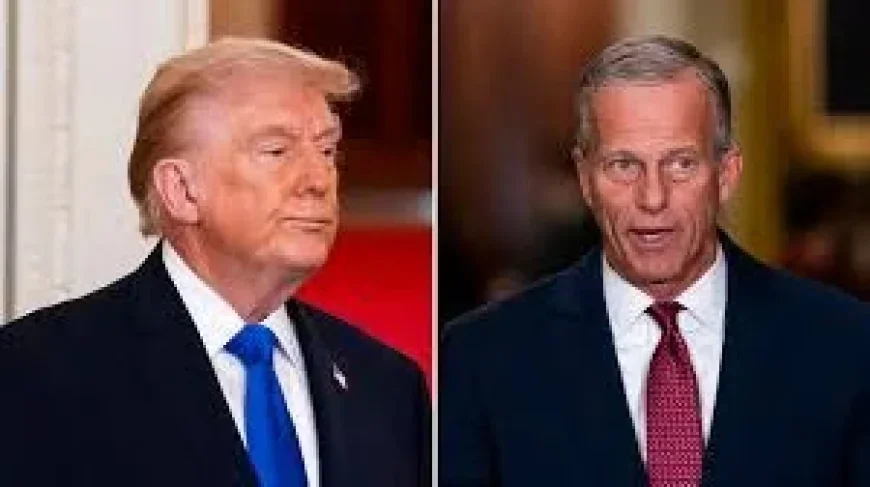
Thune Defies Trump, Says Parliamentarian Job Safe
Senate Majority Leader John Thune (R-SD) on Monday quickly dismissed President Donald Trump’s demand that he fire Senate Parliamentarian Elizabeth MacDonough, signaling a rare public break between the top Senate Republican and the former president.
Trump, in a scathing Truth Social post, accused MacDonough of being a “Radical Left Lunatic” who “treats Republicans … horribly” and urged Thune to remove her “IMMEDIATELY.” The president’s ire was sparked by MacDonough’s ruling that blocked Senate Republicans from including $1 billion in Secret Service funding sought by Trump in their reconciliation bill — a key component of the so-called “SAVE AMERICA ACT.”
But Thune, according to Punchbowl News’ Andrew Desiderio, didn’t budge. “Parliamentarian rulings break both ways. You lose a few, you win a few. That’s been true when the Democrats have been in the majority too. That’s a hard job. It’s a very specific skill set. And you need somebody that is going to be a fair referee,” Thune said when asked about Trump’s comments.
The exchange marks the latest chapter in Trump’s long-running feud with MacDonough, who has served as Senate parliamentarian since 2012, appointed under then-Majority Leader Harry Reid (D-NV). Trump has previously accused her of being “brutal to Republicans, but not so to the Dumocrats,” and has repeatedly called for her ouster — a demand Thune has now resisted twice in as many months.
The Stakes: Reconciliation Bill and GOP Unity at Risk
The dispute centers on the arcane but powerful role of the Senate parliamentarian, who advises the presiding officer on procedural rules, particularly during the budget reconciliation process. Reconciliation allows certain legislation to pass with a simple majority, bypassing the 60-vote filibuster threshold. But the parliamentarian’s rulings on what provisions qualify — known as the “Byrd rule” — can make or break a party’s legislative agenda.
In this case, MacDonough ruled that the $1 billion for the Secret Service — a priority for Trump — did not meet the strict budgetary criteria required for reconciliation. That ruling effectively killed the provision unless Republicans can find a way to include it in a separate bill or overcome a filibuster.
Trump’s fury reflects a broader frustration among some conservatives that Republican leaders have been too deferential to Senate procedure, allowing Democrats to block key priorities. “As long as she’s there, we will never get our desperately needed, SAVE AMERICA ACT, approved, and put into full force and effect!” Trump wrote.
But Thune’s stance underscores the institutionalist perspective that has long governed the Senate, where the parliamentarian is seen as a nonpartisan referee whose rulings can benefit either party. “You lose a few, you win a few,” Thune noted, a sentiment echoing the approach of his predecessor, Mitch McConnell, who also defended MacDonough against similar attacks from Trump during his presidency.
The tension comes at a delicate moment for Senate Republicans, who hold a narrow majority and are grappling with internal divisions on spending, border security, and debt ceiling negotiations. Thune’s refusal to fire MacDonough may placate institutionalists but risks angering Trump’s loyal base ahead of the 2026 midterm elections.
Broader Implications: Executive vs. Legislative Authority
Thune’s pushback is more than a procedural squabble — it highlights the ongoing struggle between the executive branch and the legislative branch over control of internal Senate rules. Trump’s demand that a Senate employee be fired by the majority leader, over a procedural ruling, represents an attempt to exert presidential influence over a coequal branch’s internal operations.
Political analysts note that firing the parliamentarian would be unprecedented in modern history. The position is designed to be insulated from political pressure, providing neutral advice based on precedent and Senate rules. Ousting MacDonough could set a dangerous precedent, allowing the majority leader to replace the parliamentarian with a partisan loyalist, potentially weakening the integrity of the Senate’s legislative process.
“That’s a hard job,” Thune said of the role, signaling his respect for the institution’s traditions. His comment also reflects the practical reality: finding a replacement with MacDonough’s expertise and institutional memory would be difficult, especially in the middle of a legislative session.
This episode also echoes past conflicts. Trump previously attacked MacDonough during his administration over rulings on immigration and health care. Then-Senate Majority Leader Mitch McConnell also defended her, much to Trump’s chagrin. Now, Thune is following that same playbook, even as he navigates his own relationship with the former president.
The broader trend is clear: the Senate parliamentarian’s role has become a flashpoint in the partisan battle over the filibuster and reconciliation. While Republicans currently hold the majority, Democrats have also chafed at MacDonough’s rulings in the past, including on minimum wage and immigration. The position’s fate may ultimately hinge on which party controls the Senate and whether leaders continue to value institutional norms over short-term political wins.
What’s Next for Trump and Thune?
For now, MacDonough’s job appears secure. But Trump has shown he does not easily forget perceived slights. His Truth Social posts attacking Thune and MacDonough suggest the feud is likely to continue, potentially complicating Thune’s leadership and Republican unity ahead of the 2026 elections.
Meanwhile, the $1 billion Secret Service funding remains in limbo. Republicans may attempt to attach it to a separate must-pass bill or negotiate with Democrats on a compromise. But without the reconciliation shortcut, the provision faces a steep uphill climb in a divided Senate.
Thune’s deft handling of the situation — acknowledging Trump’s frustration while firmly defending the parliamentarian — may help him maintain credibility with both institutionalists and the broader GOP caucus. But it also risks further alienating the former president’s die-hard supporters, who see the parliamentarian as an obstacle to conservative priorities.
In an era of heightened partisan tensions, Thune’s statement that “that’s a hard job” serves as a reminder of the delicate balance Senate leaders must strike: between satisfying a powerful party figure and preserving the integrity of the institution they lead.
Comments