
Sundar Pichai avoids AI, faces walkout at Stanford commencement
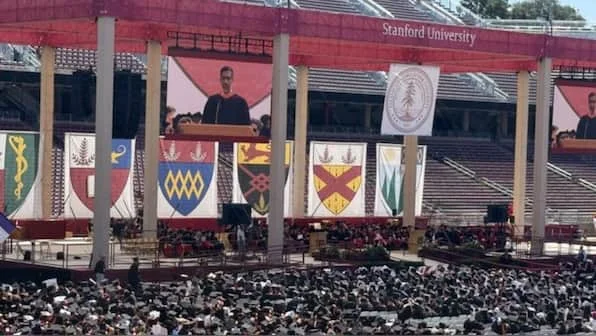
Alphabet and Google CEO Sundar Pichai delivered the commencement address at Stanford University on June 14, 2026, in a speech that carefully sidestepped mentions of artificial intelligence — and triggered a walkout by dozens of graduates protesting the company's ties to Israel.
Pichai, who earned a master's degree in materials science and engineering from Stanford in 1995, returned to his alma mater as the keynote speaker for the Class of 2026. He took the stage at Stanford Stadium as scores of students stood, booed, and marched out of the ceremony, some chanting “free, free Palestine.” The vast majority of the nearly 6,000 graduates remained seated.
Despite the disruptions, Pichai appeared unfazed. “What I see in front of me is how graduation should be,” he said early in his address, acknowledging the protesters. “Graduates celebrating together with the people you love who have supported you on your journey.”
A speech without AI, but with a message of optimism
Pichai explicitly acknowledged the pressure he faced to avoid the topic of artificial intelligence. “I know today is about giving you all advice. But people have also been giving me a lot of advice on what to say. Actually, it's been the same advice, and it's about what not to say,” he told graduates.
He then made a light joke about his own name: “People thought it would be really difficult for me; it is the last two letters of my last name, after all.”
The cautious approach comes after a series of tech-heavy commencement addresses this spring that were met with hostility. Former Google CEO Eric Schmidt was booed at the University of Arizona when he spoke about AI. Big Machine Records CEO Scott Borchetta faced similar reactions at Middle Tennessee State University. With student sentiment toward the technology increasingly skeptical — particularly around job displacement and ethical concerns — Pichai chose a different path.
Instead, he urged the Class of 2026 to “choose optimism,” sharing a personal story about his arrival in California in the 1990s. He described expecting to see lush, green landscapes but encountering only brown hills — until a friend reframed the view as “golden.”
“That's exactly what I mean by choosing optimism. It's about reframing for the positive: Where I saw brown, she saw golden,” Pichai said. “This slight change of perspective had a huge ripple effect on how I thought about the world around me.”
The walkout and the protest
The protest over Israel appeared to be the main driver of the walkout. As Stanford President Jonathan Levin introduced Pichai as the CEO of “one of the most innovative companies in the world,” many students booed. When Pichai himself stepped up to the microphone, dozens of graduates stood up and exited the stadium, some chanting.
The demonstration reflected ongoing tensions on U.S. college campuses over the Israel-Hamas war and the role of technology companies in military contracts. Google has faced scrutiny over its cloud computing and AI services provided to the Israeli government. The walkout echoed similar protests at other universities this year, where students have demanded divestment from companies linked to Israel.
Pichai did not directly address the protest or the geopolitical situation during his speech.
A personal story about skipping class
To illustrate his broader message that graduation is not a make-or-break moment, Pichai shared an anecdote from his own time at Stanford — one that he admitted his parents were hearing for the first time.
During his first winter quarter, a classmate named Pat — an edgy student from Long Beach with a Honda Prelude — invited him on an impromptu road trip to Las Vegas. Pichai, who had never skipped a class before, agreed. They drove through snow-capped mountains — the first snow Pichai had ever seen — and ended up in Las Vegas, where Pat taught him to play blackjack. He won $15 and cashed out. The next day, they drove back. No one noticed they had missed class.
“For the first time, I realized the world won't end if I relaxed a little,” Pichai said. He used the story to remind graduates that only a few decisions in life — like choosing a partner or a major career pivot — require deep intention. Most other moments, he argued, only seem big.
“Your first job out of college? The city you move to next? Whether to take that road trip? While those moments add texture to your journey, they rarely determine the course of your life,” Pichai said.
Context: A season of campus protests and tech backlash
Pichai’s speech came at a moment when trust in Big Tech is eroding, especially among younger generations. AI-driven automation is reshaping entry-level jobs, and graduates face uncertain labor markets. The walkout at Stanford also fits into a broader pattern of campus activism in 2026, with students leveraging commencement ceremonies as platforms for protest.
Similar walkouts have occurred at other elite universities throughout the spring. At the same time, political polarization in the U.S. has intensified, with recent polls showing approval ratings for key leaders at lows not seen in years — a trend some analysts link to growing discontent over foreign policy and economic inequality. For context, recent data has shown that Trump Approval Hits Second-Term Low in NBC Poll as Democrats Gain Midterm Edge, reflecting a volatile mood across the country.
The ‘California optimism’ vs. a skeptical generation
Pichai’s call for optimism — what he described as “California optimism” — may have seemed out of step with the mood of a generation grappling with climate change, housing affordability, and the ethical implications of AI. But he framed it not as naivety, but as a deliberate mindset.
“Very few moments in life are make or break,” he said, urging students to focus on what truly matters. His message was a departure from the bold, AI-centric visions delivered by other tech leaders. By avoiding the technology altogether, Pichai acknowledged — without saying it explicitly — that the audience was not ready to hear it.
Whether his strategy of avoidance and humor will resonate with the Class of 2026 remains to be seen. But in a season of boos and walkouts, Pichai managed to deliver a speech that ended without further disruption. For a CEO leading one of the most powerful companies in the world, that was likely the goal.
Comments