
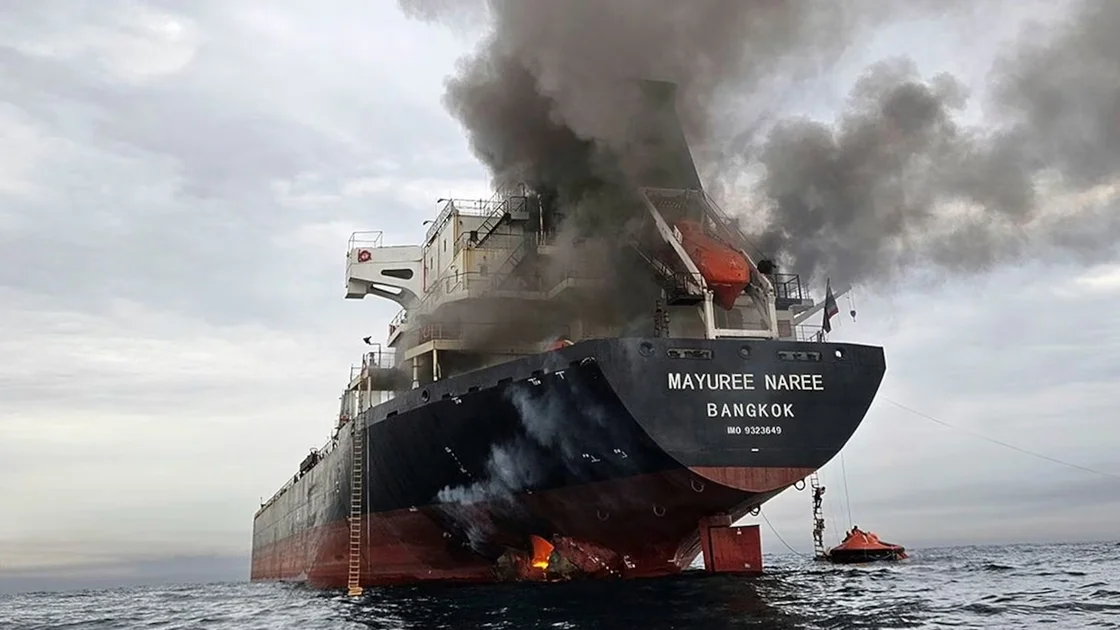
Attacks in Strait of Hormuz Hit Record High
Reported attacks in and around the Strait of Hormuz have surged to their highest level since the war between the U.S., Israel, and Iran began in late February, according to maritime data compiled by the United Kingdom Maritime Trade Operations Centre (UKMTO) and the International Maritime Organization (IMO). The sharp increase is complicating U.S.-led efforts to keep oil flowing through the strategically vital waterway, which handles a fifth of global oil and gas.
UKMTO reported 31 attacks in and around the Strait of Hormuz in October and about 19 in November as of Nov. 18. The IMO has confirmed 34 attacks in October and November so far. These figures mark a significant escalation from the 53 incidents reported to UKMTO between March and September, which averaged 10 to 15 per month across the Strait and surrounding gulfs. The IMO has tallied 138 attacks on vessels in total across the Middle East since the war began.
On Sunday, UKMTO reported an incident "involving a tanker and military forces in the Gulf of Oman," with investigations ongoing. Separately, Iran's Islamic Revolutionary Guard Corps (IRGC) navy claimed that two tankers "exploded and stopped due to collision with sea mines north of Ghanem Island and east of the Strait of Hormuz," alleging the vessels were on "unauthorized routes." It is unclear whether the incidents are related.
Iran Intensifies Attacks on Shipping and U.S. Assets
The surge in attacks appears to be a deliberate Iranian strategy to keep the Omani route—described as a U.S.-facilitated passage—high-risk and to disrupt energy recovery, experts told ABC News. "Iran's objective remains to keep the Omani route, which is described as a U.S.-facilitated route, a very high-risk passage and to keep the energy recovery inconsistent," said Noam Raydan, senior fellow at the Washington Institute for Near East Policy.
Most attacked vessels were in the very southern portion of the Strait of Hormuz, staying close to the Omani coastline, according to UKMTO data. The attacks come as Iran's President Masoud Pezeshkian said his country is facing a "silent economic war" amid U.S. sanctions and a naval blockade. The U.S. says it is enforcing a naval blockade of Iran's Persian Gulf and Gulf of Oman ports, while Iran claims control over the Strait.
Over the past week, at least 25 tankers have been hit in and around the Strait, causing Gulf oil flow to drop sharply. Iran has also intensified strikes on U.S. assets in the region. On Saturday, Bahrain said an Iranian strike hit a civilian industrial facility, starting a fire, and injured two people. The IRGC claimed it targeted U.S. military positions at the al-Riffa and Awali bases in Bahrain, destroying two U.S. Patriot air defense radars. The IRGC said the operation was retaliation for a U.S. strike on a radar installation on Iran's Hengam Island. Iranian state media reported that an interceptor missile launched from the U.S. Fifth Fleet base in Bahrain crashed on Sitra Island, sparking a large fire. Regional nations, including Saudi Arabia, Kuwait, and Qatar, condemned the attack on Bahrain.
Context: Stalled Talks and a Strategic Chokepoint
The escalation comes as talks between the U.S. and Iran remain stalled despite a memorandum of understanding signed in June aimed at ending the war. The conflict began with joint American-Israeli strikes on Iran in February that killed top Iranian officials, including Supreme Leader Ayatollah Ali Khamenei. While the two sides have continued to exchange strikes, they have not returned to the intense fighting of the early stages.
The Strait of Hormuz is the world's most important oil chokepoint, with a fifth of global oil and gas passing through it. The attacks threaten to disrupt global energy supplies and have already caused a drop in Gulf oil flow. The U.S. and its regional partners have found ways to keep oil flowing, but the recent surge in attacks is testing those efforts.
Broader Implications
The increase in attacks could force the U.S. and Iran back to the negotiating table or trigger a new round of hostilities. The international community is watching closely, as any prolonged disruption to the Strait could have far-reaching consequences for the global economy. With diplomatic efforts stalled and attacks intensifying, the situation remains volatile.
Comments