
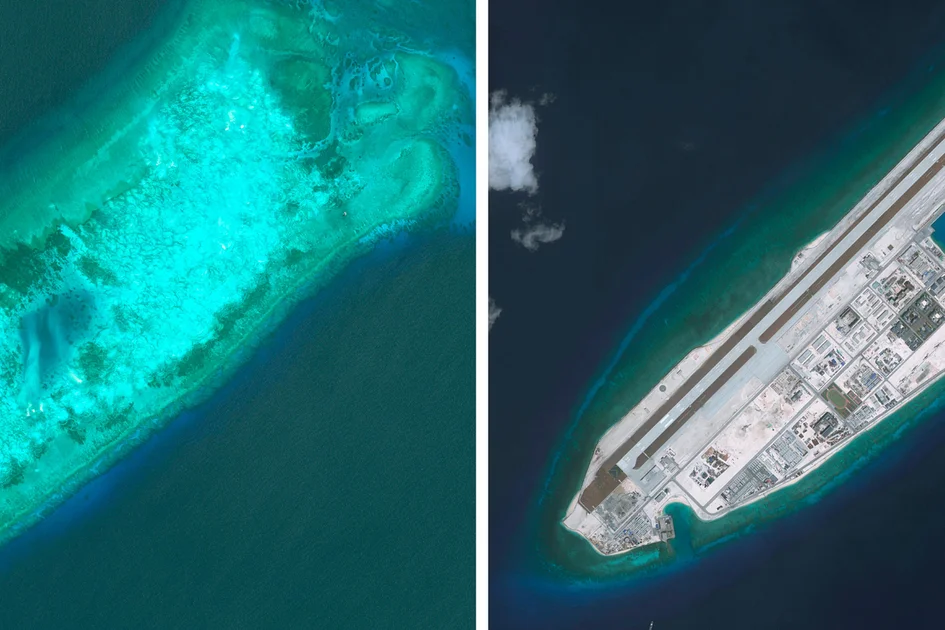
Race for the South China Sea: Philippines, Vietnam Build as China Goes Underwater
As U.S. President and Chinese President prepare to meet tomorrow, the South China Sea has emerged as a central flashpoint. Recent satellite imagery and think tank reports reveal a three-way acceleration of territorial consolidation: the Philippines is extending its airstrip on Thitu Island, Vietnam has added 534 acres of reclaimed land across the Spratlys in the past year, and China has quietly launched its first commercial underwater AI data center off Hainan Island. These developments underscore a intensifying competition for control over one of the world’s most contested waterways.
Manila’s Runway Extension: A Response to Chinese Aggression
The Philippines is actively upgrading facilities on two islands it controls in the disputed Spratly chain, according to satellite images reviewed by Radio Free Asia. The expansion of the runway at Thitu Island (known locally as Pag-asa, meaning “Hope”) and the port at Nanshan Island are designed to solidify Manila’s physical presence in response to recent Chinese escalations.
In its 2025 budget, Manila allocated 1.65 billion pesos (US$27 million) to extend the runway from 1.3 kilometers to 1.5 kilometers—a length sufficient to accommodate certain variants of the F-16 fighter jet, as well as light combat and transport aircraft. An additional 300 million pesos ($5 million) has been set aside for a sheltered port. Satellite imagery from Planet Labs confirms construction began shortly after the budget was approved and remains ongoing as of May 2026. The roughly 200-meter extension appears to be built over previously submerged area; in an April 2 image, a barge can be seen delivering construction materials.
Harrison Prétat, deputy director of the Washington-based Asia Maritime Transparency Initiative (AMTI), told RFA that the runway extension "marks a significant shift in the Philippines’ posture to strengthen the resilience of its outposts in the South China Sea." The real drivers? "The tensions between China and Philippines at Second Thomas Shoal from around 2021 up until 2024," he said. Second Thomas Shoal, located roughly 224 kilometers from Thitu, has been a flashpoint since 1999.
Vietnam’s Land-Grab: 534 Acres Added in One Year
Meanwhile, Vietnam has dramatically expanded its own island-building operations. A May 8 report by AMTI at the Center for Strategic and International Studies (CSIS) reveals that Hanoi added 534 acres (216.1 hectares) of artificial land across the Spratlys in the past year. That brings Vietnam’s total reclaimed area to approximately 2,771 acres.
After completing landfill operations at Barque Canada Reef—now Vietnam’s largest base in the islands—in spring 2025, Hanoi began smaller expansions at several new features in the second half of 2025. The environmental toll is significant: Vietnam’s total reef destruction, including reefs covered by landfill and areas dredged for channels and harbors, now stands at roughly 4,120 acres.
Vietnam has also made notable infrastructure developments, with three additional harbors taking shape at Grierson Reef, Petley Reef, and South Reef. That brings Hanoi’s total harbors in the archipelago to 15, 11 of them created since 2021. Initial construction of another likely harbor can already be seen at Landsdowne Reef.
China, which claims almost the entire South China Sea, has opposed Vietnam’s construction activities. Last year, Beijing called Barque Canada Reef "Chinese territory." The AMTI report notes that Vietnam’s island-building had appeared to catch up to China’s in early 2025, but new Chinese reclamation activities at Antelope Reef have widened the gap. China now has about 5,460 acres of artificial land and 6,224 acres of reef destruction.
China’s Undersea AI Data Center: A New Frontier
In a move that blends technology and territorial strategy, China has launched its first commercial underwater data center in the South China Sea, located off the coast of Hainan Island. Developed by Beijing Highlander Digital Technology Co., Ltd., the facility sits around 35 meters below sea level, connected to shore via submarine cables. It is designed to support AI computing, cloud services, and large-scale data processing.
The location carries deep geopolitical significance. Hainan hosts major Chinese naval and military assets; the undersea data center effectively embeds strategic digital infrastructure in a region where Beijing asserts sovereignty. As AI competition intensifies globally, China views undersea computing as part of its long-term digital ambitions—tied to economic competitiveness, cyber capabilities, and national security.
This development parallels the broader tech rivalry with the U.S. In related news, Nvidia CEO joins Trump in China as AI chip sales hang in the balance, highlighting how semiconductor access remains a core lever in great-power competition.
Stakes for Island Residents: Caught Between Geopolitics and Daily Life
For the people living on Thitu Island, these high-level maneuvers translate into tangible anxiety. NPR’s Jan Camenzind Broomby reported from the island, describing a recent rap concert organized to boost morale. In the crowd, local resident Jorge Olean Misajo said, "It’s the first time that they invited a band, and they really enjoyed it. I think it really boosts the morale of everyone."
But the calm masks tension. China claims most of the South China Sea, including Thitu, despite a 2016 tribunal in The Hague that sided with Manila. In the last decade, Beijing has reinforced its claims with an increased coast guard presence. Fisherman Ken Rabaya told NPR: "There’s a lot of Chinese militia, like Chinese coast guard. They are provoking for the fishermen. We are afraid."
Local government worker Cris Anit echoed the sentiment: "It’s very hard because of the contention between the two nations. What I worry is that the time will come when our territory becomes compromised because of international conflict." Because Manila is a treaty ally of Washington, a spark could eventually escalate.
The Environmental Cost
The island-building race carries a heavy ecological price. According to the AMTI report, Vietnam’s total reef destruction is now 4,120 acres, while China’s stands at 6,224 acres. These figures represent not just lost habitat but the obliteration of entire coral ecosystems that support marine biodiversity and local fisheries.
Broader Implications: A Tinderbox in the Indo-Pacific
These simultaneous developments—Philippine construction, Vietnamese land reclamation, and Chinese undersea infrastructure—represent a new phase in the South China Sea dispute. No longer limited to naval skirmishes or coast guard standoffs, the competition now encompasses physical infrastructure, digital capabilities, and artificial intelligence.
A Tripartite Arms Race
Each claimant is pursuing distinct strategies. The Philippines is fortifying its existing outposts to ensure military readiness and civilian supply lines. Vietnam is aggressively expanding its territorial footprint through reclamation. China, already the dominant player with the largest artificial landmass, is investing in underwater computing assets that could give it a strategic edge in data sovereignty and surveillance.
The timing is critical. The upcoming US-China summit will likely address these tensions, but with each side entrenching further, diplomatic solutions grow more elusive. The U.S. has backed the Philippines through the Mutual Defense Treaty, but avoiding direct confrontation remains a priority for both superpowers.
The Tech Dimension
AI and data centers are becoming instruments of geopolitical influence. China’s underwater data center near Hainan not only serves commercial AI computing needs but also establishes a persistent digital presence in a contested maritime zone. This move mirrors the broader trend of technology being used to project power—from 5G networks to satellite constellations.
For the U.S. and its allies, the challenge is to match China’s technological investment while maintaining diplomatic pressure. The NS&I Premium Bonds rate rise: 22m savers get July boost as odds shorten might seem unrelated, but even domestic economic policies reflect the fiscal priorities nations assign to defense and tech competitiveness.
What This Changes
The South China Sea is no longer just a maritime dispute—it is becoming a laboratory for 21st-century power projection. Island runways enable fighter jets; reclaimed land creates new bases; undersea data centers provide computational supremacy. The next flashpoint may not be a naval collision but a cyberattack on an underwater cable, or an AI-driven surveillance operation.
For residents of Thitu and fishermen across the Spratlys, the immediate concern remains safety and livelihood. For diplomats and strategists, the question is whether the accelerating pace of construction can be matched by diplomacy—or whether the South China Sea is sliding toward a new, more volatile normal.
As the U.S. and Chinese leaders meet, the world will be watching not just their statements but the satellite images that continue to reveal new layers of this slow-motion conflict.
Comments