
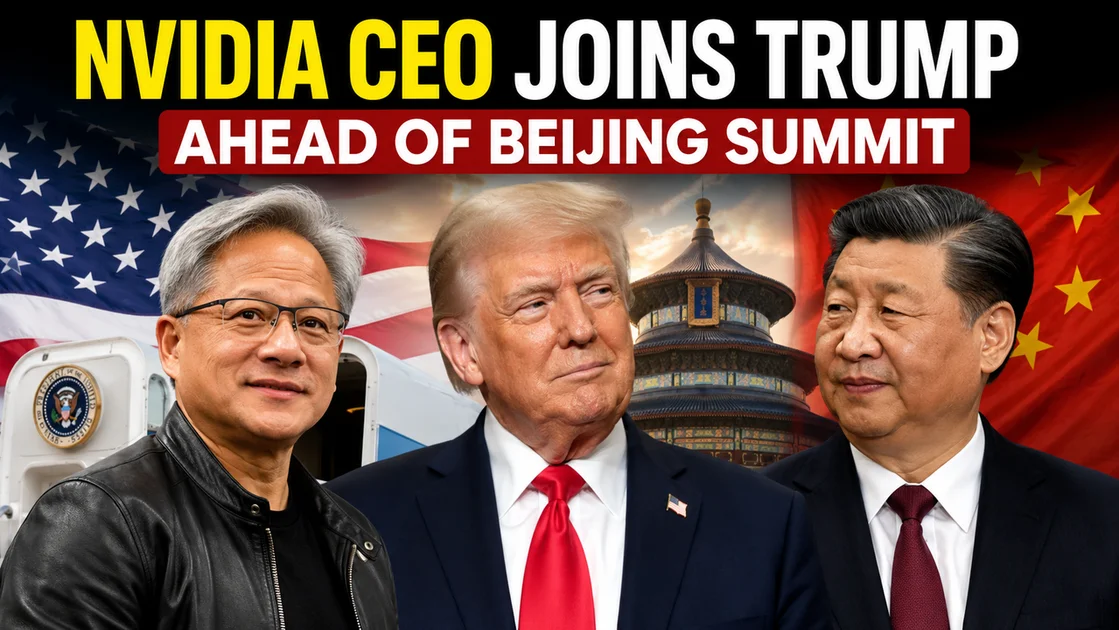
Nvidia CEO Rides With Trump to Beijing Summit
President Donald Trump landed in Beijing on Wednesday with an unusual guest in his entourage: Nvidia CEO Jensen Huang. The surprise addition to the presidential delegation underscores the high stakes for one of America’s most valuable technology companies as it struggles to regain access to the Chinese market for its advanced artificial intelligence chips.
Trump and Chinese President Xi Jinping are scheduled for two days of talks beginning May 14, covering trade, technology, and geopolitics. The summit marks the first visit by a U.S. president to China in nearly a decade, and Trump has framed it as a bid to persuade Xi to "open up" to American business. In a post on Truth Social, Trump said he would make that request his "very first" to Xi, whom he called "a Leader of extraordinary distinction."
Huang joined the trip at the last minute, according to a source familiar with the matter, and was spotted boarding Air Force One during a refueling stop in Alaska. He was not the only tech titan on board: Elon Musk also traveled with the delegation, alongside other CEOs seeking resolution to business disputes with Beijing.
Why Nvidia’s China Problem Matters
For Nvidia, the summit is not merely a diplomatic photo opportunity—it is a last-ditch effort to unlock a market that has become all but closed to its most lucrative products. The company has been unable to secure regulatory permission to sell its powerful H200 artificial intelligence chips in China, a ban that has chipped away at revenue and opened the door for domestic competitors.
The H200 is Nvidia’s premier chip for training large language models and running high-performance AI workloads. Without access to Chinese cloud giants and AI startups, Nvidia has watched its growth trajectory flatten relative to rivals like Advanced Micro Devices, whose stock has more than doubled in 2026, outperforming Nvidia’s 18% gain year-to-date.
China remains one of the world’s largest markets for semiconductors, and U.S. chipmakers have long lobbied for looser export controls. The Trump administration, despite its hawkish stance on technology transfer, has shown willingness to negotiate when economic wins are within reach. Trade negotiator Scott Bessent wrapped up three hours of preparatory talks with Chinese officials in South Korea ahead of the summit, described by China’s Xinhua news agency as “candid, in-depth and constructive.”
A Fragile Trade Truce
The summit takes place against a backdrop of heightened tensions: the Iran war, U.S. arms sales to Taiwan, and an ongoing trade war that has strained supply chains. Trump, facing public approval ratings battered by the Iran conflict, is eager to secure tangible economic outcomes. A deal that allows Nvidia to resume H200 sales in China could serve as a centerpiece achievement.
Yet the path is far from clear. Beijing has its own ambitions to build a domestic AI chip ecosystem, and companies like Huawei have stepped up production of alternatives. Any agreement would likely require reciprocal concessions, possibly including looser restrictions on Chinese tech firms operating in the U.S. or commitments to intellectual property protections.
Broader Implications for AI and the Chip Industry
The outcome of the Trump-Xi talks on Nvidia’s future in China will reverberate far beyond one company’s bottom line. The chip industry is in the midst of a structural shift, with demand for AI processors accelerating across data centers, edge devices, and autonomous systems. AMD’s recent earnings call highlighted this trend: CEO Lisa Su doubled the company’s long-term forecast for CPU market growth, citing a “structural shift” driven by AI inference and agentic workloads.
Nvidia, once the undisputed leader in AI chips, now faces a more fragmented landscape. While its stock is up 18% year-to-date, it lags behind AMD’s 115% surge and Alphabet’s 25% gain. Competitors are eating into Nvidia’s GPU dominance with optimized chips for inference—the process of running trained AI models—which often requires less raw compute power and can be handled by more efficient CPUs or custom accelerators.
If Trump succeeds in reopening China, Nvidia could regain a crucial growth engine. But even then, the company must navigate a world where AI chip demand is spreading beyond GPUs to CPUs and specialized ASICs. The Clarity Act heading to Senate markup underscores that regulatory frameworks for emerging technologies remain in flux globally.
A New Era of Chip Diplomacy
The sight of Jensen Huang stepping off Air Force One in Beijing is a vivid symbol of how intertwined geopolitics and cutting-edge technology have become. Gone are the days when semiconductor sales could be separated from national security concerns. Every chip deal is now a diplomatic negotiation.
Trump’s delegation includes executives from companies that see China not just as a market, but as an indispensable partner in global supply chains. The same tensions that have led to export controls and tariff wars are now being resolved—or not—on red carpets and in banquet halls.
For investors, the next 48 hours could define the next leg of the AI trade. If a deal emerges, Nvidia shares may rally, pulling other chip stocks higher. If talks stall, the market may brace for a prolonged period of restricted access, accelerating the shift toward domestic alternatives in both China and the U.S.
Meanwhile, the broader trend is unmistakable: AI is no longer a niche technology play but a driver of macroeconomic and geopolitical strategy. The power demands of data centers are so immense that utility grids are straining, and chips have become a currency of influence.
What happens in Beijing this week will influence which companies thrive, which alliances hold, and how quickly the next wave of AI innovation reaches the world.
Comments