
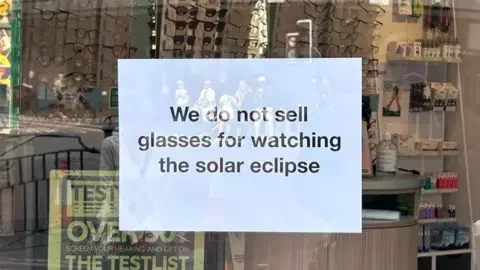
DIY Solar Eclipse Viewers: Safe Ways to Watch as Glasses Sell Out
As the UK prepares for its most significant solar eclipse in nearly three decades, a nationwide shortage of eclipse glasses has prompted astronomers and educators to urge the public to turn to simple household items. With the partial solar eclipse occurring on Wednesday, August 12, at around 6:10 PM BST, many are discovering that a piece of card, some kitchen foil, or even a kitchen colander can provide a safe and surprisingly effective viewing experience.
The eclipse, which will see approximately 90% of the sun obscured across most of the UK, and up to 96% from the south-western tip of Cornwall, has sparked a frenzy for specialized viewing glasses. However, with online orders failing to arrive in time and physical shops running out of stock, experts warn that looking directly at the sun—even during an eclipse—can cause permanent retinal damage. Fortunately, a range of DIY pinhole projectors and indirect viewing methods offer a safe alternative that is both accessible and educational.
Why You Shouldn't Stare at the Sun
The human eye is incredibly sensitive to light, and the sun's intense ultraviolet and visible radiation can burn the retina, leading to permanent vision loss. This risk remains even when the sun is partially obscured by the moon, as the remaining sliver is still extremely bright. According to the Royal Astronomical Society, ordinary sunglasses, even dark ones, do not provide sufficient UV protection for direct solar observation. They can also cause the pupil to dilate, allowing even more damaging radiation to enter the eye.
Specialist eclipse glasses, which use solar filters meeting the ISO 12312-2 safety standard, are the only safe way to look directly at the sun. But with the surge in demand, these have become scarce. The BBC reports that many retailers have sold out, and online deliveries are unlikely to arrive in time for Wednesday's event. This has led to a surge in interest in DIY viewing methods, which allow enthusiasts to enjoy the spectacle without risking their eyesight.
How to Make a Pinhole Projector: Step-by-Step
Creating a pinhole projector is one of the simplest and most effective ways to view a solar eclipse indirectly. The principle is based on the camera obscura effect, where light from the sun passes through a small hole and projects an inverted image onto a surface. Here are two popular methods, as outlined by astronomy groups and educational resources.
The Two-Card Method
This method, recommended by the Royal Astronomical Society, requires only a piece of card, a sheet of paper, and a ballpoint pen. To start, use the pen to push a small hole through the centre of the card. Then, holding the card in one hand and the blank paper in the other, stand with your back to the sun. Position the card so that the sun's light passes through the hole and falls onto the paper. You should see a small, sharp image of the sun, with its shape changing as the eclipse progresses.
It's important to note that the image will be tiny, but it will be clearly visible. The projection method allows you to watch the entire event without ever looking at the sky directly. For a larger image, you can increase the distance between the card and paper, though this will make the image dimmer.
The Box Projector: A More Durable Option
For those with a little more time, a cardboard box, kitchen foil, and tape can be transformed into a sturdy pinhole projector. As demonstrated in a viral TikTok video by educational resource Twinkl, the process involves cutting a white piece of paper to fit inside one end of the box, and cutting two square holes in the opposite end. Cover one hole with foil, taped securely, and use a pin to make a tiny hole in the foil. Seal the box completely, leaving only the pinhole and the open square as light sources. When you hold the box with the pinhole facing the sun, an image of the eclipse will appear on the white paper inside, visible through the open square.
This box projector is particularly popular with families, as it allows children to safely view the eclipse while learning about optics and the science of eclipses. The Glasgow Live article highlights this as a perfect summer holiday activity, engaging young minds in astronomy.
The Colander Trick: A Kitchen Hack
In a pinch, a simple kitchen colander can serve as a multi-pinhole projector. As the BBC notes, the colander's many holes create a grid of small, inverted sun images on the ground or a piece of white card. Holding the colander above a surface, you'll see dozens of tiny crescents during the eclipse. This method is perhaps the most accessible, requiring no preparation whatsoever.
Similarly, any object with small holes, such as a sieve, a straw hat, or even your interlaced fingers (forming a waffle pattern), can be used to project the sun's image. The key is to allow the light to pass through small openings and cast shadows. This hack has become a popular tip on social media platforms like X and TikTok, with users sharing images of colander shadows during previous eclipses.
Viewing the 2026 Eclipse Across the UK
For those lucky enough to be in the path of totality—which crosses Greenland, Iceland, and northern Spain—the eclipse will be a dramatic event, with the sky darkening and stars becoming visible. However, for the rest of the UK, it will be a deep partial eclipse, with the sun reduced to a thin crescent. The exact degree of coverage varies by location: London and Edinburgh will see around 90% coverage, while Devon's Exmoor, an International Dark Sky Reserve, will see 94%, and Land's End will see the most at 96%.
The eclipse will begin at about 6:10 PM and end at 8:10 PM, with the maximum visible around 7:10 PM. The sun will be low in the western sky, so an unobstructed view to the west is recommended. Some may also be able to witness the Perseid meteor shower later that night, as the moon's light will be minimal.
For those unable to watch outdoors, the Royal Observatory Greenwich will be live streaming the event from 6:15 PM on YouTube and Facebook, offering a safe, close-up view through their telescopes with expert commentary.
Why This Eclipse Matters
This eclipse holds significant importance for the UK, as it is the closest the nation has come to a total solar eclipse since August 11, 1999. That event, which saw totality in Cornwall and Devon, is still remembered by many as a once-in-a-lifetime experience. Total solar eclipses are rare for any given location—on average, they occur only once every 360 to 410 years. The next total eclipse over the UK is not expected until 2090, and a partial eclipse of this magnitude will not be seen again until 2081. This makes Wednesday's event a truly generational opportunity.
The surge in interest in DIY viewers highlights not only the scarcity of glasses but also the public's eagerness to engage with astronomical phenomena. This trend is part of a broader movement in citizen science, where everyday people use simple tools to observe and understand the universe. As the editor of the astronomy blog Cosmic Pursuits, Brian Ventrudo, told The Guardian, "The eclipse brings people together, and the DIY methods are a wonderful way to involve children and newcomers in the wonder of the cosmos."
Safety Tips and Common Mistakes
While DIY projectors are safe, there are several pitfalls to avoid. First, never look directly at the sun through the pinhole—this defeats the purpose and can damage your eyes. Always project the image onto a surface. Second, ensure that your pinhole is small and round; a jagged or large hole will produce a blurry image. Third, if using a box projector, make sure the box is opaque and sealed so that no stray light enters, which would wash out the image.
It's also crucial to remember that binoculars, cameras, or the naked eye are not safe for direct viewing. The lens of a camera can focus the sun's rays and cause permanent damage to both the camera and your eyes if you look through the viewfinder. Finally, if you are using eclipse glasses, they must be certified with the ISO 12312-2 standard. Counterfeit glasses are common, and they can give a false sense of security.
The weather forecast for Wednesday evening is mostly clear across the UK, according to the Met Office, but some cloud cover could interfere in certain regions. Should clouds obscure the sky, the live stream from Greenwich is a reliable alternative.
Beyond the Eclipse: A New Era of Home Astronomy
The DIY eclipse viewer phenomenon is more than just a stopgap for a supply shortage. It reflects a growing trend in accessible astronomy, where high-tech and low-tech methods combine to bring the cosmos to everyone. While space agencies and billionaires explore Mars, everyday citizens are discovering that they can participate in astronomical observation with items from their kitchen drawers.
The eclipse is also a reminder of the importance of science education. With children on summer holiday, building a pinhole projector is an engaging, hands-on lesson in how light and shadows work. Organizations like Twinkl and the Royal Astronomical Society have teamed up to provide free instructional content, emphasizing that science is for everyone.
Looking ahead, the next major eclipse event in the UK will be a total eclipse in 2090—a prospect that feels far off, but for many, the experience on Wednesday will create lasting memories and maybe even inspire a new generation of astronomers. In the meantime, the lessons from today's eclipse—on safety, ingenuity, and community—will remain relevant for years to come.
As the sun sets on August 12, millions will look up (or down at a projected image) to witness the moon's shadow crossing our star. Whether you're using a colander, a box, or a piece of card with a pen hole, the message is the same: enjoy the event, but protect your eyes. With the right DIY method, you can safely be part of this historic occasion.
For related coverage on how technology is shaping other fields, see Oracle Layoffs: AI-Driven Cuts Signal New Era of Tech Workforce Reduction.
Comments