
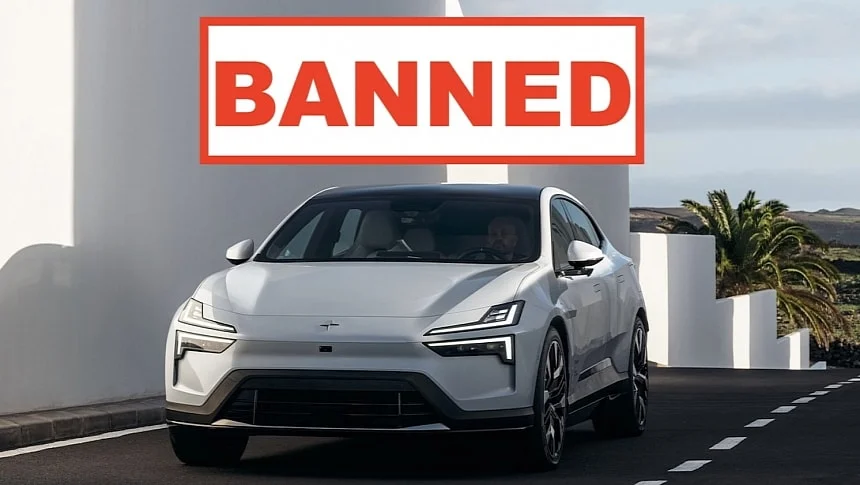
Polestar Banned in US: End of the Road for Swedish EV Brand Under Chinese Ownership
Polestar, the Swedish electric vehicle brand owned by China's Geely Holding, has announced it will cease selling new cars in the United States after the U.S. Department of Commerce denied the company authorization under the federal Connected Vehicle Rule. The decision, confirmed on June 25, 2026, blocks Polestar from marketing or selling model year 2027 vehicles in the American market, effectively ending the brand's U.S. presence after a short but notable run.
The ban, which stems from a Biden-era rule restricting foreign-connected vehicle technology from China and Russia, marks the first major casualty of the regulation in the American auto industry. Polestar's stock fell more than 13% in midday trading following the announcement. The company will wind down its U.S. sales and marketing operations, though its 32 dealers will remain open to service existing customers and sell down current inventory of the Polestar 3 and Polestar 4 models.
"The automotive industry is entering a new phase, based on regional dynamics. Our strategy reflects that, with Europe being our largest growth engine and our plan to manufacture Polestar 7 in Europe," said Michael Lohscheller, Polestar's CEO. He emphasized that existing owners and lease customers will continue to receive full support, with all warranties honored.
What the Connected Vehicle Rule Means
The Connected Vehicle Rule, finalized by the Commerce Department's Bureau of Industry and Security, targets data security concerns by restricting the use of certain foreign-developed software and hardware in vehicles sold in the U.S. The software ban applies to model year 2027 vehicles containing systems designed or maintained by Chinese or Russian companies, while a hardware restriction will prohibit the import and sale of vehicle-connected hardware from those countries starting in 2030.
Polestar, though headquartered in Sweden and born from Volvo, is wholly owned by the Chinese conglomerate Zhejiang Geely Holding. The company's vehicles—including the Polestar 3 built at a plant in Charleston, South Carolina, shared with Volvo—contain software and components tied to its Chinese parentage. U.S. regulators determined that Polestar did not meet the standards for authorization, unlike its corporate sibling.
Why It Matters: The Stakes for Geely, Volvo, and the EV Market
Polestar's exit is not just a corporate setback—it highlights a deepening chasm between the U.S. and China over automotive technology, especially as electric vehicles become more software-dependent. The decision has immediate consequences for Geely's American ambitions and raises questions about the future of other Chinese-linked brands.
Volvo Gets a Waiver, Polestar Does Not
In a twist that underscores the rule's case-by-case nature, Volvo—also a Geely subsidiary—received authorization from the Commerce Department in May 2026 to continue selling vehicles in the U.S. under the same regulation. Volvo stated that the waiver followed "constructive discussions with the U.S. Department of Commerce and other U.S. officials regarding Volvo Cars' governance, technology and data security."
Polestar, however, was unable to secure similar approval. The company told Ars Technica just weeks ago that it was "continuing to work with U.S. authorities" to meet the regulations, but those efforts proved futile. The discrepancy suggests that regulators may have drawn a line between brands with more independent governance structures and those more tightly integrated with Chinese parent companies.
Ironically, the Polestar 3 is built alongside Volvo vehicles in South Carolina, while Polestar 4 models destined for the U.S. were manufactured in South Korea. Yet the software and data architecture remained tied to Chinese supply chains, making the brand vulnerable under the new rules.
A Blow to Polestar's Growth Ambitions
Polestar had been struggling to achieve profitability despite respectable sales. In February 2026, the company announced a new roadmap acknowledging its original business plan "wasn't quite working," including plans for an unplanned second-generation Polestar 2. The U.S. had been a key growth market, but the brand's sales remained modest compared to European figures. Now, models like the Polestar 5 sedan and Polestar 6 roadster—both highly anticipated—will never reach American shores, at least not in this decade barring a major legislative change.
Polestar executives noted that the vast bulk of sales had always occurred outside the U.S., and the company will now redirect resources to Europe, where growth has been strongest. The brand also plans to expand in Southeast Asia, Eastern Europe, Latin America, and Canada.
Perspective: Broader Implications and What This Changes
The Polestar ban is a watershed moment for the auto industry, signaling that the Connected Vehicle Rule will have real consequences for automakers with Chinese ties. While protectionist measures have broad support across the U.S. political spectrum, the rule's implementation has been uneven and contentious.
A Trend Toward Regionalization
Polestar's CEO framed the exit as part of a broader industry shift. "The automotive industry is entering a new phase, based on regional dynamics," he said. This aligns with a global trend where automakers are increasingly tailoring their strategies to regional regulations, supply chains, and political climates. The U.S. ban effectively forces Polestar to become a Europe-centric brand, while Chinese automakers like BYD and NIO continue to face headwinds in the American market.
What It Means for Other Chinese-Linked Brands
Polestar is unlikely to be the last casualty. Other Geely-owned brands, such as Lynk & Co and Zeekr, as well as automakers like BYD and SAIC, could face similar scrutiny if they attempt to enter the U.S. market. The rule also affects software vendors: suppliers like Baidu, Alibaba, and Tencent that develop connected-car platforms may see their U.S. business dry up. For consumers, the outcome means fewer options in the EV market, particularly in the premium segment where Polestar competed with Tesla, BMW, and Mercedes-Benz.
A Silver Lining for Existing Owners
For the roughly 10,000 Polestar owners in the U.S., the news is bittersweet. The company has pledged to maintain service, parts, and warranty support through its dealer network. However, resale values may suffer as the brand's U.S. future evaporates. Some owners may find comfort in the brand's continued European growth, which could ensure long-term parts availability. Meanwhile, the Polestar 3 and Polestar 4 will become collector's items of a sort—the last new Polestars ever sold in America.
The Bigger Picture: Data Security vs. Free Trade
The Connected Vehicle Rule reflects a broader U.S. effort to counter Chinese influence in critical technologies, from semiconductors to telecommunications. Yet critics argue that the rules are protectionist in nature, favoring domestic automakers and allies over Chinese-linked competitors. The case of Polestar—a Swedish brand building cars in the U.S.—illustrates the complexity: even American-made vehicles can be caught in the crossfire if their software originates in China.
As the auto industry hurtles toward a software-defined future, the tension between national security and global supply chains will only intensify. For now, Polestar's departure leaves a hole in the U.S. EV landscape—one that other brands will be eager to fill.
In the meantime, sports fans may welcome a brief distraction: the England's World Cup Round of 32 draw offers a different kind of global competition, one where borders don't dictate the game.
Comments