
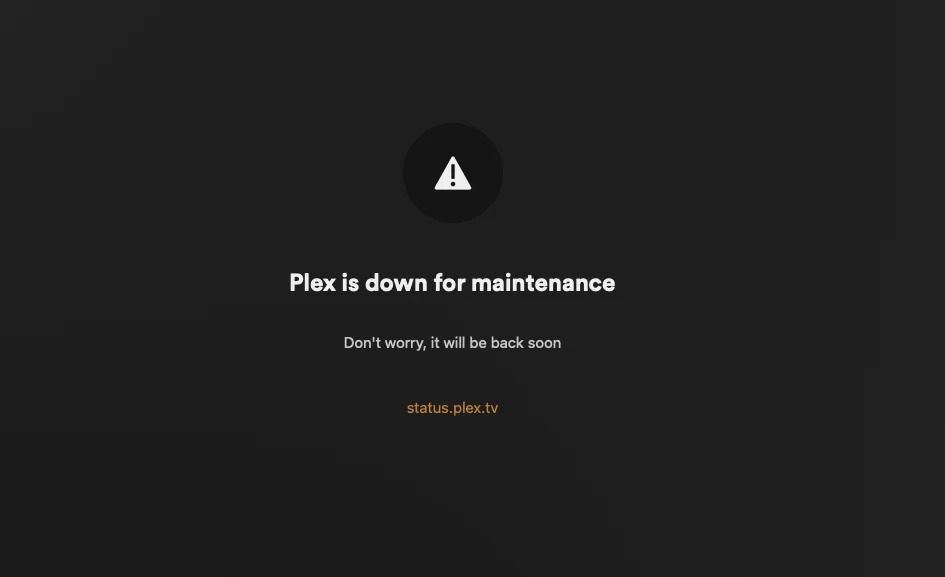
Plex Server Down: Authentication Outage Sparks Exodus as Users Lose Local Access
Plex suffered a significant outage on July 14-15, 2026, leaving thousands of users unable to access their own media libraries—even on their home networks. The disruption, which began around 11 a.m. EST on Tuesday, primarily affected authentication and API servers (plex.tv), causing login failures and server connection errors for over 500 reported incidents on Downdetector.
According to status monitoring service StatusGator, the outage generated 409 user-submitted reports within 24 hours, with users in the U.S., UK, Spain, and Nepal reporting "Server is Currently Unavailable" errors, app loading failures, and connectivity issues. While Plex's official status page showed the service as operational by Wednesday morning, the incident has reignited criticism of the platform's reliance on cloud-based authentication for local access.
Even Your Own Media Isn't Safe When Plex's Servers Go Down
The core of the problem lies in Plex's architecture: even when streaming media stored on a device in the same room, users must authenticate through Plex's remote servers. As How-To Geek reported during the outage, "Even accessing your Plex server through its local IP address requires authentication with Plex, which can't happen when Plex's servers are down." This means a user sitting next to their media server cannot watch a single movie or TV show until Plex's cloud infrastructure is restored—a design choice that has frustrated the homelab community for years.
For many, this outage was the final straw. Plex has been under mounting scrutiny for its direction under corporate ownership. The company recently raised the lifetime Plex Pass price from $250 to $750—a 200% increase that WIRED described as "more than a decade of annual passes, assuming Plex lasts the next decade." Meanwhile, the platform has added social features, user reviews, and ad-supported content, pushing its own streaming service over personal media libraries. Users report feeling that Plex is prioritizing monetization over functionality, a sentiment that WIRED contributor echoed: "I want to watch stuff—not talk about it with strangers."
Why This Outage Matters: The Growing Jellyfin Shift
This outage is not an isolated event. Plex's authentication dependency has been a known vulnerability for years, but with the price hike and feature bloat, many users are reassessing their loyalty. The incident highlights a broader tension in the self-hosted media space: the trade-off between convenience and control.
Jellyfin, a free and open-source alternative, is gaining momentum as a result. Unlike Plex, Jellyfin has no cloud infrastructure—users access media entirely on their local network. WIRED's review notes that Jellyfin "works great" for local streaming and can be set up "in a couple of minutes." However, remote access requires manual configuration (like setting up a VPN or reverse proxy), which may be a barrier for less tech-savvy users. The trade-off is clear: you sacrifice the plug-and-play convenience of Plex's relay system, but you never get locked out of your own library.
The Price of Convenience: A $750 Lesson?
The timing of the outage compounds existing frustrations. Plex's lifetime pass price hike to $750—a 200% increase from $250—feels particularly galling when users cannot access their purchased software without a working internet connection. As one Reddit user commented during the outage: "I paid $750 for a lifetime pass, and I can't even watch a movie stored on the same hard drive."
The situation echoes broader industry trends where digital ownership is undermined by always-online requirements. Just as gamers have protested always-online DRM, Plex users are now confronting the fragility of cloud-dependent local media systems.
Broader Implications: The End of Plex's Dominance?
This outage may mark a turning point for the self-hosted media community. For years, Plex was the default choice for cord-cutters and media enthusiasts. But the combination of rising costs, feature bloat, and reliability issues is creating a vacuum that Jellyfin—and to a lesser extent, Emby—are poised to fill.
Jellyfin has been steadily maturing. Its client apps now support all major platforms, its metadata scanning has improved significantly, and its community-driven development model avoids the corporate conflicts of interest that plague Plex. While Jellyfin still lacks some polish—particularly in remote access and mobile app quality—the gap is narrowing.
A Shift in User Priorities
The outage also reflects a broader cultural shift: users are increasingly prioritizing ownership and offline reliability over convenience. In an era of subscription fatigue and data privacy concerns, the idea of a media server that works entirely without internet access is appealing. This sentiment is not limited to Plex; it mirrors frustrations with streaming services that remove content, increase prices, or enforce DRM restrictions.
For now, Plex remains the market leader, but the cracks are showing. If another major outage occurs—especially during a high-demand period like a holiday weekend—the exodus to Jellyfin could accelerate significantly. The question is not whether Plex will lose users, but how many it will lose before it addresses the fundamental design flaws that make local media dependent on remote servers.
As one user on Downdetector wrote: "Switching to Jellyfin tonight. Tired of being locked out of my own files."
Comments