
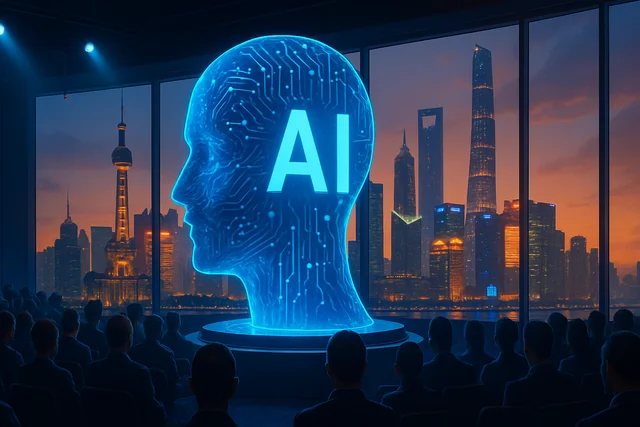
Shanghai to Host Record-Breaking AI Conference as Global Governance Debate Heats Up
The 2026 World Artificial Intelligence Conference (WAIC) and High-Level Meeting on Global AI Governance is set to take place in Shanghai from July 17 to 20, marking a pivotal moment in international efforts to shape the future of artificial intelligence. Organized under the theme “AI Partnership for a Brighter Future,” the event will bring together over 1,400 prominent guests, including industry leaders, top executives, venture capitalists, and representatives from twelve national ministries and commissions, eight key national laboratories, more than ten international organizations, and over twenty world-class universities.
This year’s WAIC represents an unprecedented scale and influence, with an exhibition spanning 100,000 square meters across three key locations in Shanghai: the Shanghai World Expo Exhibition and Convention Center, the West Bund area, and the Zhangjiang area. The conference is jointly organized by the Ministry of Foreign Affairs, the National Development and Reform Commission, the Ministry of Industry and Information Technology, the Ministry of Education, the Ministry of Science and Technology, and the Shanghai government.
Zhou Haibing, deputy head of the National Development and Reform Commission, emphasized at a recent news conference that China looks forward to using this conference as an opportunity to strengthen international cooperation on AI. He underscored that AI governance is a global issue vital to humanity’s future and that China remains committed to multilateralism, openness, and inclusivity. The event aims to balance growth and security, ensuring AI development serves the greater good.
Why This Conference Matters Now
The timing of WAIC 2026 is critical, as artificial intelligence continues to reshape industries, economies, and societies worldwide. Recent breakthroughs in generative AI, autonomous systems, and machine learning have accelerated the need for robust governance frameworks. Nations are grappling with questions of ethics, safety, data privacy, and job displacement, while also racing to harness AI’s economic potential.
China’s role in this landscape is particularly significant. As a leading AI developer and adopter, the country has invested heavily in AI infrastructure, research, and talent. The Shanghai conference signals a deliberate push toward global collaboration, even as geopolitical tensions around technology persist. The event’s focus on transforming AI from a technical tool to a collaborative partner reflects a broader shift in discourse—away from fear and competition toward shared responsibility and mutual benefit.
The scale of WAIC 2026—record-breaking in terms of participation and exhibition space—indicates the growing importance of AI as a mainstream policy and business priority. With 1,400 guests and dozens of institutional partners, the conference is positioned to influence global AI standards and partnerships for years to come.
The Stakes for Global AI Governance
AI governance has become a central issue for governments, corporations, and civil society. The European Union’s AI Act, the U.S. Executive Order on AI, and various national strategies have emerged as attempts to regulate the technology. However, without international coordination, these efforts risk fragmentation and inconsistency. The Shanghai conference aims to address this by fostering dialogue and proposing Chinese solutions to global AI challenges.
Zhou Haibing’s statements underscore a commitment to multilateralism, but the conference also highlights the competitive dynamics between major AI powers. China is positioning itself as a leader in AI governance, offering a model that balances innovation with state oversight. Critics argue that such models may prioritize security and control over openness, but supporters see them as necessary for responsible development.
The exhibition component of WAIC—spread across three venues—demonstrates how AI is being integrated into urban infrastructure, healthcare, education, manufacturing, and entertainment. The Shanghai World Expo Exhibition and Convention Center will showcase comprehensive AI applications, the West Bund area will feature futuristic technology exploration, and the Zhangjiang area will emphasize smart infrastructure. These displays provide tangible examples of how AI can improve daily life and industrial efficiency.
Broader Implications for the AI Industry
The Shanghai conference is part of a larger trend: the increasing institutionalization of AI discourse. Events like WAIC, the AI for Good Global Summit, and the World Economic Forum’s AI initiatives are creating platforms for cross-sector collaboration. This signals that AI is no longer just a niche technology but a fundamental driver of societal change.
For businesses, the conference offers networking opportunities, potential partnerships, and insights into regulatory trends. For researchers, it provides access to cutting-edge work and funding opportunities. For the public, it demystifies AI and highlights its potential benefits.
However, the conference also raises questions about the role of governments in shaping AI’s trajectory. China’s approach—top-down, with strong state involvement—contrasts with more market-driven models in the U.S. and Europe. The outcome of these different approaches will have long-term implications for innovation, privacy, and global power dynamics.
The Intersection of AI and Other Sectors
AI’s influence extends beyond technology into entertainment, sports, and lifestyle. For instance, how AI is used in content creation, such as in the recent ‘Cape Fear’ Episode 7 Twist: Max Cady’s Brainwashing and the Finale Setup, reflects growing capabilities in narrative generation and audience engagement. Similarly, AI’s role in sports analytics and team management, while not directly related to the conference, showcases the breadth of applications.
The conference’s emphasis on cross-industry collaboration suggests that AI will continue to blur boundaries between sectors. As AI becomes more integrated into everyday products and services, governance frameworks must remain flexible and inclusive.
The Road Ahead: From Conference to Action
While WAIC 2026 is a landmark event, its real impact will depend on follow-up actions. Commitments made at the conference—whether in terms of research collaborations, regulatory alignment, or ethical guidelines—need to translate into tangible outcomes. The high-level meeting on AI governance will be crucial in setting priorities for international cooperation.
Questions remain about how enforceable any agreements will be, especially given differing national interests. However, the sheer scale of participation suggests a shared recognition that no single country can manage AI’s challenges alone. The conference’s success may be measured not just by attendance numbers but by the quality of dialogue and the durability of partnerships formed.
Conclusion
Shanghai’s WAIC 2026 represents a significant moment in the global AI conversation. With record-breaking participation and a clear focus on governance, it underscores the urgency of international collaboration. As AI continues to transform industries and societies, events like this provide a platform for charting a responsible and inclusive path forward. The “AI Partnership for a Brighter Future” theme is aspirational, but the conference’s scale and ambition suggest that stakeholders are ready to move from words to action.
For those following the latest in technology and culture, this conference is a key indicator of where AI governance is headed. It also serves as a reminder that AI’s evolution is as much about human values and cooperation as it is about algorithms and data.
Comments