
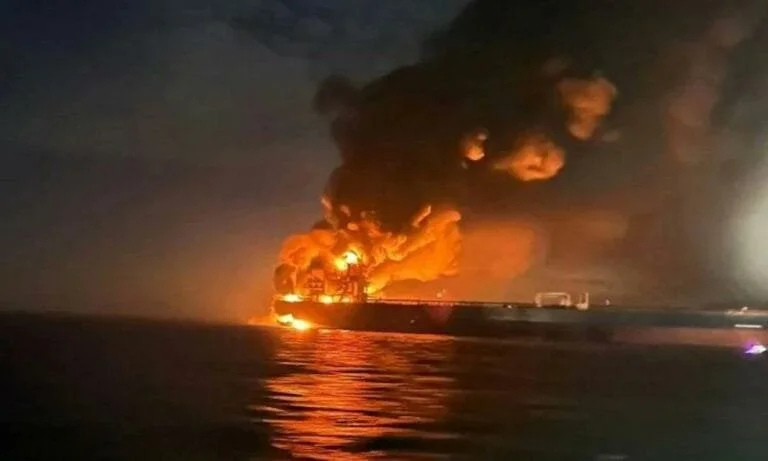
Oil Tanker Explodes in Strait of Hormuz After Hitting Naval Mine, Iranian Media Claims
An oil tanker exploded in the Strait of Hormuz on Sunday after striking a naval mine, according to Iran’s semi-official Tasnim news agency, which is linked to the Islamic Revolutionary Guard Corps (IRGC). The incident occurred when the vessel deviated from the navigation route designated by Iran in the strategic waterway, the agency reported. No official statement from Iranian authorities has been issued so far, and the identity of the tanker or its crew has not been confirmed.
The explosion adds a dramatic new element to the already volatile situation in the Strait of Hormuz, a narrow passage through which about 20% of the world’s oil passes. The US and Iran have been engaged in a two-week military escalation that saw US forces target Iranian coastal areas and infrastructure after Tehran began firing at ships attempting to transit the strait. The US paused its attacks on Sunday for a second day, and Iran said it had done the same, but the underlying tensions remain high.
UK Stands Firm Amid Iranian Threats
In a related development, British Defence Secretary Wes Streeting told the BBC that the UK is not intimidated by what he called Iran’s “sabre-rattling.” The IRGC had warned that Britain could become a “definite and legitimate target” if it continues to support the US. “We stand ready to respond to any attacks Iran wishes to wage against this country or our allies,” Streeting said, adding that the UK should not put “too much stock” in the regime’s threats.
Strait of Hormuz at the Center of a Geopolitical Storm
The explosion highlights the high stakes for global energy security and regional stability. With the US and Iran in direct confrontation, any disruption to shipping through the Strait of Hormuz could send oil prices soaring and trigger a broader economic crisis. The International Energy Agency has warned that a prolonged closure of the strait could cut off nearly 17 million barrels of oil per day.
Iran has long used its control over the strait as leverage in its disputes with the West. The IRGC has previously threatened to block the waterway in retaliation for sanctions or military actions. This weekend’s explosion, whether accidental or deliberate, underscores how quickly events in the confined, high-traffic waterway can spark further escalation.
Diplomatic Efforts Continue: Oman’s Proposed Consortium
Amid the military standoff, diplomatic channels remain open. Sources told The Jerusalem Post that Iran and Oman have made “some progress” in talks over navigation through the Strait of Hormuz. Oman has proposed a regional consortium to oversee maritime security, search-and-rescue operations, and other forms of cooperation. Crucially, participation and payments would be voluntary — a point that has drawn opposition from Iran. Tehran has insisted on mandatory payments, arguing that vessels that refuse to pay should be barred from transiting the strait.
The Omani proposal reflects a broader push by Gulf states to avoid a full-blown war while ensuring that global oil supplies are not disrupted. However, Iran’s insistence on mandatory fees indicates that it sees control of the strait as a source of both revenue and power.
Broader Implications: A Crisis That Could Reshape Global Alliances
The explosion in the Strait of Hormuz is not an isolated incident — it is part of a pattern of increasingly aggressive behavior by Iran and a hardening of US policy under President Donald Trump. Trump told French news channel LCI that he is considering resuming a “full-scale war” with Iran if he does not get “100% of what we want.” His comments come as a new poll shows MAGA support for the Iran war plummeting, with voters expressing what one pollster called “maximum level of frustration.”
Regional and Economic Ripple Effects
The crisis is also testing alliances. Britain has publicly sided with the US, despite Iranian warnings. Meanwhile, other nations are watching nervously. For example, the recent Tragedy at West Wittering: Man Dies in Double Drowning Incident at Sussex Beach may seem distant, but it underscores the global attention on maritime safety and security as tensions in the Middle East dominate headlines.
On the economic front, the risk of a sustained disruption in oil supplies is real. While the US has paused strikes for now, no ceasefire agreement is in place. If the situation worsens, it could trigger a spike in oil prices that would affect consumers worldwide, potentially leading to higher inflation and slower economic growth. The oil tanker explosion serves as a stark reminder that when geopolitical stakes are this high, a single mine can rock the global economy.
For now, the world waits to see whether diplomacy — or more mines — will define the next chapter in this unfolding crisis.
Comments