
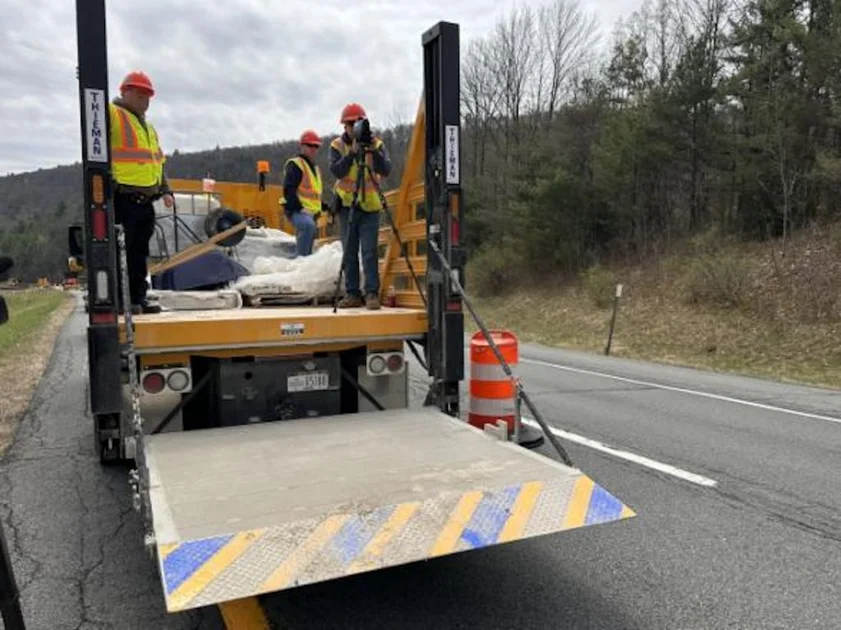
Operation Hard Hat: 50 Tickets in a Single Afternoon on the Thruway
New York State Police issued 50 traffic tickets during a five-hour enforcement operation on Tuesday, July 14, 2026, along the Thruway near Exit 23 in Albany. The operation, dubbed "Operation Hard Hat," saw plainclothes troopers disguised as construction workers stationed in active work zones, where they observed driver behavior and radioed nearby uniformed officers to pull over violators.
According to State Police, 46 of the 50 citations were for speeding in an active work zone. The remaining four tickets were issued for other vehicle and traffic law violations. In addition to the citations, troopers arrested one individual who was wanted on an outstanding felony warrant. The enforcement action lasted from approximately midday to early evening, averaging 10 tickets per hour.
The operation was conducted by Troop T, the unit specifically tasked with patrolling the New York State Thruway. Authorities have not disclosed the exact location of the work zone within the Exit 23 area, but confirmed it was a clearly marked active construction site with signage, cones, and reduced speed limits in place.
Why Work Zone Safety Has Become a Growing Crisis
The high number of violations in such a short window underscores the persistent danger that highway workers face daily. New York State Police data shows that in 2025, there were 228 crashes in Thruway work zones, resulting in 28 injuries. That figure represents the highest number of work zone crashes on the Thruway since 2020, signaling that driver behavior has not improved despite increased public awareness campaigns.
Work zone crashes are often severe because they involve high-speed vehicles operating in close proximity to workers, heavy machinery, and narrowed lanes. According to the New York State Department of Transportation, more than 80% of work zone fatalities are drivers or passengers, not workers. This suggests that speeding and distracted driving pose deadly risks to everyone on the road—not just construction crews.
Operation Hard Hat is part of a broader ongoing initiative by the State Police to protect highway workers, emergency personnel, and motorists. The program deploys troopers in disguise to observe drivers who ignore reduced speed limits, fail to move over for emergency vehicles, or drive aggressively in areas where road work is underway. Similar operations have been conducted in previous years, but the July 2026 sweep yielded one of the highest ticket counts in a single day.
The Role of Plainclothes Enforcement
The tactic of using plainclothes officers in work zones is not new, but it has gained traction in recent years as a direct response to rising work zone fatalities nationwide. In Operation Hard Hat, troopers wear high-visibility vests and hard hats, blending in with actual construction workers. Once they spot a violation, they communicate via radio to uniformed troopers positioned a short distance away, who then stop the vehicle and issue a citation.
This method is designed to catch drivers who would otherwise slow down only when they see a marked police car. Critics sometimes argue that such operations amount to entrapment, but courts have consistently upheld the legality of plainclothes enforcement as long as the officer did not induce the driver to commit a violation. In this case, troopers merely observed illegal behavior—primarily speeding—that occurred regardless of their presence.
The Human Toll of Work Zone Speeding
Between 2020 and 2025, the number of work zone crashes on the Thruway fluctuated, but 2025 marked a troubling peak. While fatalities in work zones have remained relatively low, the 28 injuries reported last year represent families forever changed by a moment of inattention or impatience.
Highway workers operate in some of the most dangerous conditions of any profession. They stand inches from traffic moving at 65 miles per hour or more, often at night or in poor weather. A driver looking down at a phone for just two seconds doubles the risk of a crash, according to federal safety data. In a work zone, that split second can mean the difference between life and death.
The State Police statement following Tuesday's operation emphasized that the goal is not merely to issue tickets but to change behavior. "Every ticket issued is a potential life saved," a spokesperson said. "We want drivers to understand that work zones are not suggestions—they are areas where people are working to improve the roads for everyone."
Broader Trends in Traffic Enforcement
Operation Hard Hat is part of a larger trend in New York and across the country toward data-driven, targeted traffic enforcement. Rather than random patrols, police agencies are increasingly focusing on specific locations and times when violations are most likely to occur and cause harm. In New York, work zone enforcement has been prioritized because crashes in these areas are both predictable and preventable.
The shift mirrors similar efforts in other states. California, Texas, and Pennsylvania have all conducted versions of Operation Hard Hat, often with comparable results. In Pennsylvania, a 2024 operation using similar tactics resulted in more than 100 citations in a single day on Interstate 476. The repeatability of these results suggests a systemic problem with driver behavior that requires sustained enforcement.
What This Means for Drivers and Highway Workers
The July 2026 operation sends a clear message to drivers: State Police are watching, and they are willing to use unconventional methods to enforce the law. For highway workers, the operation provides a measure of reassurance that their safety is being taken seriously. For the driving public, it serves as a reminder that fines for work zone speeding are substantial—often double or triple the usual penalty—and that a momentary lapse in judgment can have lasting financial and legal consequences.
New York law imposes fines starting at $150 for a first work zone speeding violation, with higher fines for subsequent offenses. In some cases, drivers may also face license suspension or mandatory traffic school. The arrest of a felony warrant holder during this operation also illustrates a secondary benefit of heavy enforcement: wanted individuals are often apprehended when police conduct high-visibility operations in concentrated areas.
A Broader Look at Highway Safety Trends
Work zone safety is not the only concern on New York roads. The state has seen a rise in distracted driving and aggressive driving since the pandemic, as traffic volumes rebounded and some drivers adopted riskier habits. In 2025, total traffic fatalities in New York rose by 6% compared to the previous year, reversing a decade-long decline.
Law enforcement agencies are responding with a mix of education, engineering, and enforcement. Operation Hard Hat is an enforcement-heavy tactic, but it is complemented by public service announcements, digital billboards warning drivers of work zones, and increased use of speed cameras in construction areas. The combination of these tools aims to create a culture of compliance, not just fear of tickets.
For context, the federal government has also stepped up attention on work zone safety. The U.S. Department of Transportation launched a National Work Zone Awareness Week campaign in 2025, and the Federal Highway Administration has encouraged states to adopt automated speed enforcement in work zones. Several states including Illinois and Maryland have done so, reporting significant reductions in speeding and crashes.
Future of Operation Hard Hat and Work Zone Enforcement
State Police have indicated that Operation Hard Hat will continue throughout the summer construction season, with additional operations planned on other sections of the Thruway and major state highways. The timing is critical: summer is the peak season for road construction across New York, meaning more work zones and more opportunities for dangerous driving.
Authorities have not released the exact schedule of future operations, citing the need to maintain the element of surprise. However, they have encouraged drivers to always slow down in work zones, regardless of whether they see a police cruiser or a construction worker. The safest approach, they say, is to assume that enforcement is ongoing at all times.
Lessons from Other Enforcement Efforts
The success of Operation Hard Hat mirrors findings from other targeted enforcement campaigns nationally. For instance, multi-state settlements often include provisions for improved transparency and accountability, similar to how traffic enforcement agencies are now expected to publicly report their results. Just as the Cash App $45M Multi-State Settlement: 46 States, Security Failures, and Reform highlighted the need for corporate accountability, Operation Hard Hat underscores the importance of government accountability in protecting public safety.
Similarly, the response to the operation on social media and in news comments has been mixed—some drivers applaud the crackdown, while others view it as a money grab. But State Police remain firm: the numbers speak for themselves. With 228 crashes and 28 injuries in work zones last year, New York cannot afford to be lenient behind the wheel.
Conclusion: Protecting Lives One Ticket at a Time
Operation Hard Hat is not a gimmick. It is a data-driven, life-saving measure that directly addresses one of the most dangerous situations on American roads: a highway work zone. The 50 tickets issued on July 14 represent 50 moments when a driver chose speed over safety. Without the operation, some of those drivers might have caused a crash.
The broader implications are clear. As construction season intensifies and traffic volumes remain high, the risk to highway workers will only grow. Continued enforcement, combined with public education and better road design, offers the best path forward. State Police have promised that Operation Hard Hat will remain a permanent tool in their enforcement arsenal—and drivers should take note.
For those who still doubt the severity of work zone dangers, consider this: the next time you see orange cones and a reduced speed limit, there might be a trooper in a hard hat watching your every move. And even if there isn’t, the life you save by slowing down could be your own.
Comments